
Hell Yes. Hell no. Hell maybe?
There was a crotchety old man who was always critical of everyone else. He died and somehow made it to heaven. While there, he was able to look over and see large crowds in hell who were partying it up and seemed to be having quite a good time. Meanwhile, God was preparing the banquet feast – some microwaved hot dogs. As He was setting the table, the man said, “God – I don’t mean to complain here, but it looks like they’re enjoying quite a feast over there and … well … re-warmed hot dogs for us?! To which God replied, “Yeah – I know. It’s just hard to get into cooking for just the two of us.”
My message is on a controversial topic, hell. How you look at hell will profoundly influence your vision of God and consequently how you approach life. Did God set up an eternal torture chamber or not? You do not have to buy into my view, but I hope you at least wrestle with what I have to say.
First: Hell no. The key word to focus on is all.
- Luke 3:6: “And all people will see God’s salvation.”
- John 17:2: “since you have given him power over all flesh, to give eternal life to all you have given him.”
- 1 John 2:2 Christ is “the atoning sacrifice for our sins, and not only for ours but also for the sins of all the world.”
Second: Hell yes.
- 2 Thessalonians 1:5-12 – “those who do not obey the gospel of our Lord Jesus will suffer the punishment of eternal destruction, away from the presence of the Lord.
- Matthew 25:41 “Then he will say to those on his left, ‘Depart from me, you cursed, into the eternal fire prepared for the devil and his angels.
So what is it going to be, hell yes or hell no? At a minimum we should all be able to agree that the case is somewhat ambiguous.
Carlton Pearson was an evangelical bishop, megachurch pastor, on the board of Oral Roberts’s University and like a son to Oral Roberts. His faith taught that if you have not accepted Jesus as your personal Lord and Savior, then you will burn in hell. Carlton was watching a TV documentary that showed emaciated, starving children in Africa with no chance of ever being evangelized. He thought, “What kind of a God would doom those children to hell?” He had an epiphany which motivated him to do a complete and thorough study of the ancient message of universal salvation. Carlton writes, “The message of Inclusion, also known as Universal Reconciliation, is not new. It was a widely held position of respected early church fathers and founders throughout the first five hundred years of church history.
- Augustine (354–430), of African descent and one of the four great Latin/Afro church fathers admitted, “There are very many in our day, who though not denying the Holy Scriptures, do not believe in endless torments.”
- Origen lived from 185 to 254 and is considered one of the great theologians and scholars of the Eastern Church. He wrote: “We think, indeed, that the goodness of God, through His Christ, may recall all His creatures to one end, that is, salvation, even His enemies being conquered and subdued for Christ.”
- Gregory of Nyssa (335–390 ) said “For it is evident that God will in truth be all in all when there shall be no evil in existence, when every created being is at harmony with itself and every tongue shall confess that Jesus Christ is Lord; when every creature shall have been made one body. “
Carlton started preaching universal salvation and lost everything. He was kicked out, maligned, shunned etc.
There were some early church fathers that believed in universal restoration but would not preach it to the people. They feared that with the threat of hell removed, the people would go on some kind of sin rampage. Lordy.
This is from Richard Rohr: “Hell is not what we’ve pictured it to be but simply a much-needed metaphor (found in most religions) for the ultimate tragedy of not choosing life and love. If all will be saved by the unconditional victory of God, then why does Jesus tell stories that show harsh judgment, casting the rejected into “outer darkness” and “eternal punishment,” in places like Matthew 25:46. Here is the text he is referring to:
Then it will be their turn to ask, “Lord, when did we see you hungry or thirsty, a stranger or lacking clothes, sick or in prison, and did not come to your help?”
Then he will answer, “In truth I tell you, in so far as you neglected to do this to one of the least of these, you neglected to do it to me.” And they will go away to eternal punishment, and the upright to eternal life.
Back to Richard Rohr: Ending an important parable with this final damning line seems to undo all the mercy and forgiveness Jesus demonstrates throughout the rest of his life and teaching. Let me explain how I see it. Clear-headed dualistic black/white, yes/no, right/wrong thinking must precede any further movement into non-dual or mystical consciousness. But the problem with such dualistic statements is that any call to change is aimed at the lowest level of motivation—threat and fear. This does not create loving people, but fearful people. The New Testament passages about Gehenna (Jerusalem’s smoldering dump), Sheol (the place of the dead, with no intimation of punishment), and “eternal punishment” are mostly found in Matthew and seem to be his way of making dramatic and contrasting statements about issues of ultimate significance, which does call the reader to choice and decision. The trouble is that the threat in the last line becomes the lasting memory and message instead of the primary invitation and promise of the whole previous text. The real message of the parable is a call to a transformed mind and heart.
Matt 5:29-30
If your right eye should be your downfall, tear it out and throw it away; for it will do you less harm to lose one part of yourself than to have your whole body thrown into hell.And if your right hand should be your downfall, cut it off and throw it away; for it will do you less harm to lose one part of yourself than to have your whole body go to hell.
Here is my take: If folks are going to interpret hell at the end of those verses literally, then they better interpret the rest seriously, and if so, shouldn’t there should be a whole lot of blind, limbless Christians walking around?
Many denominations take the “hell yes” passages seriously but ignore love your enemies, do good to those who hate you, bless those who curse you, pray for those who mistreat you, and let the man who has two coats give one to the man who has none.
The Greek word, Aion, transliterated “aeon,” is a period of time of longer or shorter duration, having a beginning and an end, and complete in itself. When St. Jerome translated the Greek text into Latin aeon was translated as eternity, forever. Quite a different meaning.
Fire is mentioned many times in the Bible and our knee-jerk reaction interprets fire as a method of punishment. However fire can be seen as purifying, refining, renewing and a means to light the way.
Let’s revisit one of the texts I put in the “hell yes” column but change eternity to a period of some duration and fire into cleansing fire.
Matthew 25:34 “Then he will say to those on his left, ‘Depart from me, you cursed, into the eternal fire.
becomes
“Then he will say to those on his left, ‘Depart from me, you cursed, into a period of cleansing fire.’
Here is another well-known verse: Luke 12:49 “I have come to bring fire on the earth, and how I wish it were already kindled!” Make one change.
“I have come to bring cleansing fire on the earth, and how I wish it were already kindled.” The verse goes from sounding like retribution to restoration.
‘Hell fire and damnation” becomes “cleansing fire and salvation.”
Pope Benedict XVI was not a raving liberal. As a cardinal charged with enforcing doctrinal purity, Benedict was given the nickname “God’s Rottweiler” for his uncompromising conservative views. However in his encyclical Spe Salvi Benedict said, “Some recent theologians are of the opinion that the fire which both burns and saves is Christ himself, the Judge and Savior. The encounter with him is the decisive act of judgement. Before his gaze all falsehood melts away. This encounter with him, as it burns us, transforms and frees us, allowing us to become truly ourselves.”
The Apostles creed says, “I believe in God, the Father almighty, Creator of heaven and earth, and in Jesus Christ, his only Son, our Lord, who was conceived by the Holy Spirit, born of the Virgin Mary, suffered under Pontius Pilate, was crucified, died and was buried; he descended into hell; on the third day he rose again from the dead; he ascended into heaven, etc.
Many denominations say that creed and never give it much thought, but wait a minute? “He descended into hell?” What the heck was Christ doing in hell? There are different theological takes on that. I like the Eastern Orthodox churches’ the best. This Eastern Orthodox icon of the risen Lord visiting hell says it all.

This is from a commentary on the icon: Jesus takes center stage, victoriously robed in heavenly white. Notice the bluish oval that surrounds Him, often studded with stars. This is a mandorla (Italian for almond) which represents the uncreated, eternal light of Christ. It is not simply a pretty, bright light. It is the same light which filled the apostles with wonder when they witnessed His Transfiguration. It is the light which Christ Himself described as the power of the Kingdom of God. It is the light that filled the once perpetual darkness of Hades when Christ descended and brought life into the realm of death.
As you examine the mandorla, you will see that it becomes a darker blue as it moves toward Christ at its center. At first, this traditional usage of blue seems like an odd choice. But the light depicted is not sunlight, which is localized and casts shadows. It is the uncreated, omnipresent light of God. Those who seek God will find that the more they know Him, the less they comprehend Him. To know God, to experience Him, is to walk in the darkness of His light, to enter into the mystery of His presence.
In every Resurrection icon He is shown pulling an old man from the tomb. This figure is Adam, the first man, illustrating that Christ’s victory redeems all of humankind from the beginning. On Jesus’ left is Eve, and Christ is often shown pulling her from the tomb also. Christ grasps them by the wrist indicating it is solely his doing, not theirs.
Beneath Jesus’ nail-scarred feet lie two gold bars, often in the shape of a cross. These are the gates of Hades, which He has broken open.
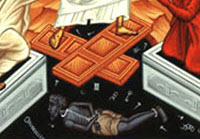
Most Resurrection icons show keys, chains, and locks scattered in the darkness, because the power of death to bind humanity has been destroyed. And in the depths of the pit, a skeletal being is sometimes shown, lying prostrate and bound up. This is Hades personified—Death and/or Satan, who has been destroyed and defeated by Christ, illustrating the truth of Hebrews 2:14, that “through death he might destroy him who has the power of death, that is, the devil.” Our Savior’s death brings life to all.
Here’s my take: There is a dark corner in all of us that wants there to be hell so that “those (fill in the blank)_____________people” will be punished. If hell is a place of gruesome punishment, then it gives us free rein to do the same in God’s name. Do I need to provide any evidence of that? Burning heretics and witches? No big deal. They are going to burn anyway. Hate and violently abuse people you don’t like. No problem, they are going to burn anyway. Sometimes it seems that we reverse the tables on God. We create a God in our image, to our liking.
Here is an excerpt from a conversation between St. Silouan (1866–1938), an Orthodox elder, and a hermit. ”There was a certain hermit who declared to Silouan with evident satisfaction: ‘God will punish all atheists. They will burn in everlasting fire.’ Obviously upset, Silouan said: ‘Tell me, supposing you went to paradise and there looked down and saw somebody burning in hell-fire, would you feel happy?’ ‘It can’t be helped. It would be their own fault,’ said the hermit. Silouan answered him with a sorrowful countenance. ‘Love could not bear that.’
You can search through scripture and find numerous arguments in favor of hell. The possibility to say no to God by our free will must be an option, otherwise we are robots. However, I cannot even begin to believe that where they end up is a place of torment. C.S. Lewis in his novel “The Great Divorce” pictures hell as a drab, dreary city with a bus people can take to heaven. But when there, some of them have baggage they won’t let go of — anger, resentments, grudges, etc. — so they choose to take the bus back on its return trip.
In Julie Ferwerda’s book, “Raising Hell”, she sites Luke 10:21 where Jesus exclaims, “I praise you, Father, Lord of heaven and earth, because you have hidden these things from the wise and learned, and revealed them to little children.” Ferwerda continues, “What child in the world would ever believe (without adult influence) that a loving parent would create a fear full place of torment and then endlessly abandon most of his children there, punishing them for a moment of unbelief or rebellion or for choices made from ignorance, deception or bad influences?” If children can figure it out, why can’t some adult Christians?
This imaginary scenario of mine convinces me there is no hell. You, your spouse and 3 children are at home enjoying movie night. An armed intruder breaks in and hog ties you, your spouse and 3 children. The intruder’s name is Fred. Fred methodically tortures the children and your spouse until one by one they die. Fred is about to start on you but he hears a siren, rushes to his car, drives off, misses a corner, crashes into a tree and dies. For the rest of your life you carry a burden of intense grief and anger. You die and when you meet God, he takes you aside, shows you a room. Fred is in the room bound to a chair. God points to a switch. If the switch is turned on Fred will experience pain beyond belief. It will be worse than any human-derived torture because there will be no end to it. Fred will never be released. God turns the switch on. You are told that only you can turn the switch off and once a month you have to watch Fred and listen to his screaming for 1 hour.
I believe that all of you would at one point turn off the switch and say “Enough!” If we would, why wouldn’t God? This jumped out at me when I saw it in the June 24th bulletin. “If we could read the secret history of those we would like to punish, we would find in each life enough grief and suffering to make us stop wishing anything more on them.” God knows our history. As wave after wave of God’s unconditional love and mercy washed over Fred, wouldn’t his hard heart start to melt? Wouldn’t Fred be on the path to restoration?
Many of the “hell no” scriptures I read have the word all in them. Luke 3:6: “And all people will see God’s salvation.” Can’t God get what God wants?
Thank you.
References:
Carlton Pearson, The Gospel of Inclusion
Julie Ferwerda, Raising Hell
Rob Bell, Love Wins
This message was given at Spokane Friends Meeting on June 9, 2023, during Sunday morning worship by John Kinney
Discover more from Spokane Friends Meeting
Subscribe to get the latest posts sent to your email.
 Spokane Friends Meeting
You must be logged in to post a comment.