Spiritualty . . .a sanctuary of mind by Walter Simon, October 1, 2023

It occurred to me most recent, having octogenarian credentials, as well having outlived my worst critics, that I have a responsibility to open my heart beyond writing poetry, an obligation to add voice to our community, given we share common values on Sundays, so I’m going to have a Quaker moment, attempting to translate spirituality into helpful words.

No less than now, my wife years past, accused me of “thinking in too much”, a self-communication –but I explain it as a constant aspect of a creative mind. You’re there, but yourself is somewhere else.  You can’t help it –a self-interested creature whipped by a greater Muse.   

That’s why I feel comfortable and grounded with a silent service, a house cleaning of the mind, a moral polestar, a balance between the hardship of reality also an unabated healing aspect of the soul when forced to search for answers.  

My spiritual guide considers David’s biblical Psalm: (46-10) “Be still and know that I am the voice of God.”  I hope to consider today the personal value of spiritual thought…a feeling without words.

My religious values are reached through meditation, and as any Quaker would suggest hoping to see the light without illusion, blinders, or dampened by ego. 

Before I tapped into Quaker thought at Seattle Friends in 1962 –over 60-years past- was more than satisfied with a stoic position as to organized religion, though trying to understand that with all the gods available and claimed through history, how war and petulance, greed and deception is a part of life, also led to a career as a critic of social discourse, as well spiritual guides considering a long search for peace-of-mind.

How we manifest our religious beliefs is a clear example of seeking a moral structure that satisfies something within, do I dare suggest justifies our conduct, as you wrestle with present realities. For me the Ten Commandments proved ethical, a tremendous social lesson.

There are many approaches to spirituality. Consider this: spirituality is a feeling: can’t cup it in your hand, or tightly grasp it in a fist… only feel. Can’t hug it, but sense it clearly exists in mind and body. You can’t touch it, only sense it. I consider it as a presence, a manifestation of a guiding spirit in search of clarity, guidance and discovery. It’s the motor -I mean energy- that will keep us grounded.

Clearly not a theory, or a haunting specter, but an intimate understanding –a private acceptance of faith where feelings are fortified by moral judgement.

The only way to achieve this insight is through quiet contemplation, and for reinforcement social interaction with the Society of Friends.  Consider these beneficial and positive thoughts, an understanding. I suggest this comes through meditation, equally it’s prudent to understand the way we act defines the presence of a willing spirit. 

For me “silent service” is therapy, private and personal questions answered, a grounding that has led me through many complex social issues.  Please understand we are part of compound societies, a sometimes-confusing interactive process; and I hope for satisfaction to honor convictions being motivated by seemingly thoughtful inherent judgements.

I started reading the monk, Thomas Merton, decades past, to seek a spiritual message. Went through two of his books, found much of the thinking defined me, a path offered as reference, to seek a better, and clear, creative and moral path.

In this light I truly can’t fully communicate to you spiritual healing, but believe it’s in you, waiting for discovery, if not already achieved. Spirituality has no voice but offers an elated focus. I do understand the hours spent downstairs honoring a practice –I’ve observed for decades– hopefully helps me continue to absorb positive sensations, and let me add…and fully appreciate the good in you for honoring this tradition.   

In a moment of whimsy allow me to offer another form of therapeutic discovery, a lifting if you will. When issues of life get ya’ down, watch Walker Texas Ranger on TV for a gymnastic and vicarious exercise; or better recall the words of Vanna White, a media pundit, who wisely observed “When you spin the wheel you never know what you’ll get!”

This message was given to Spokane Friends by Walter Simon during Sunday morning worship on October 1, 2023.

Posted in Messages | Comments Off on Spiritualty . . .a sanctuary of mind by Walter Simon, October 1, 2023

Salt, Light, and Tough Choices (A Silver Age of Evangelism?) … Part 2 by Johan Maurer, September 24, 2023

I want to start with a story from our Friends meeting in Russia. Some of you may remember us telling this story when we visited you about ten years ago. And Stas, a member of Moscow Meeting who’s online with us today, may remember this, too.

Here is the outside of the Building where Moscow Friends Meeting met.

After entering from the street, you came to another door

Then you went down a stairway and turned to the right.

Our unprogrammed, silent meeting for worship had been going for about half an hour. As usual, there was a candle and a Bible on the table around which we had gathered. Suddenly a man burst into our meeting room and loudly demanded to know what gave us the right to have and display “sectarian” literature. He demanded, “Remove this stuff immediately and stop your sectarian activities.”

The word “sect” in Russian has overtones close to the word “cult,” and this identification could spell political or even legal trouble for us. I couldn’t help thinking about the seriousness of his charge and its possible consequences. But I realized that my only choice was to trust that it was all in God’s hands.

Our assistant clerk, Misha Roshchin, stood up and led our unexpected visitor out to the kitchen for a conversation about his concerns, while the rest of us tried to settle back into worship. We could hear their animated conversation going on for quite a while. As we found out later, our visitor’s worries began when he made a summertime visit to the community center we were using, in his role as one of the managers of the center. In those years, we didn’t meet during the summer, but he saw some of our booklets and leaflets on a bookshelf and decided he needed to check on us.

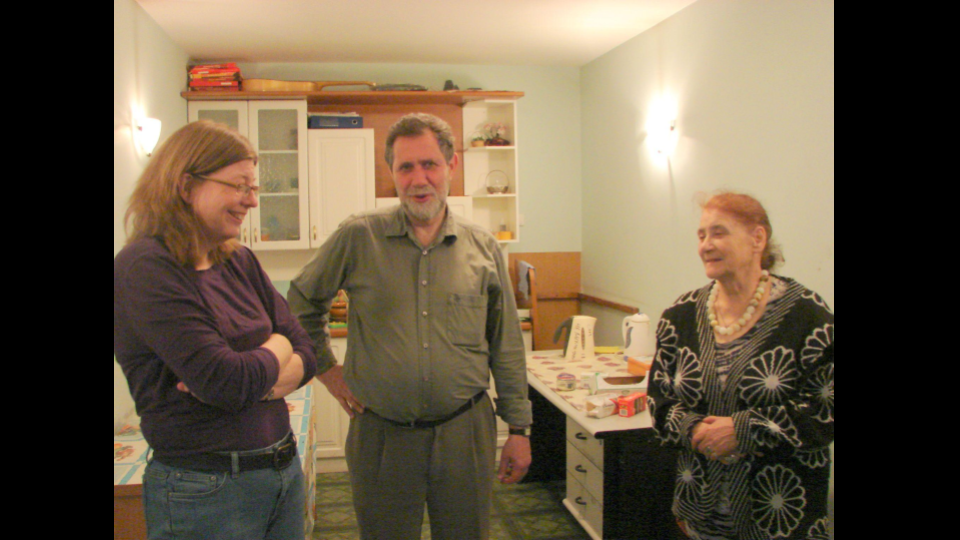
This is our kitchen and the man in the middle is Misha.

While Misha and the visitor talked, our worship time came to an end and we had a chance to meet our guest in a calmer setting. After that conversation and some tea, we were able to do what we’d planned to do for our education hour: we watched a beautiful documentary film about the great Russian Orthodox priest and bishop Anthony Bloom, and our visitor actually stayed to watch it with us.

Metropolitan Anthony (Bloom) of Sourozh was a prominent writer and broadcaster on prayer and the Christian life, as well as the founder and leader of the Russian Orthodox Diocese of Sourozh.

Judy and I were the only foreigners there, and for whatever reasons, he was especially eager to get to know us. We certainly had not planned in advance to show a film about a famous Orthodox priest in order to disarm a suspicious visitor. Nor did we, looking back on it, try to impress him with how wonderful we were as Quakers. We were just being who we were.

We came out of that incident apparently unscathed, but it wasn’t the end of our story with that community center. Our arrangement for the meeting room came to an end when the owners of the building decided to rent the space out, for far more money than we could have afforded, to a pet food store. We were promised another meeting place in the same complex, but it never came about. But we soon found another place to meet, and this too is a remarkable story. The room was in the offices of a nonprofit organization—but here’s the interesting twist. This nonprofit was far larger than we were, and it was getting its funding from a variety of official and non-official sources, local and international, but its seed money, years earlier, had come from Friends, through Friends House Moscow. We had helped them begin, and now they were the ones giving us shelter.

Last month, I began speaking about the qualities of our lives as people of faith, and how those qualities communicate our faith. I mentioned the apostle Paul in Athens, and then went on to generalize about how the Christian faith spread in the Roman world.

I said, “comparing today’s USA with the Roman empire of Paul’s day, we have a similar mix of anger and polarization on the one hand, the kind that drove Paul and his friends from more than one Mediterranean town, and, on the other hand, an overall tolerance that welcomes all sorts of faiths and, at the same time, trivializes them. Nowadays there’s some evidence that the more militant versions of Christianity have driven young people into the ranks of the ‘nones,’ … but what we share with most of the Roman empire in its first two centuries is that there is no one religion that demands total loyalty. The tacit American assumption that being Christian meant being part of the establishment has weakened almost to the vanishing point. If being publicly identified as church people once carried a social advantage, apparently it doesn’t do so any longer.”

I went on to ask, “What openings does this provide us Friends? We have very little investment in promoting ourselves as defenders of Christian respectability, or promoters of the religion industry in general. Our whole approach to evangelism is similar to what Paul said to the Athenians, ‘… God is not far from any one of us. For in God we live and move and have our being.’ And our invitation is to look inward and see that witness that God has put into each of God’s beloved, and to join us in learning how to live by that witness and its ethical consequences. This invitation can be as fresh for someone who’s spent a lifetime in the church, as it might be for someone who has never had any church experience at all.”

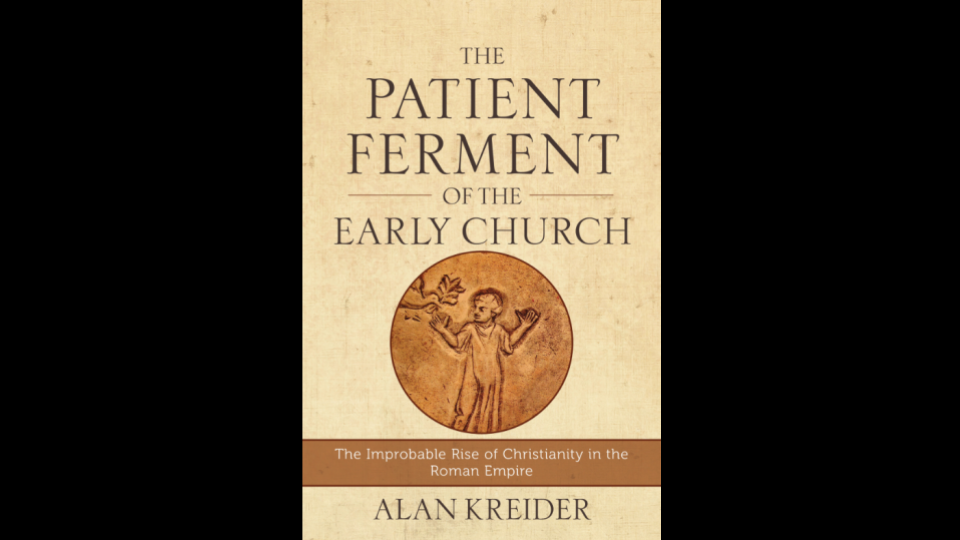
I referred to the Mennonite historian Alan Kreider, and his book, The Patient Ferment of the Early Church: The Improbable Rise of Christianity in the Roman Empire. His two central words, “patient,” and “ferment,” are very fertile ideas for thinking about how our life as followers of Jesus can express hope and freedom to those around us who need precisely those things.

Kreider says that the patience of early Christians meant that they did not seek to control outcomes or people. This quality shaped an approach to life that, without those motives of control, had a power of its own. In Kreider’s words, “The sources rarely indicate that the early Christians grew in number because they won arguments; instead they grew because their habitual behavior (rooted in patience) was distinctive and intriguing. … When challenged about their ideas, Christians pointed to their actions.”

Kreider went on to describe how the educational and mentoring patterns of the early church helped people form and maintain these habits. The cumulative effect was that ferment that led the Christian movement to grow rapidly, without hype, theatrics, or pressure. They didn’t seem to be telling the world, “Look how wonderful we are—especially compared to those fill-in-the-blanks who are corrupting our nation.” (In today’s times, you can fill in the blank with your favorite left-wing or right-wing villains.) If the engine that powered their communication wasn’t their own specialness or their own irresistible arguments, what was it? And is it still available to us today?

Kreider’s description of the virtue of patience in the ferment of the early church is that it entirely rested on trust. As the hymn says, “The Lord hath promised good to me, His word my hope secures.” The more I thought about it, the more I saw that one way to look at this motivating core of our faith, that communicates to others through our habits and practices is to see it as faith in the promises of God.

There’s nothing particularly abstract or pious about the promises of God. The Scripture that I proposed for today comes out of a messy case study of the church, a case study we know as First and Second Corinthians. And those two books are composed of letters from Paul to the Christians in the city of Corinth, in the same Greek province as Athens. These letters are just two of several that went back and forth in both directions, and some scholars say Second Corinthians actually draws from several different letters. And in those six or so years between Paul’s first visit to Corinth and the last letter, he may have made several visits, and we know that at least some of them were confrontational. The church was dealing with internal controversies and disciplinary cases, and they also had awkward questions for Paul himself. His leadership wasn’t taken for granted. So: the church at Corinth may have been part of Alan Kreider’s “patient ferment,” but it certainly wasn’t all peace and calm.

Let me read just a sample of Paul’s mentoring of a church in conflict. For context, Paul is trying to explain why he changed his travel plans, and if we read between the lines, we can detect some other controversies in the background. In the beginning of this letter, Paul also refers to the persecutions that Paul AND the Corinthians had to endure as a consequence of their faith, and as a setting for their exercises in trust.

2 Corinthians 1:12 Now this is our boast: Our conscience testifies that we have conducted ourselves in the world, and especially in our relations with you, with integrity and godly sincerity. We have done so, relying not on worldly wisdom but on God’s grace. 13 For we do not write you anything you cannot read or understand. And I hope that, 14 as you have understood us in part, you will come to understand fully that you can boast of us just as we will boast of you in the day of the Lord Jesus.

15 Because I was confident of this, I wanted to visit you first so that you might benefit twice. 16 I wanted to visit you on my way to Macedonia and to come back to you from Macedonia, and then to have you send me on my way to Judea. 17 Was I fickle when I intended to do this? Or do I make my plans in a worldly manner so that in the same breath I say both “Yes, yes” and “No, no”?

18 But as surely as God is faithful, our message to you is not “Yes” and “No.” 19 For the Son of God, Jesus Christ, who was preached among you by us—by me and Silas and Timothy—was not “Yes” and “No,” but in him it has always been “Yes.” 20 For no matter how many promises God has made, they are “Yes” in Christ. And so through him the “Amen” is spoken by us to the glory of God.”

By the way, I like the interpretation of the word “amen” that has the sense of “this is reliable, worthy of commitment.” It has a hint of “promise” about it.

This morning, I’m suggesting that it’s trust in the promises of God that shapes and empowers our faith, and the community that we visibly form in the larger world.

I admit that I’m talking aspirationally here. I don’t think that we actually always live in that trust. I make this confession on two levels.

First, on an individual level, we are not always in a place where trust comes easily. In the first moments of that confrontation with the angry visitor to Moscow Meeting, I wasn’t thinking about the Lamb upon his throne; I was thinking about what might happen if this guy began spreading the word about a cult operating in their community center. What if next time we were surrounded by a mob of angry anti-sectarian campaigners? It’s happened many times in Russia.

The peace came later, as together we pooled our anxieties and our prayers, and settled back into worship. One of the best things about a beloved community like this one I’m speaking to, is that we don’t all have to be at the same level of trust at the same time; we support each other as Paul and the Corinthians supported each other, even boasted of each other, in their ups and downs.

Secondly, let’s be realistic about the cultural context we’re in. The world’s messages that surround us, and inevitably influence us, are not messages of trust and promises. I’m reminded of something that the philosopher Os Guinness said a few years ago in an interview.

I remember when I was in Australia, speaking on modernity, a visiting Japanese CEO came up to me and said, “When I meet a Buddhist monk, I meet a holy man in touch with another world. When I meet a Western missionary, I meet a manager who is only in touch with the world I know.” You could say today that many, many Christians are atheists unawares; they are implicit, practicing atheists because they are so secular in their consciousness. So we have words like prayer, supernatural, revival, but we don’t actually operate in the world named by those words. To live with the spiritual disciplines opening us up to another reality, to other powers and other dimensions, cracks secularization very powerfully.

We should not be surprised that trusting and living in God’s promises doesn’t come automatically. It’s like Kreider says: it’s a matter of formation, mentorship, discipline, and practice, but not only that—we begin to experience God’s promises for ourselves.

What are God’s promises? God makes promises to us, and through us. Throughout the various biblical covenants—to Noah, Abraham, Moses, David, and the promises recorded in Jeremiah (“I will write my law on their hearts”) and in Second Chronicles chapter 7 verse 14 (“…If my people, who are called by my name, will humble themselves and pray and seek my face and turn from their wicked ways, then I will hear from heaven, and I will forgive their sin and will heal their land”) … in all these and many other places, a picture forms of a people formed by God’s promises: a people reconciled with God, living in anticipation of peace and hope, and a people formed to bless others. You and your descendants will be a blessing to the whole world, God promises Abraham. “I will heal their land,” God promises Solomon. And in times of trouble, Jesus promises in Luke chapter 12, “When you are brought before synagogues, rulers and authorities, do not worry about how you will defend yourselves or what you will say, for the Holy Spirit will teach you at that time what you should say.”

Speaking of the Holy Spirit teaching us what to say, there’s a PS to the story of our angry guest in Moscow. One of our elderly members responded to his opening outburst by saying, with her face shining with kindness, “What’s wrong? We’re just studying English.” I do not claim that she was acting under the immediate guidance of the Holy Spirit, but we all realized that she had spent most of her many decades learning how to cope with life in the anti-religious Soviet Union.

What does it mean for us as a community to see ourselves as people receiving God’s promises, trusting in them, and living them out? Here are some suggestions. Maybe more suggestions, or better ways to express these, will come to you in the open worship.

First of all, I have a new appreciation for that ancient virtue of patience. I don’t ever mean to shame natural responses of fear or anger or pain. I just mean that we don’t stop there, and beyond that, we don’t simply react. We do what we can to move, maybe even to stumble and blunder, toward that space where we can turn our situation over to God, and we ask our community to walk with us.

Secondly, we ourselves become agents of God’s promises. I think this comes naturally to Spokane Friends. Some of us may be especially gifted in direct help to others, to meeting the needs of people who are suffering, or in prison, or targets of discrimination, or in some kind of bondage. Others are gifted to ask the prophet’s question, “Why is this happening?” and propose systemic solutions. Still others pray for the community within which these gifts emerge, and educate its newcomers and children. Nobody wastes time fighting over which approach is more righteous.

Finally, we are a learning community. We’re bound to blunder. Sometimes we do end up wasting time in conflicts. Maybe we overlook opportunities for service. We rightly cherish our three and a half centuries of experience in discipleship, but sometimes there’s too much Quaker and not enough God. And sometimes we gloriously get it right, and our unforced, patient kindness to each other and our neighbors adds to the sum total of joy in the universe. In any case, we watch and learn. After all, what is a church if it’s not people who are gathered around the Living God, learning what it means to live that way, including its ethical consequences, and helping each other in that lifelong process, through all the ups and downs?

What does it mean to you to be people formed and empowered by the promises of God … promises made to you, and promises made through you to the world?

This message was given to Spokane Friends by Johan Maurer during Sunday worship service on September 24, 2023.

Posted in Messages, Sermons | Comments Off on Salt, Light, and Tough Choices (A Silver Age of Evangelism?) … Part 2 by Johan Maurer, September 24, 2023

Inside Outside Upside Down  by LaVerne Biel, September 17, 2023

Thank you for allowing me the opportunity to speak with you today.  For some of you that don’t know me, I thought I’d give you a little background on who I am.  I was the middle child of five.  I was raised in California, and I also spent my summers on a farm in Amity, Oregon, with my grandparents. 

I asked my husband Kent to define me personally in a few sentences.  (Thankfully he was kind.)  The first thing he mentioned was that I like to think outside the box and approach things/problems creatively.  His second attribute was that I was driven and determined (like the character in this story).  I like to see things through.   I agree.   

When I sat down to craft this message, I started in one direction and ended up in another.  This happens to me a lot!  It’s how my brain works and for some of you that don’t know me ………my brain never stops.  I believe that I landed where the Holy Spirit was directing me to the story of Zacchaeus.  Zacchaeus is a great short story (pun intended), but it is not a children’s story.  In this story, I believe that Jesus is showing me the importance of mentorship.  I looked up “mentorship” online, and there were anywhere from 5 to 15 traits describing what a mentor is.  In Zacchaeus’ story I found two: to be present and to listen.   Sometimes to do that you have to look at things inside, outside, and upside down. 

My mentoring jumping-board topic sprang from something that happened this summer.  Kent was working with his siblings for a recent family reunion.  The reunion was going to take place in a town where none of them had lived.  The siblings were texting back and forth to come up with things to do and interesting places to visit.  One of Kent’s sisters came up with the idea to visit the Spam Museum in Austin, Minnesota.  Kent’s brother Mark replied that he was not interested in going and would do something else.  No one said anything in the group text, and they continued making plans and arrangements.  Then a text showed up from Mark which said, “Pam and I were talking and apparently, I was mistaken.  I would love to go the Spam Museum.”  Sometimes a mentor nudges you in the right direction. 

Since mentoring was my topic, I began looking at great mentors in the Bible.  I looked at Jethro and Moses, Samuel and David, Priscilla and Aquila, and came up dry.   I then turned my attention on Luke because he’s my favorite gospel writer.  I looked over all the stories that were told, parables explained, and miracles performed by Jesus.  Since Luke was a physician, he loves to encompass body, mind, and spirit in his writings.  In Luke we find that Jesus addressed body issues by cleansing ten lepers.  He outlined dedication and persistence through the Parable of the Persistent Widow.  With a surgeon’s precision Jesus dissected the heart of the Pharisees and the Tax Collector.  Jesus recovered a blind beggar’s sight.  And then, he enters Jericho and befriends Zacchaeus.    

I found it interesting that Luke’s gospel is the only one who recounts Jesus’ encounter with Zacchaeus.   This story must have struck a chord with Luke’s inclusion of body, mind, and spirit.  Jesus was showing Luke (and me) how to mentor others.  Let’s read Luke 19:1- 10:

 Jesus entered Jericho and was passing through. A man was there by the name of Zacchaeus; he was a chief tax collector and was wealthy. He wanted to see who Jesus was, but because he was short, he could not see over the crowd. So he ran ahead and climbed a sycamore-fig tree to see him, since Jesus was coming that way.

When Jesus reached the spot, he looked up and said to him, “Zacchaeus, come down immediately. I must stay at your house today.” So he came down at once and welcomed him gladly.

All the people saw this and began to mutter, “He has gone to be the guest of a sinner.”

But Zacchaeus stood up and said to the Lord, “Look, Lord! Here and now, I give half of my possessions to the poor, and if I have cheated anybody out of anything, I will pay back four times the amount.”

Jesus said to him, “Today salvation has come to this house, because this man, too, is a son of Abraham. 10 For the Son of Man came to seek and to save the lost.”

What do we know about this passage?  Jericho was a pivotal point throughout Biblical history.  Moses died near Jericho.  It was home to Rahab.  We know about the falling walls of Jericho.  The rebuilding of its walls was cursed by Joshua.  The prophet Elisha visited Jericho.  A Babylonian king was captured in Jericho.  It is safe to say that Jericho had an extensive history with a colorful past.  I surmise that Zacchaeus had a colorful past as well.   

My title gave me license to explore this topic inside, outside and upside down.  Be warned that I’ve taken some creative liberties with this passage.  Let’s look inside Zacchaeus first. 

Inside the character of Zacchaeus: 

You know that I’m Jewish and work as a Roman tax collector.  Because of this, I am despised by the entire Jewish community of Jericho.  The Romans know this and use my position against me.  I have no friends. 

What you may not realize was that I was an only child.  My parents didn’t have much money, but they provided me with food, shelter, and love.  For some reason I didn’t grow as tall as my friends and classmates.  No matter what I did, I received scorn and ridicule.  Then it turned physical.  I couldn’t defend myself and would constantly find myself bruised and battered.  These beatings crushed me and my confidence and spirit.  I grew resentful and angry. 

When my parents passed away,  I had to find a way to support myself.  I had to take a job that no one else wanted and the only job that I was qualified for.  I had no choice.  I knew that a good Jew would not work for Rome.  I was not loyal to my people because they could care less about me.  So, I became a tax collector.  I convinced myself that way I would gain stature through my money and my influence.  The people of Jericho couldn’t hurt me anymore than they already had.  I would show them! 

Here I am years later, and I feel lonely and deserted.  My money has no value.  It’s cold and unfeeling.  I’ve learned that influence is fleeting.  Then I heard about Jesus.  He sounds amazing.  I’ve heard that he is a great teacher and counselor.  There is talk that he sees through people’s physical and emotional limitations.  He’s a miracle worker that heals them.  I need healing.  I need to repair my relationship with my people.  I don’t know where to start.  I believe that Jesus can help me show others that I really need them.  I need companions.  I need a sense of family. 

When I heard that Jesus was coming to Jericho, I knew I had to make a change.  I had to see and talk with him at all costs.   I ran out to meet him without my security guards.  I ran back and forth up and down the street.  People were lined up in front of me.  I couldn’t see anything.  I jumped as high as I could.  I weaved between people, but they would close ranks and block me at every turn.  They knew it was me.  They turned and looked down on me and pulled their children to their shoulders to make it more difficult to see Jesus.  Then they closed ranks and stepped closer together to block me. 

How can I gain height?  How can I see Jesus?  A sycamore tree.  Sycamore trees are plentiful.  I can climb up to see him that way!  It sounded like a great plan.  I just need to find one where I can reach the first limb.  I ran until I found one!  People are watching me, and no one offered to help!  They turn their back on me again.  It’s okay.  I must do this!  The first limb was almost beyond my reach.  I jumped up and managed to grab it.  I used my sandaled feet to climb up, straddle, and finally sit on the branch.  I know that if I’m able to glance at him that everything will change and change it did. 

Next let’s examine who was on the Outside: the people of Jericho:

Oh no, can you believe it?  Look who decided to show up to see Jesus!  What could Zaccheaus possibly want?  Is he planning on selling tickets to make more money?  Jesus is all about healing and lifting people up.  He’s rich.  He doesn’t need Jesus’ help.  People are shouting out loud, “Jesus can’t make you taller, Zaccheaus”.  There was laughter throughout the crowd.  “Go away, Jesus is Jewish not Roman.  He’ll want nothing to do with you”.    “Hey everyone, block Zaccheaus’ path!   There was lots of jostling and sniggering.  Wait, what is he doing?  Zaccheaus is running around looking for something.  Look, he’s attempting to climb a tree.  This is hilarious.  This is not his best look no matter who he is.  He’s hanging on to that tree for his life.  With his weight I’m not sure it will hold him.  What!  He caught his cloak on a branch.  More laughter from the crowd.  Not good.  I must look away.  After all, I came to see Jesus, not Zacchaeus!

Where is he?  Oh, I see him.  He looks like one of us.  That’s a surprise.  Jesus is coming and I have a front row view of him.  I wonder who he’ll heal today?   Wait.  Did I hear that right?  There must be something wrong with my ears!  What did he say to Zaccheaus?  That can’t be right.  Why would Jesus go to a self-glorified, money-hungry traitor’s home?   What about us?  I thought he came to seek and to save the lost.  Why is he wasting his time with Zaccheaus?  The crowd starts booing and shouting.    

The Upside/down of Jesus and Zaccheaus:

Zaccheaus was perched high above the crowd when Jesus spotted him in the sycamore tree.  Zaccheaus had tuned out the crowd.  He only had his ears and eyes on Jesus.  Zaccheaus thought, What?  Is he talking to me?  I’ve never met him and yet he knows my name.  The Lord said, “Zacchaeus, come down immediately. I must stay at your house today.”  The crowd witnessed Zacchaeus almost falling to the ground in front of the Lord’s feet.  He collected himself and uttered, “Look, Lord! Here and now, I give half of my possessions to the poor, and if I have cheated anybody out of anything, I will pay back four times the amount.”  A gasp came across the crowd!  People cheered.  They approached Zacchaeus and slapped him on the back.   Maybe we were wrong about him after all. 

Jesus said to him, “Today salvation has come to this house, because this man, too, is a son of Abraham. 10 For the Son of Man came to seek and to save the lost.”

This Biblical story is upside down and backwards from what we experience in our everyday  lives.  Jesus stated clearly for all to hear that Zacchaeus was one of them, a son of Abraham.  Zacchaeus needed them as much as they needed Zacchaeus.  Jesus gave him salvation because of his faith and fortitude, not because of his position or money.  He had been lost and Jesus found him.    

Today people openly and freely tell you when you’re wrong.  I don’t believe it’s any different today than it was 2,000 + years ago.  They don’t expect you to change.  It’s easier to talk at each other than to each other. 

In conclusion:  I know that I need to be more Christ-like .  Jesus exposed Zaccheaus to the crowd.   He mentored him with laser focus.  He didn’t admonish, condemn, or criticize what he had done or why.  Jesus knew that Zacchaeus was broken and off-track but willing to change.  Why else would he have shown up sitting in a sycamore tree?  Jesus’ mentoring style was to be present and listen.   I purposely didn’t write any queries, I thought I would leave that open.   Remember, sometimes you must look at things inside, outside, and upside down to figure it out.  It wasn’t about where he was but where Zacchaeus needed to be.  After all Zacchaeus name means pure heart.  Jesus had to come to Jericho to remind him of that.   

This message was given to Spokane Friends by LaVerne Biel during Sunday worship service on September 17, 2023

Note: My title taken from a Berenstain Bears children’s story.

Posted in Messages | Comments Off on Inside Outside Upside Down  by LaVerne Biel, September 17, 2023

“Earth’s Crammed with God” by John Kinney, August 13, 2023

I want to begin with this excerpt from the poem “Aurora Leigh” by Elizabeth Barrett Browning and tweak it a bit to make it a prayer.

“Earth’s crammed with heaven,
And every common bush afire with God,
But only those who see take off their shoes;
The rest sit round and pluck blackberries.”

We are blind. Help us to see.

It is always good to be with you in person. I feel that I can get pretty intense and opinionated in my messages, especially if they are about controversial subjects such as my recent message about hell. If you disagreed we could get into an argument. If it was several hundred years ago, as the sad history of Christianity shows, we might want to kill each other. Over the centuries it has been Catholics killing Lutherans, Lutherans killing Catholics, Puritans killing Quakers and on and on. It was evil. Not once did Jesus say, “Thou shalt be right.” Not once did Jesus say “Thou shalt have correct beliefs with creeds supported by sound theological principles.” Not once did Jesus even say, “Worship me.” However he said, “Follow me” thirteen times. Have whatever beliefs and worship in whatever manner that helps you do the follow. The belief and worship don’t ask much of us. The follow does. If you have two coats, give one away. Try to be last instead of first. Lose your life to gain it. Love those that are hard to love, the corrupt politicians and CEO’s, the white supremacists.

I want to start by talking about a subject that has come up frequently, dogs. One of the cool things about dogs is that they are satisfied living in their “doggness”. Dogs aren’t trying to be something they aren’t. They know exactly what they are and are content. Recently I came across the transcript of an interview done with a dog. The dog’s name is Ruff and Ruff could speak.

Interviewer: Ruff, what do you like most about yourself?

Ruff: I like being a dog.

Interviewer: What do you do?

Ruff: I do being a dog.

Interviewer: What are your future career aspirations?

Ruff: Being a dog.

Interviewer: If you could be anything in the world what would you want to be?

Ruff: Duh! A dog. Grrrr!

Interviewer: Ruff, you are 4 years old in human years which is 28 in dog years, correct?

Ruff: No. Dogs do not age linearly with a slope of 7 and y intercept of 0. It is more exponential. Didn’t they teach you anything in math?

Back to us. We are beloved children of God. Always will be, but we start to forget. We go on to spend the rest of our lives building a persona that is measuring, evaluating, calculating, dualistic, judging, fragile and easily offended. It is our ego self, the false self. Engineers need to be calculating, judging and evaluating if they are building a bridge. The false self is not the bad self. It just isn’t the true self. Right now I have my “give the message” hat on. However, as we go about our day we need to frequently stop, step out of whatever role we are playing and be who we really are, beloved sons and daughters of the divine. Thomas Merton said something like, “When you get to heaven you will find that there won’t be much of what you thought was you there.” All of what a dog is will be there. Dogs have a leg up on us . . which reminds me of my dog Asa’s recent odd marking behavior.

When I had Asa out for a walk he was double marking his favorite pole meaning he would pee this way then turn around and pee the other way and mark as high up as possible. Usually he eats his food in 20 seconds — he started leaving most of it for days. He never howls. Recently I heard him give out a howl that was low and filled with longing. He is on a run line and instead of being by his house, he sat at the end of the line looking down the road with anticipation. I finally figured it out. Within a 4 mile radius a female dog was in heat. Asa was in love and what a romantic. Not eating all his food was an invitation to dinner. His howling was a heartfelt love song and the double markings were fervent love letters written in bold with numerous exclamation points.

You just experienced history in the making. Never has and never again will anyone witness a cradle Catholic science/math teacher give a message in a Friends meeting house talking about the height of dog pee on a pole.

Years from now you will be sitting in your living room and a grandchild will say, “Grandpa and grandma, I just read in the “This Day in History” section of the newspaper that on August 13, 2023, a man gave a message at the Spokane Friends meeting house and he talked about dog pee. Were you there? Is that true? Was he crazy?” You will respond, “Yes, I can remember it as if it was yesterday. It is something I want to forget but can’t. Was he crazy? That is a bit harsh. Let’s just say he only had one oar in the water.”

If only for a fleeting moment we all just experienced heaven right here, right now. How so? We laughed together. We were happy. Heaven is a state of consciousness as much as it is anything else.

Misconceptions about heaven:

  1. Heaven is up there. That made sense to our ancient ancestors because up there was a mystery. We now know better. The universe is up there and its wonders are an awesome manifestation of the spirits’ immense creativity. Recently released images from the James Webb telescope are spectacular. Creation did not stop on the seventh day in a garden between the Tigris and Euphrates Rivers. The Spirit continues to dance as new stars are born. If heaven were only up there, then God would be distant, aloof, disengaged. God is right here, right now.
  1. Heaven is after I die. Yes and no. The first heaven should be right now. In fact we were taught to pray for it to be now. “Thy kingdom come, thy will be done on earth as it is in heaven.” To which God replies, “You are my body. Get with it. Start making it happen. That is why I sent the Holy Spirit to help you.” Mark 1:15 “The kingdom of God is at hand.” St. Catherine of Siena said, “It is heaven all the way to heaven.”

If heaven is all about something later, then it can become my personal salvation plan and consequently I don’t give a rip about what is happening here and now because, “I’m gonna be out of this dump.”

  1. Heaven is about worthiness. No, thank God. It is about accepting an invitation. It is a choice. Matt 22: 1-14. “‘Tell those who have been invited that I have prepared my dinner . . . and everything is ready. Come to the wedding banquet.’ But they paid no attention and went off—one to his field, another to his business”.
  1. Who is included? I just alluded to that in Matthew, but it is worth hitting again.

Luke 14: 18-23: When the time for the banquet came, he sent his servant to say to those who had been invited, “Come along: everything is ready now.” But all alike started to make excuses. The first said, “I have bought a piece of land and must go and see it. Please accept my apologies.” Another said, “I have bought five yoke of oxen and am on my way to try them out. Please accept my apologies.” Another said, “I have just got married and so am unable to come.” The servant returned and reported this to his master. Then the householder, in a rage, said to his servant, “Go out quickly into the streets and alleys of the town and bring in here the poor, the crippled, the blind and the lame.” “Sir,” said the servant, “your orders have been carried out and there is still room.” Then the master said to his servant, “Go to the open roads and the hedgerows and press people to come in, to make sure my house is full.

Thank God again.

  1. Press people to come in?” If that isn’t talking about total inclusiveness I don’t know what is. Apparently the only people that won’t be there are the ones that refuse to be there.
  1. What is the here and now heaven supposed to be? The most frequent metaphor that Jesus uses for heaven is a banquet. I would say the defining thing about a banquet is everyone having enough. Maybe enoughness is what we are supposed to make happen. Everyone having enough to eat and drink. Everyone being happy enough. Everyone feeling safe, secure and special enough. Everyone knowing they are loved enough. Could that really happen across the entire world? I doubt it so we have to do what we can in our little corner
  1. Heaven is just about me and my quest. No. Heaven is about us. We are more joined than we are separate. John 17:20-23: “I am praying not only for these disciples but also for all who will ever believe in me through their message. I pray that they will all be one, just as you and I are one—as you are in me, Father, and I am in you. And may they be in us so that the world will believe you sent me. I have given them the glory you gave me, so they may be one as we are one. I am in them and you are in me. May they experience such perfect unity that the world will know that you sent me and that you love them as much as you love me.”

    You in me and me in you and God in us and we are all one and perfect unity. It is very hard for me to grasp that. I don’t sense it. I am surrounded by voices screaming me, me, me and I, I, I. I have not experienced it but many have. Thomas Merton did. Lori Erickson’s writes this about Merton in her Spiritual Travels site.

    Thomas Merton was a Trappist monk who was instrumental in bringing back contemplative prayer to the Catholic tradition. On March 18, 1958, he was running errands in downtown Louisville when he had an experience that would change his life and influence countless others. The spot is marked with a historical marker, the only known one in the United States that marks a mystical experience.

    Merton described it this way.

    “In Louisville, at the corner of Fourth and Walnut, in the center of the shopping district, I was suddenly overwhelmed with the realization that I loved all these people, that they were mine and I theirs, that we could not be alien to one another even though we were total strangers. It was like waking from a dream of separateness, of spurious self-isolation.

    This sense of liberation from an illusory difference was such a relief and such a joy to me that I almost laughed out loud. . . . I have the immense joy of being a member of a race in which God Himself became incarnate. As if the sorrows and stupidities of the human condition could overwhelm me, now that I realize what we all are. And if only everybody could realize this! But it cannot be explained. There is no way of telling people that they are all walking around shining like the sun.

    Then it was as if I suddenly saw the secret beauty of their hearts, the depths of their hearts where neither sin nor desire nor self-knowledge can reach, the core of their reality, the person that each one is in God’s eyes. If only they could all see themselves as they really are. If only we could see each other that way all the time. There would be no more war, no more hatred, no more cruelty, no more greed. . . . But this cannot be seen, only believed and understood by a peculiar gift.”

    — Thomas Merton, Conjectures of a Guilty Bystander

    I pray with all my heart that one day all of us will be given that peculiar gift.

    Query: When have you experienced heaven?

    This message was given to Spokane Friends by John Kinney during Sunday worship service on August 13, 2023.

    Notes: I did not include the following in my message. It is similar to what Merton experienced. Richard Rohr writes:

    The twentieth-century English mystic Caryll Houselander (19011954) describes how an ordinary underground train journey in London transformed into a vision that changed her life. I share Houselander’s description of this startling experience because it poignantly demonstrates what I call the Christ Mystery, the indwelling of the Divine Presence in everyone and everything since the beginning of time as we know it:

    All sorts of people jostled together, sitting and strap-hanging—workers of every description going home at the end of the day. Quite suddenly I saw with my mind, but as vividly as a wonderful picture, Christ in them all. But I saw more than that; not only was Christ in every one of them, living in them, dying in them, rejoicing in them, sorrowing in them—but because He was in them, and because they were here, the whole world was here too . . . all those people who had lived in the past, and all those yet to come.

    I came out into the street and walked for a long time in the crowds. It was the same here, on every side, in every passer-by, everywhere—Christ.

    I had long been haunted by the Russian conception of the humiliated Christ, the lame Christ limping through Russia, begging His bread; the Christ who, all through the ages, might return to the earth and come even to sinners to win their compassion by His need. Now, in the flash of a second, I knew that this dream is a fact . . . Christ in [humankind]. . . .

    I saw too the reverence that everyone must have for a sinner; instead of condoning his [or her] sin, which is in reality [their] utmost sorrow, one must comfort Christ who is suffering in [them]. And this reverence must be paid even to those sinners whose souls seem to be dead, because it is Christ, who is the life of the soul, who is dead in them; they are His tombs, and Christ in the tomb is potentially the risen Christ. . . .

    Christ is everywhere; in Him every kind of life has a meaning and has an influence on every other kind of life. . . . Realization of our oneness in Christ is the only cure for human loneliness. For me, too, it is the only ultimate meaning of life, the only thing that gives meaning and purpose to every life.

    Posted in Messages | Comments Off on “Earth’s Crammed with God” by John Kinney, August 13, 2023

    Lamentation by John Kinney, October 8, 2023

    Nice to be with you.  If I do anything right in my messages you get a lot of the credit.  I am not sure how it works, but I believe you are part of what draws thoughts and ideas out of me.  Thank you. 

    This is a prayer by Thomas Keating, a Trappist monk instrumental in resurrecting the lost Catholic contemplative prayer tradition. In the form of unguided silent worship, Matthew Fox imbedded it from the beginning.

    My topic today is lamentation.  In light of the recent fires I believe lamentation is very appropriate.  Before I talk about the scripture verses I have chosen, I would like to give the verses a chance to talk to you.  I did that a few months ago.  I can only give you second hand information.  In silent contemplation there is no middle man, you get information from the source, the light within.

    Step 1: I will read the passage a total of three times with 2 minutes of silence after each reading.  As you listen, see if there is one word or phrase that you’re drawn to?

    The “He” the author refers to is Yahweh. Lamentations 3:1-18:

    I am a man familiar with misery under the rod of his fury.  He has led and guided me into darkness, not light.  Against none but me does he turn his hand, again and again, all day.  He has wasted my flesh and skin away, has broken my bones.   He has walled me in so that I cannot escape; he has weighed me down with chains; even when I shout for help, he shuts out my prayer.  For me he is a lurking bear, a lion in hiding.  Heading me off, he has torn me apart, leaving me shattered.  He has bent his bow and used me as a target for his arrows.  I have forgotten what happiness is and thought, ‘My lasting hope in Yahweh is lost.’

    Step 2: If you haven’t received a word yet, it’s okay. Keep listening as it may come later. 

    As I read the text again,  What do you feel?   What are your emotions? What specific situation in your life today relates?

    I am a man familiar with misery under the rod of his fury.  He has led and guided me into darkness, not light.  Against none but me does he turn his hand, again and again, all day.  He has wasted my flesh and skin away, has broken my bones.   He has walled me in so that I cannot escape; he has weighed me down with chains; even when I shout for help, he shuts out my prayer.  For me he is a lurking bear, a lion in hiding.  Heading me off, he has torn me apart, leaving me shattered.  He has bent his bow and used me as a target for his arrows.  I have forgotten what happiness is and thought, ‘My lasting hope in Yahweh is lost.’

    Step 3:  To hear God, you need to turn off the critic or cynic in your mind that questions whether you’re really hearing God. When God speaks, it’s usually in thoughts and feelings that come into your mind.

    I am a man familiar with misery under the rod of his fury.  He has led and guided me into darkness, not light.  Against none but me does he turn his hand, again and again, all day.  He has wasted my flesh and skin away, has broken my bones.   He has walled me in so that I cannot escape; he has weighed me down with chains; even when I shout for help, he shuts out my prayer.  For me he is a lurking bear, a lion in hiding.  Heading me off, he has torn me apart, leaving me shattered.  He has bent his bow and used me as a target for his arrows.  I have forgotten what happiness is and thought, ‘My lasting hope in Yahweh is lost.’

    Anyone like to share anything?

    Many times I am struck by a profound sense of sadness mixed with anger.  Sad that we are trashing and burning up our home.  Angry that God seems absent.  Sad that war is everywhere and is an addiction of our country.  Angered by gun violence, refugee issues, racism, LGQBT persecution and on and on.  Where is God?  Does God even care? 

    One third of the Psalms and the entire book of Lamentations are filled with verses of anguish and complaint, but I have never heard a sermon devoted to those topics.  I wonder why?  Richard Rohr says, “We think, perhaps they express sinful anger or negativity, when grief and loss are actually something quite different.  We think they make us appear weak, helpless, and vulnerable, and most of us don’t want to go there.  We think, perhaps, they show a lack of faith, whereas they are probably the summit of faith. So we quickly resort to praise and thanksgiving, even when it is often dishonest.”

    Have you ever spoken insincerely to God with praise and thanksgiving, when what you really wanted to do was shout at God?  I had to deal with some difficult mental stuff years ago, and I remember screaming at God, “What kind of God are you?  How can I call you my father when I would do everything in my power to prevent what is happening to me from happening to my children.  You are a monster. Screw you, God. “

    It is good to keep in mind that in all the scriptures of lament, a ray of hope can be found.  They never end in despair. The verses from Lamentations continue.

    Lamentations: 3:24-33:

    “This is what I shall keep in mind and so regain some hope: Surely Yahweh’s mercies are not over, his deeds of faithful love not exhausted; ‘Yahweh is all I have,’ I say to myself.  Yahweh is good to those who trust him, to all who search for him. It is good to wait in silence for Yahweh to save.  It is good for someone to bear the yoke from a young age, to sit in solitude and silence when it weighs heavy, to lay one’s head in the dust — to offer one’s cheek to the striker, to have one’s fill of disgrace.  If he brings grief, he will have pity out of the fullness of his faithful love, for it is not for his own pleasure that he torments and grieves the human race.”

    From Richard Rohr: Lament is not despair. It is not whining. It is not a cry into a void. Lament is a cry directed to God. It is the cry of those who see the truth of the world’s deep wounds and the cost of seeking peace. It is the prayer of those who are deeply disturbed by the way things are. We are enjoined to learn to see and feel what the psalmists see and feel and to join our prayer with theirs. The journey of reconciliation is grounded in the practice of lament.  

    Easy for you to say, Rohr.  When my head was in the dust, I could not see any hope.  Despair was all I felt for a very long time.  God was not the cause of my suffering.  I wanted God to fix it.  We have to be very careful when we go down the “God as the fixer” road. 

    Fred and Tom are good people.  They are kind, generous and humble.  A raging fire is roaring towards both of their houses coming from the north.  Fred’s house is 100 feet south of Tom’s.  Both are praying with all their might that God will save their houses.  The fire rapidly consumes Tom’s house but then the wind reverses direction and Fred’s house is saved. Fred rejoices that God saved his house.  What is Tom supposed to conclude?  He didn’t pray hard enough?  God wanted to punish him and reward Fred?  I think that what happened had nothing to do with God. It just happened.  I am not saying that we should not ask God for things in prayer. I am saying we have to be careful about conclusions.   Actually I don’t know what I am talking about.   It is beyond me.  What I do know for sure is that God rejoices with Fred and weeps with Tom.

    In Matthew 27:46 Jesus says:   ‘My God, my God, why have you forsaken me?’  That is one of the most powerful verses in all of scripture. That through which we live, move and have our being.  That which we name God. That which took on flesh as Jesus to become one with us knows lament.  It gives me comfort to know that Jesus resurrected as Christ plumbed the depths of all human emotions.

    Colossians 3: 11: “There is only Christ: he is everything and he is in everything.“ We are a melding of the divine and human.  Divinity is embedded in our DNA at birth.   Jesus came to show us how to deal with sorrow, rejection, disappointment, violence and lamentation.  Jesus did not come to show us how to be spiritual, he came to show us how to be human. 

    Thank you.

    This message was given to Spokane Friends by John Kinney during Sunday worship service on September 10, 2023.

    Posted in Messages | Comments Off on Lamentation by John Kinney, October 8, 2023

    A Silver Age of Evangelism? Part I by Johan Maurer, August 27, 2023

    Today I want to speak about evangelism, which is a bit of a loaded topic among some Friends, so let me say briefly what I mean by this word. By “evangelism,” I mean the engaging and persuasive communication of our faith, combined with an invitation to visit the community that has been shaped by that faith. I want to emphasize that second part: an evangelistic communication isn’t complete unless it includes a way to experience how people who claim that faith have been shaped by it. In Quaker language, we communicate both faith and practice, implying that we do our best to keep them consistent with each other, and, welcome to Spokane Friends Meeting; here’s how we’re trying to live that out.

    I want to contrast “evangelism” with “proselytism.” I see the first as a positive thing, and the second as problematic. Proselytism is trying to attract newcomers from spiritual homes that are serving them well, by implying that what we have is better than what they have. In other words, sheep-stealing.

    You may have noticed that I put a question mark at the end of the title of today’s message, “A Silver Age of Evangelism?” The question mark is to signal that I’m asking questions rather than pretending to lay down things that I’m certain about.

    So, for example, I’m going to suggest that the current attitude toward religion in the USA, which is increasingly negative, should be viewed as a time of great opportunity for evangelism. I’d like to compare today’s situation with what we might call “The Golden Age of Evangelism,” that is, that early period of church history that began with the Book of Acts. What can we learn from those earliest Christians that might apply to our challenging time?

    The “golden” and “silver” comparisons are just handy tags for two different historical eras, which I’m borrowing from Russian cultural history. The Golden Age of Russian literature was the first three quarters of the nineteenth century, starting with Pushkin, and ending with Chekhov. It includes the giants Gogol, Tolstoy, and Dostoevsky. The Silver Age began shortly afterwards, and was especially noted for its amazing poets, such as Blok, Akhmatova, and Tsvetaeva, and included the early work of Mandelstam and Pasternak. Even though the two eras were not far apart chronologically, the context changed mightily from the Golden to the Silver Age. In the Golden Age, the Tsars basically had Russia locked down in what looked like a stable autocracy with little chance for reform. By the time the Silver Age began, revolutionaries had succeeded in assassinating a tsar, and a chain of events and personalities and polarizations was visibly underway that would end with the October Revolution in 1917. During those decades of the Silver Age, all the old certainties were up for discussion, including those involving faith and established religion.

    Of course the parallels between church history and Russian literary history are very limited. Both Golden Ages involve strong and established empires; both Silver Ages are times of ferment, experimentation, and polarization. But the Golden Age of Evangelism, as I suggest it, started nearly 2000 years ago, and there’ve been numerous other cycles of stability and revolution in various parts of the Christian world before we arrive at our present situation. So my main question isn’t about how useful these tags are. I’m more interested in what the first era of church expansion in rough times can tell us about how to communicate our faith now.

    Let’s look at the situation back at the beginning of church history, when Paul and the other apostles and their friends were building what became the church. We get several dramatic episodes in the book of Acts, and in particular in the series of visits Paul makes before and after today’s account of his visit to Athens. You might remember that his visits both before and after Athens were full of drama, as he and his friends clashed with both religious and secular authorities in the various towns he visited. Some of these clashes are with the established leaders of the Jewish communities from which Christianity arose, but those leaders are also nervously looking over their shoulders, worried that the disruptions caused by their disputes will attract unfavorable attention from the Roman overlords.

    So … Paul basically goes to Athens for respite in between some of these turbulent visits, and waits for his companions to catch up with him there. And that’s where today’s excerpt begins:  

    Acts 17:16 [NIV, adapted]

    While Paul was waiting for them in Athens, he was greatly distressed to see that the city was full of idols. 17 So he reasoned in the synagogue with both Jews and God-fearing Greeks, as well as in the marketplace day by day with those who happened to be there. 18 A group of Epicurean and Stoic philosophers began to debate with him. Some of them asked, “What is this babbler trying to say?” Others remarked, “He seems to be advocating foreign gods.” They said this because Paul was preaching the good news about Jesus and the resurrection. 19 Then they took him and brought him to a meeting of the Areopagus, where they said to him, “May we know what this new teaching is that you are presenting? 20 You are bringing some strange ideas to our ears, and we would like to know what they mean.” 21 (All the Athenians and the foreigners who lived there spent their time doing nothing but talking about and listening to the latest ideas.)

    22 Paul then stood up in the meeting of the Areopagus and said: “People of Athens! I see that in every way you are very religious. 23 For as I walked around and looked carefully at your objects of worship, I even found an altar with this inscription: to an unknown god. So you are ignorant of the very thing you worship—and this is what I am going to proclaim to you.

    24 “The God who made the world and everything in it is the Lord of heaven and earth and does not live in temples built by human hands. 25 And God is not served by human hands, as if God needed anything. Rather, it is God who gives everyone life and breath and everything else. 26 From one man God made all the nations, that they should inhabit the whole earth; and God marked out their appointed times in history and the boundaries of their lands. 27 God did this so that they would seek God and perhaps reach out for God and find God, though God is not far from any one of us. 28 ‘For in God we live and move and have our being.’[b] As some of your own poets have said, ‘We are God’s offspring.’[c]

    29 “Therefore since we are God’s offspring, we should not think that the divine being is like gold or silver or stone—an image made by human design and skill. 30 In the past God overlooked such ignorance, but now God commands all people everywhere to repent. 31 For God has set a day when God will judge the world with justice by the man God has appointed. God has given proof of this to everyone by raising him from the dead.”

    32 When they heard about the resurrection of the dead, some of them sneered, but others said, “We want to hear you again on this subject.”

    33 At that, Paul left the Council. 34 Some of the people became followers of Paul and believed. Among them was Dionysius, a member of the Areopagus, also a woman named Damaris, and a number of others.

    Here are some things that strike me from this story; let’s see how many of them add to our thinking about communicating our faith today.

    First of all, look how calm these discussions seem to be; Paul “reasons” with the people in the synagogue, with people out in the public, and with the Stoics and Epicurians. He speaks to the town council, a sort of combination of legislature and judicial body, and convinces at least one of them. Some people are not impressed by his message, as Luke candidly tells us, but others are.

    Why this low-key experience? First of all, the Roman Empire, at least most of the time, was tolerant toward its many religions and deities. Even when people were commanded to exalt an emperor, they were not required to abandon their existing religious ties. The only thing that was not tolerated was political opposition to the empire and its authorities. It was not surprising that, in the melting-pot context of Athens, so many people were ready to hear new religious ideas.

    Second, Paul’s approach itself was non-confrontational. He spoke about Jesus and the resurrection, but he also made connections with the public expressions of religious belief and religious yearning that he saw around him. He referred directly to that yearning: “God is not far from any one of us.” Their varieties of human-made idols doesn’t disqualify them from realizing this; in the past, God overlooked these substitutes that people made, not knowing that their Creator was closer than any of those substitutes.

    A few days ago, I read a column in the Washington Post by Perry Bacon entitled “I left the church — and now long for a ‘church for the nones’.” He grew up in the church and became accustomed to the church being his primary social community. As he grew farther away from the theology and doctrines of the church, he couldn’t deny the importance of that community experience, and now he would love to see that same quality of community available to those like himself that he labels “the nones.” As you’ve probably heard, the “nones” are people who pollsters and sociologists in the USA say have no specific religious identity. As of a couple of years ago, those “nones” have grown to be as large as the Protestant and the Roman Catholic population of the United States, and are, or soon will be, the majority of Americans.

    As Bacon says, “America today is a nation of believers (about 70 percent say they have some religious faith) who don’t regularly attend religious services (only 30 percent go to services at least once a month). I’m the reverse: a person without clear beliefs about God who wants to go to something like church frequently anyway.”

    What’s interesting is that there have been attempts to create communities with churchy culture, singing, potlucks, and service opportunities, just without the faith component, but they have not taken off. According to historian Alan Kreider, the private social clubs of the Roman empire had similar functions; ostensibly organized around this or that deity, they were essentially a combination of supper club, mutual aid society, and a form of burial insurance.

    Comparing today’s USA with the Roman empire of Paul’s day, we have a similar mix of anger and polarization on the one hand, the kind that drove Paul and his friends from more than one Mediterranean town, and, on the other hand, an overall tolerance that welcomes all sorts of faiths and, at the same time, trivializes them. Nowadays there’s some evidence that the more militant versions of Christianity have driven young people into the ranks of the “nones,” … but what we share with most of the Roman empire in its first two centuries is that there is no one religion that demands total loyalty. The tacit American assumption that being Christian meant being part of the establishment has weakened almost to the vanishing point. If being publicly identified as church people once carried a social advantage, apparently it doesn’t do so any longer.

    What openings does this provide us Friends? We have very little investment in promoting ourselves as defenders of Christian respectability, or promoters of the religion industry in general. Our whole approach to evangelism is similar to what Paul said to the Athenians, “… God is not far from any one of us. For in God we live and move and have our being.” And our invitation is to look inward and see that witness that God has put into each of God’s beloved, and to join us in learning how to live by that witness, and its ethical consequences. This invitation can be as fresh for someone who’s spent a lifetime in the church, as it might be for someone who has never had any church experience at all.

    For more of what we can learn from the early church, I’ve been reading a wonderful book by that historian I mentioned earlier, Alan Kreider.

    The book is called The Patient Ferment of the Early Church: The Improbable Rise of Christianity in the Roman Empire. I really recommend it. He helps us understand how this tiny little community of disciples, often despised, belittled, sometimes violently repressed, and utterly without political advantages in the Roman colonies around the Mediterranean and beyond, grew at the astounding rate that it did, and did so organically, without any evangelistic campaigns or requirements that converts try to convert others. By the time the Emperor Constantine claimed to become Christian early in the fourth century, the numbers had reached five or six million.

    Alan Kreider’s explanations are fascinating, and seem to me to apply directly to our own situation, where our potential “great people to be gathered,” to draw on George Fox’s vision for Friends, are often angry, cynical, or allergic to actual theology. To summarize Kreider, he says that four factors were behind this improbable rise:

    First, the virtue of patience. He writes, “The Christians believed that God is patient and that Jesus visibly embodied patience. And they concluded that they, trusting in God, should be patient—not controlling events, not anxious or in a hurry, and never using force to achieve their ends.” Kreider goes on to point out that this very virtue of patience even strengthened those Christians who met their ends in the gladiators’ arenas.

    Second, the style of life and discipleship that such patience shapes. He writes, “The sources rarely indicate that the early Christians grew in number because they won arguments; instead they grew because their habitual behavior (rooted in patience) was distinctive and intriguing. … When challenged about their ideas, Christians pointed to their actions.”

    Third, catechesis and worship. (“Catechesis” refers to preparation for baptism.) Kreider writes, “The Christians were vastly more serious about catechesis than were the members of other religions of their time—and for good reason. They believed that impatient habits (unlike those of Jesus Christ) were deeply ingrained in people who were raised in Greco-Roman societies. From experience they knew that if people were to develop patient reflexes, they need time, the friendship of mentors, and the opportunity to grow in patient ways of living that were normal for Christians. After being shaped by catechesis, people who become Christians were baptized and then were sustained by the worship of Christian communities.” Kreider points out that full participation in worship was only possible after the end of this shaping process.

    Fourth, what Kreider calls “ferment.” It’s his metaphor for the dynamism of this patient but cumulatively impressive growth of the church. Kreider writes, “It operated reticently, by what theologian Origen called God’s ‘invisible power.’ It was not susceptible to human control, and its pace could not be sped up. But in the ferment there was a bubbling energy—a bubbling-up inner life—that had immense potential.”

    Taken all together, we might conclude that all we have to do in our Quaker churches is keep our fires lit and assume that a passive approach will ensure the future of our witness to our suffering and angry world. I’d want to add a condition: do we see this ferment, this bubbling? Does our correct reluctance to resort to hype and theatrics in growing the church mean that we forget how to welcome and nurture those drawn by our patient witness? Specifically, when we’re challenged by the “nones” in our community to explain why we hunger for more than social togetherness, how do we gently and humbly testify to our assurance that “Christ has come to teach his people himself”?

    Here are a few queries to consider in the silence. Use them if they’re helpful, but put the Holy Spirit first.

    Do you find the concept of patience helpful? If it isn’t a virtue that you’d associate with yourself, do you appreciate the company of patient people?

    How has the church (at any scale) helped shape your faith and your habits? Is there more that the church could do? Is there more you could do to help others in the church?

    What more might Quakers do in this city, to provide more access to the church (this meeting or to the church at any scale) for people with spiritual and physical hunger? If answers do not appear immediately, might this be a question for patient consideration and waiting?

    I hope to hear from you in these next weeks, and continue this conversation the next time I am with you.

    This message was given to Spokane Friends Meeting by Johan Maurer during Sunday worship on August 27, 2023

    Posted in Messages | Comments Off on A Silver Age of Evangelism? Part I by Johan Maurer, August 27, 2023

    Is It Time Yet?  (Patience) by Ruthie Tippin, August 20, 2023

    Patience can wear a person out!  At least being patient can.  But perhaps the certain style or design of patience that the Apostle Paul encourages us to wear is a bit different than what we normally think of. 

    Here is what Paul writes in Colossians 3:12-14 (Amplified Bible):

    12 So, as God’s own chosen people, who are holy [set apart, sanctified for His purpose] and well-beloved [by God Himself], put on a heart of compassion, kindness, humility, gentleness, and patience [which has the power to endure whatever injustice or unpleasantness comes, with good temper]; 13 bearing graciously with one another, and willingly forgiving each other if one has a cause for complaint against another; just as the Lord has forgiven you, so should you forgive. 14 Beyond all these things put on and wrap yourselves in [unselfish] love, which is the perfect bond of unity [for everything is bound together in agreement when each one seeks the best for others].

    The Amplified Bible describes it as longsuffering, tireless and powerful.  Patience with power?  Yes.  Power to endure whatever comes.

    Are we there yet?  Is it time yet?  How do we wait, tirelessly?  How long can we endure?  What is this power to endure?  Perhaps it’s in whatever comes.  Maybe the power we receive to endure comes in the waiting itself, and all that God reveals to us about Godself – and about ourselves as well – while we wait.

    Thomas Edison tried more than two thousand experiments before he got the lightbulb to work.  When a reporter asked him how it felt to fail so many times, Edison replied, “I didn’t fail.  I just discovered two thousand ways how NOT to make a lightbulb.”

    The power to endure, to keep at it, to be patient with process, with our personal effort, with the longsuffering tread of daily work that it takes to see something through is wearying.  But it can also be strengthening.  It can be creative.  It will be rewarding in the end.  Paul writes in 2nd Timothy 4:7-8:

    “I have fought the good fight, I have finished the race, I have kept the faith. Now there is in store for me the crown of righteousness, which the Lord, the righteous Judge, will award to me on that day—and not only to me, but also to all who have longed for his appearing.” 

    Endurance brings its own reward, and Paul felt there was a spiritual reward, as well as a personal one.  Notice that he does not say he has won the race.  No.  Paul has finished the race.  And still, he looks toward the crown he is to receive.  It’s not just a laurel wreath placed on the head of the Olympic runner, but that God, the righteous judge who watches the race, will award the wreaths to all who cross the finish line.  Running the race, enduring the distance, brings the reward. 

    “Clothe yourselves with patience – which is tireless, long-suffering, and has the power to endure whatever comes, with good temper.”  [Colossians 3:12]

    I taught Elementary Music at Regal Elementary in Hillyard for a long time – a long time ago – and one of the little kids’ favorite folks songs was one you’ve known since you were a little kid.  And it has a lot to teach us about patience – and waiting.

    She’ll be comin’ round the mountain when she comes…

     She’ll be drivin’ six white horses when she comes…

    And we’ll all go out to meet her when she comes…

    We will kill the old red rooster when she comes…

    And we’ll all have chicken and dumplins when she comes…

    What is the most important part of this song???  The words “when she comes!”  We have no idea when the woman drivin’, bringin’ those six white horses is comin’ round that mountain.  But…, we’ll be ready to meet her, to fix a chicken dinner with dumplins for her – AND for all of us!  And that poor, worried old rooster who’s been pacing and crowing, and crowing and pacing, will finally be at peace!  We are not just sitting around, folks!  We’re making plans!  We’re feeding the chickens and having Dumplin’ Bake-Offs!!  We’re grooming that rooster!  We’ve got our Welcome Signs painted up!  And the Livery Stable is adding stalls!  And last I heard, a youngster got himself a brand new pair of binoculars.  He wants to be the first one to see that lady come round the mountain!  

    Just like those under Roman occupation so long ago longing for a savior, and those suffering under Russian aggression today fighting for survival of their country, we do well to care for ourselves, for those around us, and to look to our future together while we wait.  We are called to endure, to pay attention even as we suffer, and perhaps, while waiting, to look for God at work.

    Psalm 40 is a beautiful hymn for waiting.  Here are some excerpts from The Message Bible for us to take in with our ears, our hearts, and our remembrances of times when we have had to keep patience near… It is such a human expression.

    Psalm 40; excerpts from The Message Bible

     1-3 I waited and waited and waited for God.  At last, he looked; finally he listened.

    He lifted me out of the ditch, pulled me from deep mud.
    He stood me up on a solid rock to make sure I wouldn’t slip.
    He taught me how to sing the latest God-song, a praise-song to our God.

    More and more people are seeing this:
    they enter the mystery, abandoning themselves to God.

    4-5 Blessed are you who give yourselves over to God,

    turn your backs on the world’s “sure thing,” ignore what the world worships;
    The world’s a huge stockpile of God-wonders and God-thoughts.
    Nothing and no one compares to you!

    11 Now God, don’t hold out on me, don’t hold back your passion.
    Your love and truth are all that keeps me together.

    16-17 But all who are hunting for you — oh, let them sing and be happy.
    Let those who know what you’re all about

    tell the world you’re great and not quitting…
    You can do it; you’ve got what it takes — but God, don’t put it off.

    An owl, a pig, a bear, a puppy, and a rabbit have much to teach us in Kevin Henkes’ award-winning book for children titled “Waiting”.  [Excerpt]

    “There were five of them and they were waiting.

    The owl with spots was waiting for the moon.

    The pig with the umbrella was waiting for the rain.

    The bear with the kite was waiting for the wind.

    The puppy on the sled was waiting for the snow.

    The rabbit with stars wasn’t waiting for anything in particular.  He just liked to look out the window and wait.”  (I think he must have been a Quaker Rabbit!)

    Each is waiting for something.  Well, except for the rabbit who is happy just looking out the window – to wait!  We’re all waiting for something.  What happens while we wait?  Beyond the concerns we hold or joys we anticipate, life is happening!  Day comes and night falls.  So much mystery.  Are we tending to the life God reveals to and through us, or are we wound tightly in a focus on something we have no power to control?

    I often think, hope, and trust that the things we long for are known to God.  Nothing needed is lost or has fallen away.  Nothing is ignored.  God sees and knows what must be done, but in ‘good order’, as Friends like to say.  Perhaps another’s need must be met in order for our concern to be answered.  God is working God’s purpose out in our lives as well as those around us.  The boundaries and strictures we feel might be protection we need from costly mistakes.  This is where the giving over of ourselves to waiting for the Lord can bring strength and heart to our lives. ‘Wait for the Lord – keep watch – take heart.” Let us release God’s power in us to endure, to enjoy, to see beyond sight into what we’re given while we wait for whatever comes.

    Prayer:        Dear Lord, Your power, my patience, my release. Amen.

    This message was given by Ruthie Tippin to Spokane Friends during Sunday morning worship on August 20, 2023.

    References: ‘Waiting’ by Kevin Henkes, Greenwillow Books, 2015, https://www.youtube.com/watch?v=BpOHL81Q94c

    Posted in Messages | Comments Off on Is It Time Yet?  (Patience) by Ruthie Tippin, August 20, 2023

    Hell Yes, Hell No by John Kinney, July 9, 2023

    Hell Yes.  Hell no.  Hell maybe? 

    There was a crotchety old man who was always critical of everyone else. He died and somehow made it to heaven. While there, he was able to look over and see large crowds in hell who were partying it up and seemed to be having quite a good time. Meanwhile, God was preparing the banquet feast – some microwaved hot dogs. As He was setting the table, the man said, “God – I don’t mean to complain here, but it looks like they’re enjoying quite a feast over there and … well … re-warmed hot dogs for us?! To which God replied, “Yeah – I know. It’s just hard to get into cooking for just the two of us.”

    My message is on a controversial topic, hell.  How you look at hell will profoundly influence your vision of God and consequently how you approach life.  Did God set up an eternal torture chamber or not? You do not have to buy into my view, but I hope you at least wrestle with what I have to say. 

    First: Hell no.  The key word to focus on is all.

      • Luke 3:6: “And all people will see God’s salvation.”
      • John 17:2: “since you have given him power over all flesh, to give eternal life to all you have given him.”
      • 1 John 2:2 Christ is “the atoning sacrifice for our sins, and not only for ours but also for the sins of all the world.”

      Second: Hell yes.

      • 2 Thessalonians 1:5-12 – “those who do not obey the gospel of our Lord Jesus will suffer the punishment of eternal destruction, away from the presence of the Lord.  
      • Matthew 25:41 “Then he will say to those on his left, ‘Depart from me, you cursed, into the eternal fire prepared for the devil and his angels.

      So what is it going to be, hell yes or hell no?  At a minimum we should all be able to agree that the case is somewhat ambiguous.

      Carlton Pearson was an evangelical bishop, megachurch pastor, on the board of Oral Roberts’s University and like a son to Oral Roberts.   His faith taught that if you have not accepted Jesus as your personal Lord and Savior,  then you will burn in hell.  Carlton was watching a TV documentary that showed emaciated, starving children in Africa with no chance of ever being evangelized.  He thought, “What kind of a God would doom those children to hell?” He had an epiphany which motivated him to do a complete and thorough study of the ancient message of universal salvation. Carlton writes, “The message of Inclusion, also known as Universal Reconciliation, is not new. It was a widely held position of respected early church fathers and founders throughout the first five hundred years of church history.

      • Augustine (354–430), of African descent and one of the four great Latin/Afro church fathers admitted, “There are very many in our day, who though not denying the Holy Scriptures, do not believe in endless torments.”
      • Origen lived from 185 to 254 and is considered one of the great theologians and scholars of the Eastern Church. He wrote: “We think, indeed, that the goodness of God, through His Christ, may recall all His creatures to one end, that is, salvation, even His enemies being conquered and subdued for Christ.”
      • Gregory of Nyssa (335–390 )  said “For it is evident that God will in truth be all in all when there shall be no evil in existence, when every created being is at harmony with itself and every tongue shall confess that Jesus Christ is Lord; when every creature shall have been made one body. “

        Carlton started preaching universal salvation and lost everything.  He was kicked out, maligned, shunned etc.

        There were some early church fathers that believed in universal restoration but would not preach it to the people.  They feared that with the threat of hell removed, the people would go on some kind of sin rampage. Lordy.

        This is from Richard Rohr:  “Hell is not what we’ve pictured it to be but simply a much-needed metaphor (found in most religions) for the ultimate tragedy of not choosing life and love. If all will be saved by the unconditional victory of God, then why does Jesus tell stories that show harsh judgment, casting the rejected into “outer darkness” and “eternal punishment,” in places like Matthew 25:46.  Here is the text he is referring to:

        Then it will be their turn to ask, “Lord, when did we see you hungry or thirsty, a stranger or lacking clothes, sick or in prison, and did not come to your help?”

        Then he will answer, “In truth I tell you, in so far as you neglected to do this to one of the least of these, you neglected to do it to me.”  And they will go away to eternal punishment, and the upright to eternal life.

        Back to Richard Rohr: Ending an important parable with this final damning line seems to undo all the mercy and forgiveness Jesus demonstrates throughout the rest of his life and teaching. Let me explain how I see it.  Clear-headed dualistic black/white, yes/no, right/wrong thinking must precede any further movement into non-dual or mystical consciousness.  But the problem with such dualistic statements is that any call to change is aimed at the lowest level of motivation—threat and fear. This does not create loving people, but fearful people.  The New Testament passages about Gehenna (Jerusalem’s smoldering dump), Sheol (the place of the dead, with no intimation of punishment), and “eternal punishment” are mostly found in Matthew and seem to be his way of making dramatic and contrasting statements about issues of ultimate significance, which does call the reader to choice and decision. The trouble is that the threat in the last line becomes the lasting memory and message instead of the primary invitation and promise of the whole previous text. The real message of the parable is a call to a transformed mind and heart.

        Matt 5:29-30
        If your right eye should be your downfall, tear it out and throw it away; for it will do you less harm to lose one part of yourself than to have your whole body thrown into hell.

        And if your right hand should be your downfall, cut it off and throw it away; for it will do you less harm to lose one part of yourself than to have your whole body go to hell.

        Here is my take: If folks are going to interpret hell at the end of those verses literally, then they better interpret the rest seriously, and if so, shouldn’t there should be a whole lot of blind, limbless Christians walking around? 

        Many denominations take the “hell yes” passages seriously but ignore love your enemies, do good to those who hate you, bless those who curse you, pray for those who mistreat you, and let the man who has two coats give one to the man who has none.

        The Greek word, Aion, transliterated “aeon,” is a period of time of longer or shorter duration, having a beginning and an end, and complete in itself.  When St. Jerome translated the Greek text into Latin aeon was translated as eternity, forever.  Quite a different meaning.

        Fire is mentioned many times in the Bible and our knee-jerk reaction interprets fire as a method of punishment.  However fire can be seen as purifying, refining, renewing and a means to light the way.

        Let’s revisit one of the texts I put in the “hell yes” column but change eternity to a period of some duration and fire into cleansing fire.

        Matthew 25:34 “Then he will say to those on his left, ‘Depart from me, you cursed, into the eternal fire.

        becomes

        “Then he will say to those on his left, ‘Depart from me, you cursed, into a period of cleansing fire.’

        Here is another well-known verse: Luke 12:49 “I have come to bring fire on the earth, and how I wish it were already kindled!”  Make one change.

        “I have come to bring cleansing fire on the earth, and how I wish it were already kindled.” The verse goes from sounding like retribution to restoration.

        ‘Hell fire and damnation” becomes “cleansing fire and salvation.”

        Pope Benedict XVI was not a raving liberal.  As a cardinal charged with enforcing doctrinal purity, Benedict was given the nickname “God’s Rottweiler” for his uncompromising conservative views.  However in his encyclical Spe Salvi Benedict said, “Some recent theologians are of the opinion that the fire which both burns and saves is Christ himself, the Judge and Savior. The encounter with him is the decisive act of judgement. Before his gaze all falsehood melts away. This encounter with him, as it burns us, transforms and frees us, allowing us to become truly ourselves.”

        The Apostles creed says, “I believe in God, the Father almighty, Creator of heaven and earth, and in Jesus Christ, his only Son, our Lord, who was conceived by the Holy Spirit, born of the Virgin Mary, suffered under Pontius Pilate, was crucified, died and was buried; he descended into hell; on the third day he rose again from the dead; he ascended into heaven, etc. 

        Many denominations say that creed and never give it much thought, but wait a minute?  “He descended into hell?” What the heck was Christ doing in hell? There are different theological takes on that.  I like the Eastern Orthodox churches’ the best.  This Eastern Orthodox icon of the risen Lord visiting hell says it all. 

        This is from a commentary on the icon:  Jesus takes center stage, victoriously robed in heavenly white. Notice the bluish oval that surrounds Him, often studded with stars. This is a mandorla (Italian for almond) which represents the uncreated, eternal light of Christ.  It is not simply a pretty, bright light. It is the same light which filled the apostles with wonder when they witnessed His Transfiguration. It is the light which Christ Himself described as the power of the Kingdom of God. It is the light that filled the once perpetual darkness of Hades when Christ descended and brought life into the realm of death.  

        As you examine the mandorla, you will see that it becomes a darker blue as it moves toward Christ at its center. At first, this traditional usage of blue seems like an odd choice. But the light depicted is not sunlight, which is localized and casts shadows. It is the uncreated, omnipresent light of God. Those who seek God will find that the more they know Him, the less they comprehend Him. To know God, to experience Him, is to walk in the darkness of His light, to enter into the mystery of His presence.

        In every Resurrection icon He is shown pulling an old man from the tomb. This figure is Adam, the first man, illustrating that Christ’s victory redeems all of humankind from the beginning. On Jesus’ left is Eve, and Christ is often shown pulling her from the tomb also. Christ grasps them by the wrist indicating it is solely his doing, not theirs.

        Beneath Jesus’ nail-scarred feet lie two gold bars, often in the shape of a cross. These are the gates of Hades, which He has broken open.

        Most Resurrection icons show keys, chains, and locks scattered in the darkness, because the power of death to bind humanity has been destroyed. And in the depths of the pit, a skeletal being is sometimes shown, lying prostrate and bound up. This is Hades personified—Death and/or Satan, who has been destroyed and defeated by Christ, illustrating the truth of Hebrews 2:14, that “through death he might destroy him who has the power of death, that is, the devil.” Our Savior’s death brings life to all.

        Here’s my take: There is a dark corner in all of us that wants there to be hell so that “those (fill in the blank)_____________people” will be punished.  If hell is a place of gruesome punishment, then it gives us free rein to do the same in God’s name.  Do I need to provide any evidence of that? Burning heretics and witches?  No big deal.  They are going to burn anyway.  Hate and violently abuse people you don’t like.  No problem, they are going to burn anyway.  Sometimes it seems that we reverse the tables on God.  We create a God in our image, to our liking.

        Here is an excerpt from a conversation between St. Silouan (1866–1938), an Orthodox elder, and a hermit. ”There was a certain hermit who declared to Silouan with evident satisfaction: ‘God will punish all atheists. They will burn in everlasting fire.’  Obviously upset, Silouan said: ‘Tell me, supposing you went to paradise and there looked down and saw somebody burning in hell-fire, would you feel happy?’ ‘It can’t be helped. It would be their own fault,’ said the hermit. Silouan answered him with a sorrowful countenance. ‘Love could not bear that.’

        You can search through scripture and find numerous arguments in favor of hell.  The possibility to say no to God by our free will must be an option, otherwise we are robots.  However, I cannot even begin to believe that where they end up is a place of torment.  C.S. Lewis in his novel “The Great Divorce” pictures hell as a drab, dreary city with a bus people can take to heaven. But when there, some of them have baggage they won’t let go of — anger, resentments, grudges, etc. — so they choose to take the bus back on its return trip.

        In Julie Ferwerda’s book, “Raising Hell”, she sites Luke 10:21 where Jesus exclaims, “I praise you, Father, Lord of heaven and earth, because you have hidden these things from the wise and learned, and revealed them to little children.”  Ferwerda continues, “What child in the world would ever believe (without adult influence) that a loving parent would create a fear full place of torment and then endlessly abandon most of his children there, punishing them for a moment of unbelief or rebellion or for choices made from ignorance, deception or bad influences?” If children can figure it out, why can’t some adult Christians?

        This imaginary scenario of mine convinces me there is no hell. You, your spouse and 3 children are at home enjoying movie night.  An armed intruder breaks in and hog ties you, your spouse and 3 children.  The intruder’s name is Fred.  Fred methodically tortures the children and your spouse until one by one they die.  Fred is about to start on you but he hears a siren, rushes to his car, drives off, misses a corner, crashes into a tree and dies.  For the rest of your life you carry a burden of intense grief and anger.  You die and when you meet God, he takes you aside, shows you a room. Fred is in the room bound to a chair.  God points to a switch. If the switch is turned on Fred will experience pain beyond belief. It will be worse than any human-derived torture because there will be no end to it.  Fred will never be released.  God turns the switch on.  You are told that only you can turn the switch off and once a month you have to watch Fred and listen to his screaming for 1 hour.

        I believe that all of you would at one point turn off the switch and say “Enough!”  If we would, why wouldn’t God?  This jumped out at me when I saw it in the June 24th bulletin.  “If we could read the secret history of those we would like to punish, we would find in each life enough grief and suffering to make us stop wishing anything more on them.”   God knows our history.  As wave after wave of God’s unconditional love and mercy washed over Fred, wouldn’t his hard heart start to melt?  Wouldn’t Fred be on the path to restoration?

        Many of the “hell no” scriptures I read have the word all in them.  Luke 3:6: “And all people will see God’s salvation.” Can’t God get what God wants?

        Thank you.

        References:

        Carlton Pearson,  The Gospel of Inclusion

        Julie Ferwerda, Raising Hell

        Rob Bell, Love Wins

        This message was given at Spokane Friends Meeting on June 9, 2023, during Sunday morning worship by John Kinney

            Posted in Messages | Comments Off on Hell Yes, Hell No by John Kinney, July 9, 2023

            How Did You Make Them Feel? by Jon Maroni, July 2, 2023

            Good morning and greetings friends. The Maroni’s have been fortunate to have much to celebrate right now. Mila will turn 3 in just over a month, Krista and I celebrate 12 years of marriage tomorrow, and I finally feel like a real adult! We finally upgraded from our folding camp chairs and have patio furniture. 

            As I was processing what I wanted to speak about today, I found myself thinking about what I’ve been feeling recently. By that I mean the literal emotions. Within the past week I’ve felt: 

            • Ecstatic
            • Defeated
            • Freaked out
            • Triumphant
            • Anxious 
            • Joyful
            • Angry
            • Ashamed

            I’ve felt multiple versions of each of these, and while most of them have been self-induced there are a few that have been triggered or caused by other people — which leads me to the title and center of my sermon today. 

            I want to encourage us to interact this morning, so a priming question for each of you is “How did someone make you feel this last week?” Please speak out if you are comfortable. 

            [Jon, keep track of how many emotions are positive or negative.]

            Isn’t it interesting what we’ve all shared? Now we seem to be the exception/norm based on the human experience. 

            In general we tend to experience and remember negative emotions more deeply than we do positive ones. I think this makes sense because we try to avoid negativity at all cost. In my personal experience we haven’t practiced holding onto Joy the way we hold on to harder emotions. 

            I don’t think that I’ve ever heard someone say to me, “How are you processing that joy? Are you handling that okay?” 

            I want you to think about some of your best moments in life. For me the top two moments are Krista’s and my wedding day, and the day that we became Mila’s parents. Now I want you to think about who was with you in that moment, and did they help you feel the joy of that moment? Did they cause that joy for you?” 

            I don’t want you to think about your most challenging moments, because I don’t want you to relive them. But do you think this is true, do we feel pain, sorrow, lost, sadness, shame, grief more intensely? 

            Experiencing joy can lead to lower risks of cardiovascular disease, lowers your blood pressure, enables better sleep, essentially it is a super help for all physical conditions. So if you haven’t done so in a while, go to the comedy club or watch a comedy special, your body will thank you. 

            There are many instances in scripture where people felt joy because of others in their world. 

            Joseph, his brothers and his father reunited: 

            Genesis 45 

            Joseph could stand it no longer.

            “Out, all of you,” he cried out to his attendants, and he was left alone with his brothers. Then he wept aloud. His sobs could be heard throughout the palace, and the news was quickly carried to Pharaoh’s palace.

            “I am Joseph!” he said to his brothers. “Is my father still alive?” But his brothers couldn’t say a word, they were so stunned with surprise.

            “Come over here,” he said. So they came closer. And he said again, “I am Joseph, your brother whom you sold into Egypt! But don’t be angry with yourselves that you did this to me, for God did it! He sent me here ahead of you to preserve your lives. These two years of famine will grow to seven, during which there will be neither plowing nor harvest. God has sent me here to keep you and your families alive, so that you will become a great nation. Yes, it was God who sent me here, not you! And he has made me a counselor to Pharaoh, and manager of this entire nation, ruler of all the land of Egypt.

            “Hurry, return to my father and tell him, ‘Your son Joseph says, “God has made me chief of all the land of Egypt. Come down to me right away! 10 You shall live in the land of Goshen so that you can be near me with all your children, your grandchildren, your flocks and herds, and all that you have. 11-12 I will take care of you there”’ (you men are witnesses of my promise, and my brother Benjamin has heard me say it) ‘“for there are still five years of famine ahead of us. Otherwise you will come to utter poverty along with all your household.”’ 13 Tell our father about all my power here in Egypt, and how everyone obeys me. And bring him to me quickly.”

            14 Then, weeping with joy, he embraced Benjamin and Benjamin began weeping too. 15 And he did the same with each of his brothers, who finally found their tongues! 16 The news soon reached Pharaoh—“Joseph’s brothers have come”; and Pharaoh was very happy to hear it, as were his officials.

            Sarah giving birth to her son: 

            Genesis 21 1-2 

            Then God did as he had promised, and Sarah became pregnant and gave Abraham a baby son in his old age, at the time God had said; and Abraham named him Isaac (meaning “Laughter!”). 4-5 Eight days after he was born, Abraham circumcised him, as God required. (Abraham was 100 years old at that time.)

            And Sarah declared, “God has brought me laughter! All who hear about this shall rejoice with me. For who would have dreamed that I would ever have a baby? Yet I have given Abraham a child in his old age!”

            Jesus and the Woman caught in adultery: 

            John

            Jesus returned to the Mount of Olives, but early the next morning he was back again at the Temple. A crowd soon gathered, and he sat down and taught them. As he was speaking, the teachers of religious law and the Pharisees brought a woman who had been caught in the act of adultery. They put her in front of the crowd.

            “Teacher,” they said to Jesus, “this woman was caught in the act of adultery. The law of Moses says to stone her. What do you say?”

            They were trying to trap him into saying something they could use against him, but Jesus stooped down and wrote in the dust with his finger. They kept demanding an answer, so he stood up again and said, “All right, but let the one who has never sinned throw the first stone!” Then he stooped down again and wrote in the dust.

            When the accusers heard this, they slipped away one by one, beginning with the oldest, until only Jesus was left in the middle of the crowd with the woman. 10 Then Jesus stood up again and said to the woman, “Where are your accusers? Didn’t even one of them condemn you?”

            11 “No, Lord,” she said.

            And Jesus said, “Neither do I. Go and sin no more.”

            The question that I want us to wrestle with this morning is “how are we making others in our sphere of influence feel? How should we try to make them feel? Do we realise the power we have over how others feel?” 

            People will not remember what you said, but they will always remember how you made them feel. I challenge you to use that power responsibly. 

            As we move into our time of open worship, I do have a few queries:

            QUERIES

            How can I use my influence to bring joy to others?

            Who has caused me to feel joy, how did they do it and what can I learn from them? 

            This message was given to Spokane Friends Meeting by Jon Maroni on July 2, 2023.

            Posted in Messages | Comments Off on How Did You Make Them Feel? by Jon Maroni, July 2, 2023

            You Are So Judgmental Said the Pot to the Kettle  by John Kinney,  June 11, 2023

            It is always good to be with my brothers and sisters in Christ. I hope that what I say will be of spiritual benefit to you, but at best I just get the ball rolling.  We trust that the Light within each of us will do the rest.

            I will read several bible verses.

            Matthew 7:1-5  also in Luke 6:37-42

            “Do not judge, or you too will be judged.

            For in the same way you judge others, you will be judged, and with the measure you use, it will be measured to you.

            “Why do you look at the speck of sawdust in your brother’s eye and pay no attention to the plank in your own eye?  You hypocrite, first take the plank out of your own eye, and then you will see clearly to remove the speck from your brother’s eye.

            James 4:12

            But you—who are you to judge your neighbor?

            Romans 2:1-3

            You, therefore, have no excuse, you who pass judgment on someone else, for at whatever point you judge another, you are condemning yourself, because you who pass judgment do the same things.

            ROMANS 14:13

            13 Therefore let us stop passing judgment on one another.

            Why is it so difficult to not be judgmental?  For me, every time I get in judgment mode, my ego gets shots of jolly juice, endorphins and dopamine.  By pointing out what is wrong with you I am in effect saying look at what isn’t wrong with me.   Every one of my “put them downs” comes with a “put me up.”  Judgment has several children.  Anger is one.  Listen to someone making a judgment.  The tone is never upbeat.  Example:  Fred, you are a dimwitted jerk.” Nope. “Fred, you are a dimwitted jerk.” Accusation is another child of judgment which puts the judger on thin ice.  The Hebrew term saw tawn, Satan, is a generic noun meaning “accuser”.   But judgment feels so good and right.  Me to one of my students, “How many times have I told you? Do not leave dirty pipettes and graduated cylinders in the sink. Clean them and put them away.  I am not your mother.  What is your career goal?  Be 40 years old playing video games in your parent’s basement?”  Oh yeah.  Smacked you down and it feels good!

            Pope Francis was asked about homosexuality. Near the end of his response he said, “But who am I to judge?”  Some catholic hierarchy went bonkers.  For them the pope’s job is to judge. 

            There are circumstances when being judgmental is necessary. Your friend is becoming an out of control gossiper.  You need to talk to your friend but with tact.  Timothy 2:25 Be gentle when you correct others.  A teacher friend of mine told me that one day a 7th grader named David said, “Mr. Cain you are the nicest mean teacher I have.”  I think that is the highest compliment a teacher can receive.  Mr. Cain asked David what he meant.  David said, “If I don’t get my assignments in, they are done poorly or I am wasting time in class you get on my case but I know you like me.” 

            The three small towns in northern Pend Oreille County, Ione, Metaline and Metaline Falls, form the Selkirk School District.  In the 80’s there was a Boys Ranch in Ione.  The boys placed there had gotten into trouble and the Ranch was an alternative to juvenile detention.  During the day they went to the high school with the other students.  Most of the Boys Ranch students had lots of issues.  There was one boy that did not give a rip about school, frequently gave me lip, was disruptive, etc.  A total loser. I was talking to the principal about the boy.  The principal told me the boy came from an abusive home.  His father would knock him about, take him to the bathroom, stick his head in the toilet and flush it while he told his son that he was no better than a piece of shit.  A few months ago there was an article in the Spokesman Review.   One of the boys told his story and was initiating a law suit.  Turns out there was massive abuse going on at the ranch perpetrated by the staff.  That year at Selkirk I was always having to deal with major discipline issues.  I was angry most of the time.  At the end of the year I resigned.  Anger and judgement won, compassion lost.

            DO NOT JUDGE.

            In her March 5th message Leann Williams talked about transgenerational trauma which is the psychological and physiological effects that the trauma experienced by people has on subsequent generations in that group.  WE DON’T KNOW A PERSON’S STORY SO WE HAVE NO RIGHT TO JUDGE THEM.  THAT IS REALLY HARD. Our false self is always looking for ways to prop itself up, convince itself it is better than those people.

            Genesis Ch 2:”16.Then Yahweh God gave the man this command, ‘You are free to eat of all the trees in the garden.  But of the tree of the knowledge of good and evil you are not to eat; for, the day you eat of that, you are doomed to die.'”

            Before I talk about the verses I want to get the literal/contextual argument out of the way.

            Literalist:  It happened exactly as the text says.  If it is not factual, then we may as well toss out the Bible. The Bible is inerrant.

            Contexturalist.  It is a sacred myth. That does not mean it is a fairy tale.  Sacred myth means it is true always and everywhere.  It is about universal truth.  A rabbi said, “We don’t read stories in the Bible looking for belief.  We read them for meaning and we never let one interpretation end the conversation.  We see our scriptures as bottomless wells of meaning.  We’re looking for meaning to help us know who we are, why we are here, to help us be better people so we can heal the world.”  Obviously my bias is with the contexturalists.

            The important question to ask is, “What is with the tree of the knowledge of good and evil?”  What does it mean?  What is it trying to tell us?  Let me read it again. “But of the tree of the knowledge of good and evil you are not to eat.” Not to eat!  If it said do not eat of the tree of lust and avarice or the tree of pride and gluttony, I get it. Aren’t we supposed to know what is good and evil?  Isn’t that why we learn the Ten Commandments? At first glance it doesn’t make any sense.  But it makes sense because what goes hand in hand with the knowledge of good and evil? Judgment.  Also notice that there is no gray area, it is either good or evil.  The verse is warning against dualistic thinking where everything is black or white.  Dualistic, black and white thinking is nice because it doesn’t take much thought.  Carl Jung said, “Thinking is difficult. That is why people judge.”

            It is a warning against arrogance and absolute certitude, exactly what you find in bad religion. “We are God’s anointed, heaven bound. You will burn in hell.”  “We have the truth.  Your religion is false and of the devil.” In the long run only God knows what is really good or bad.  We don’t.  Judgment, judgment, judgment.

            I am not endorsing relativism.  There are absolute rights and wrongs.  Just stop and think before you go down the “absolutes” path.

            I know that there is some consternation in the Friends’ community regarding abortion.  A lot of judgment can be involved.  So to deescalate some tension before I say the following, I will preface my comments with a phrase one of Jon Maroni’s professors used: “Have you ever thought of it this way?”

            Here is a totally dualistic, black/white statement.  It is done in the vein of judgment’s favorite child, self-righteous indignation, which is simply cruelty in disguise.

            “Women that get abortions are baby killers.  It is murder and God will punish them in the fires of hell.”

            I happen to be pro-life, but I will never judge a woman that gets an abortion.  The woman that drives up to the abortion clinic in her Mercedes to get an abortion because having a child will hamper her career aspirations is rare.  The majority of women that get abortions are poor. Imagine the minority single mom with a child.  She is working two jobs to just make ends meet.  She gets pregnant. She has no health insurance, no prenatal care, no maternity leave, no vacation and no day care option after delivery.   If she has the baby, she will miss work, lose her job.  She and her family will become homeless.  Putting the baby up for adoption is a long time consuming process and is not an option. 

            Ironically, I am not only pro-life but pro-choice.  I am pro-choice in this sense:  provide women with access to day care, maternity leave, health care, contraception, day care and educational opportunities. Do that so women will have choices other than abortion.

            Self-righteous indignation in the name of God is amazing! You can say and do the most cruel and evil things and never feel a twinge in your conscience because you are “doing it for God.”  Jesus was never upset with or judged the folks labeled sinners, the prostitutes, the tax collectors, the Samaritans.   Jesus got really upset with the self-righteous, judging Pharisees, the sin police.

            Catholicism has gotten a lot wrong.  It got this right. Molly Monk: “Even though Catholicism is a religion with a strict and prominent hierarchy, it has a deep respect for individual reason and choice. When navigating complex moral questions, a person must first look to their own conscience to find the correct answer — not Church leaders.” This principle is known as the “primacy of conscience,” and the Catechism goes further to say, “A human being must always obey the certain judgment of his conscience.” This emphasis on personal reason is so important that when Pope Francis was recently accused of spreading heresy for valuing individual conscience over established church teaching, he doubled down and said, “The primacy of conscience must always be respected.” DO NOT JUDGE.

            This talk is difficult because in it I am being judgmental about being judgmental. It is like the man who says, “I have so many outstanding virtues.  I am kind, generous and a certified genius.  My business sense is beyond compare.  No one can match my athletic abilities, but my most amazing virtue is my humility.

            There is one exception to judging, the prophets.  They are pretty over the top with their criticism, but they are not doing it to puff themselves up and their wrath is not directed at individuals but the community.  They are insiders critiquing from the inside, their own clan.  They are not judging “those people” but “us people” and they risk punishment.  Jeremiah was mocked, humiliated, rejected, scorned and persecuted for speaking out.

            Jung said, “If you hate something in someone else, then you can be sure that you have the same bad thing in yourself.”  That hurts.  He is talking about me.  One of my many faults is impatience.  Consequently I get on people’s cases that are impatient.  Me to Erin, “We need to get going now.”  Different situation.  Me to Erin, “What is your hurry?  Let me finish this first.”

            I feel that my message has been a bit gloomy, so I would like to end on a positive note. What about the judgement of God? You can find verses to support the vision of a God that is harsh and stern. The “gotcha” God. You can find verses that support the vision of a God of compassion, mercy and restoration to A L L  —  ALL.

            Psalm 145: 8-9. “The Lord is gracious and full of compassion, slow to anger and great in mercy. The Lord is good to all, and His tender mercies are over all His works.” I will end with that thought.  Thank you.

             QUERIES

            In which areas of my life is the Light calling me to be less judgmental and more compassionate?

            Are there things I look at in a dualistic manner?  Is it warranted?

            What in other people yanks my chain?  Is it in me?

            This message was given to Spokane Friends Meeting during Sunday worship by John Kinney on June 11, 2023.

            Posted in Messages | Comments Off on You Are So Judgmental Said the Pot to the Kettle  by John Kinney,  June 11, 2023