The Prodigal Son (Jesus vs. Pharisees) by John Kinney

Luke 15: 11-32 (NIIV)

There was a man who had two sons. 12 The younger one said to his father, ‘Father, give me my share of the estate.’ So he divided his property between them.

13 “Not long after that, the younger son got together all he had, set off for a distant country and there squandered his wealth in wild living. 14 After he had spent everything, there was a severe famine in that whole country, and he began to be in need. 15 So he went and hired himself out to a citizen of that country, who sent him to his fields to feed pigs. 16 He longed to fill his stomach with the pods that the pigs were eating, but no one gave him anything.

17 “When he came to his senses, he said, ‘How many of my father’s hired servants have food to spare, and here I am starving to death! 18 I will set out and go back to my father and say to him: Father, I have sinned against heaven and against you. 19 I am no longer worthy to be called your son; make me like one of your hired servants.’ 20 So he got up and went to his father.

“But while he was still a long way off, his father saw him and was filled with compassion for him; he ran to his son, threw his arms around him and kissed him.

21 “The son said to him, ‘Father, I have sinned against heaven and against you. I am no longer worthy to be called your son.’

22 “But the father said to his servants, ‘Quick! Bring the best robe and put it on him. Put a ring on his finger and sandals on his feet. 23 Bring the fattened calf and kill it. Let’s have a feast and celebrate. 24 For this son of mine was dead and is alive again; he was lost and is found.’ So they began to celebrate.

25 “Meanwhile, the older son was in the field. When he came near the house, he heard music and dancing. 26 So he called one of the servants and asked him what was going on. 27 ‘Your brother has come,’ he replied, ‘and your father has killed the fattened calf because he has him back safe and sound.’

28 “The older brother became angry and refused to go in. So his father went out and pleaded with him. 29 But he answered his father, ‘Look! All these years I’ve been slaving for you and never disobeyed your orders. Yet you never gave me even a young goat so I could celebrate with my friends. 30 But when this son of yours who has squandered your property with prostitutes comes home, you kill the fattened calf for him!’

31 “‘My son,’ the father said, ‘you are always with me, and everything I have is yours. 32 But we had to celebrate and be glad, because this brother of yours was dead and is alive again; he was lost and is found.’”

They say that familiarity breeds contempt. With parables I think familiarity breeds, “Isn’t that nice.”

I don’t think the targeted audience would have found it “nice”. I think they would have concluded that Jesus was mad and a potential threat.

So here we go. Chapter 15 vs 1-3 gets the ball rolling. “Tax collectors and sinners were all drawing near to listen to him, but the Pharisees and scribes began to complain, saying, “This man welcomes sinners and eats with them.”

Why are they upset? To them religion is a meritocracy, a reward and punishment system.  If you are good, God loves you. If you are bad, God despises you and will punish you. You need to earn God’s love, become worthy. The Pharisees are all about who’s in, who’s out, winners and losers. Achievers and failures.  Sinners are lost causes. Rubbish. A waste of time. So bad that contact with them makes you unclean. Associating with “those kind of people” will damage your reputation. Let’s update it. Who are “those kind of people to you? Drug pushers, Gang members. Meth heads. Any group that makes you cringe. Yes them. Yes me.  Yes you.

In the parable Jesus spells out how his Father deals with “those kind of people”. “So he told them this parable”

The son asks for his inheritance. The oldest son always gets a double share. Oldest son gets 2 shares, youngest 1. That is three shares. Oldest will get 2/3 and youngest 1/3. Assume it is a farm of 150 acres with 60 sheep and 30 goats. Young son gets 50 acres, 20 sheep and 10 goats. Bad thing 1. For farms there is an economy of scale. By taking his share the youngest son has jeopardized the continued successful operation of the farm. Bad thing number 2. He sells it all for cash. You give a cherished prize possession to someone and they sell it. Awful, hurtful thing number 3.  We all know when we would normally get an inheritance so it is as if the son goes to the father and says, “Father, I hate this lousy farm and I am tired of waiting for you to die. I want my share and I want it now! “

Pharisees. Figure the next line will be,” And the father has his son stoned”. Deuteronomy 21 18

No, the father gives it to him. The Pharisees are dumb founded.  SOMETHING TO PONDER.  WHY DOES THE FATHER GIVE THE ESTATE SHARE TO THE SON?

Son goes to Vegas. Hits all the strip clubs, is a high roller, throws lavish parties, invests in dubious get richer quick schemes. Losses it all. Hits the bottom. Worst job imaginable for a Jew.  He thinks about how well his father treats his servants. Obviously a good man to work for. He is not sorry about hurting his father. Just wants a job. Formulates an insincere fake confession, starts rehearsing it sa he heads home.

Father, I have sinned against heaven and against you. 19 I am no longer worthy to be called your son; make me like one of your hired servants.’

Notice the son just hasn’t gotten it.  He is making a demand in his statement of remorse.  MAKE ME A SERVANT.

Father has heard about the plight of his son and

Pharisees: Serves the jerk right. About time he got his comeuppance. God punishes the wicked.

No, father is worried sick. Longs for the return of his son. Hikes to the top of the hill everyday watching. “He saw his son from afar.”

Pharisees. What a poor excuse for a father.

One day he sees a figure in the distance disheveled, in rags, barefoot. Realizes it is his son and

Pharisees: finally mans up disowns him and banishes him.

RUNS TO Him, embraces and kisses him. Take the characteristics of the best father and mother and you have the father.

Pharisees:  Are disgusted.

The sons starts his speech,”Father I have sinned… “and the father isn’t even interested. He is filled with joy. The son is confused.

Father:  You are back. You are back. Starts an immediate restoration with not a speck of retribution. Gets him a cloak and sandels and a ring (signet ring symbol of family heritage, authority.

Son, “No father, you can’t do this.   I hurt you so badly.  Couldn’t wait for you to die.”

Father Throws!! a party. Fatted calf pull out all the stops. The youngest son has just been overwhelmed by a tidal wave of unconditional love. Unmerited, unearned and in the warmth of yet another of his father’s embraces his heart melts.

The older brother is like the Pharisees. ‘Look! All these years I’ve been slaving for you and never disobeyed your orders. Yet you never gave me even a young goat so I could celebrate with my friends. 30 But when this son of yours who has squandered your property with prostitutes comes home, you kill the fattened calf for him He earned, he deserves.  Unconditional love makes no sense. There has to be winners and losers.  The older son is more upset with his father than his brother.  His father is “breaking all the rules.”

Yet the father reaches out to him.

Pharisees: Jesus is mad and his undermining of the established order is a threat.

Think back to when the ball got rolling “the tax collectors and sinners were all drawing near to listen to him.

It isn’t just the Pharisees that are listening to the parable.  The tax collectors and sinners are also listening and as they listen their hearts are melting.

Query:  Who are “those kind of people” to you?  Does your attitude towards them need to soften?

This message was given by John Kinney to Spokane Friends Meeting on Sunday, October 17, 2021

Posted in Messages | Comments Off on The Prodigal Son (Jesus vs. Pharisees) by John Kinney

Let Your Light Shine by John Kinney

When approached about speaking I was reluctant and not sure it was a good idea.  But I decided to trust the elder’s discernment and give it a go.  If they think I might have something to say, maybe I do.

Keep in mind that I have no theological training and if I say something you disagree with you probably have a valid point.  

I will read three short bible verses.  You do not need to grab a bible and follow along.  May as well start at the beginning. Genesis Chapter 1 verses 1-2  In the beginning God created the heavens and the earth.  Now the earth was a formless void, there was darkness over the deep, and God’s spirit hovered over the water.  God said, “Let there be light,” and there was light.

Gospel of John chapter 1 vs 4-5 (refers to Christ). All that came to be had life in him and that life was the light of men, a light that shines in the dark, a light that darkness could not understand.

Started at the beginning may as well end at the end.  Revelation Chapter 22 vs 5 It will never be night again and they will not need lamplight or sunlight, because the Lord God will be shining on them.

And lest I forget, George Fox referred to ““that Inward Light, Spirit, and Grace by which all might know their salvation”. Inspiration for talk.

Light appears as a metaphor for God 250 times in the bible.  Buddhists, Muslims and Hindus use the light metaphor in their spirituality.  When stuff appears again and again it is the Holy Spirit whupping you upside the head saying, “Pay attention!”  Actually the Holy Spirit does not do that.   For me it is more like I get this thought.

When we use metaphors it is saying _____ is like _____.   Final exams are hell.  Stubborn as a mule.

Why use metaphors? If you are going to try and speak about the sublime and ineffable, that through which we live move and have our being, that which is the ground of being, that which is utterly beyond me and totally within me,  how else are you going to do it? 

1. Listen to Terri Grose’s Fresh Air interview of God?   “If you are just joining us, my guest today is Yahweh.  In the 1956 movie “The Ten Commandments” when you speak to Moses, your voice is deep and commanding.  Is that you natural voice?“  Well Terri………

2. Buy a copy of the autobiography, “God-My Life of Unconditional Love” when it is available on Amazon?  Actually you have it in front of you, the bible.

Theologian Karl Rahner said there is a mystery we call God.  He did not say God is a mystery.  Get the difference.  Rahner said we should stop using the word God for 50 years because we do not know what we are talking about.  The word God has been distorted, carries a lot of negative baggage.

The prosperity God.  The warrior God.  The clock maker God.  The “tribal” God that just loves members of our denomination.  The God of hell fire and condemnation

Do those images make sense?

St. Augustine, no theological slouch said, “Quid ergo amo, cum deum meum amo.  What do I love when I love you my God?”

When we think of a mystery we commonly think of it as something we can’t figure out like what happened to Jimmy Hoffa.  When we refer to the mystery of God it means you can never stop figuring it out.    It is like an onion with infinite layers to be peeled away. Hey I just used a metaphor!! 

So why is light a good metaphor:

1.  Light is how God, the invisible, in the form of his creation, became visible.  I call this first manifestation of God the visibleination.  How’s that fancy pants theologians.   Scientists even date it.  13.7 billion years ago, the big bang. 

Aside: I did not include the following in my message.  It is interesting to think about and I truly believe that God has to have the most amazing sense of humor.

Imagine if you will that the Genesis story is literal, God has night vision and forgets to create light.

And the Lord took it upon himself to walk with Adam in the garden.  And behold, God looked upon Adam and spoke unto him, “How is it that thou art covered with bruises, scraps and scratches more numerous than the stars in the sky?”  Adam cried out unto to the lord. “I can’t see anything and keep bumping into stuff, tripping and falling.”  And the Lord spoke unto Adam, “Did I not giveth thee two eyes to see with.  Art thou blind?”  And Adam spoke, “It is pitch dark, duh!” And the lord spoke, “My bad. Let there be light.”

2.  Light allows us to see.  The mystics say that a goal is to see with the eyes of God so that we will see things as they are because, surprise, we see things as WE ARE.

3. Can anyone tell me what this acronym means? ROYGBIV (Red, orange, yellow, green , blue, indigo, violet)  If you shine light through a prism you see that it is composed of all the colors.   Light is all inclusive.  

4.  Light sustains us.  If you really think about it, eating a baked potato can be an experience of total awe.  In the sun two hydrogen atoms combine to produce helium by nuclear fusion.   Oversimplification: 1 g hydrogen + 1 g hydrogen does not = 2 grams helium.  You get 1.9 g.  Where did the 0.1 g go?  It was turned into energy, a boat load of energy in the form of sunlight.  Aside:  For the Hiroshima bomb the energy came from the conversion of .7 gram of mass to energy. (7/10 of the mass of a dollar bill).  The sun loses 5 million tons of mass per second.

But how does the light energy get all the way from the sun, 94 million miles away, to us?  Imagine 20 boys at one end of a swimming pool and one boy at the other end on an air mattress. The 20 boys bet the 1 boy $5 they can knock him off the mattress without touching him.  Bet is on.  The 20 boys jump in the pool all at once.  The wave they create moves down the pool and knocks the boy off the mattress.

In a kind of similar way the wave of light energy travels all the way from the sun to earth. The leaves in a potato plant take water from the soil, carbon dioxide from the air and the light energy from the sun and make glucose.  The light energy did not disappear.  It changed form and is now chemical energy in the glucose.  The plant packs a bunch of glucoses together in the form of starch and stores it in the underground potato.  You eat the potato, convert the chemical energy in the potato into a more manageable form of chemical energy and then convert the chemical energy into sound energy, mechanical energy, and heat energy.

HOLY TOLEDO.  IF THAT ISNT TOTALLY AMAZING, WHAT IS?

If the sun went out, even if we could stay warm, it is game over.

Think about this.  As the sun produces the energy that sustains us it is dying.

5. Last one.  Light makes your shadow visible.   (Talk about walking down street at night from street light to street light).  Directly under the light, no shadow, move away from the light and my shadow is in front of me and getting bigger, half way between lights very dim shadows in front and behind, walk towards the next light and my shadow is behind me.  Lots of stuff going on here metaphorically.

As we enter the silence:  Comment on anything you feel moved to comment on.

Query:  There are many metaphors for God.  There has to be.   Are there specific metaphors you are drawn to?  Why?

This message was given by John Kinney to Spokane Friends during Sunday worship on August 22, 2021.

Posted in Messages | Comments Off on Let Your Light Shine by John Kinney

Equality, Equity, Fairness and Freedom by Leann Williams

This has been quite a year for Friends in Common, not to mention the entire planet. During the fall election season, we became acutely aware of the political diversity within our group. With the pandemic it became increasingly clear that our responses to it were also divided. I worked on wording that would not sound judgmental, though I have to admit that of course, I was. The terms we agreed to use were Covid conscious and Covid casual. And so, we developed two groups. One met by Zoom regularly. The other met in person on Wednesday evenings after the official “stay at home orders” were dropped in Idaho. Bruce and I chose to not meet in person for much of the time until this spring. Having both been vaccinated, we returned to meeting in person recently. Interestingly, the Covid conscious group continues to meet via Zoom intergenerationally one Sunday morning a month because it has been a great venue to have the children share. Families can gather on their couch at home to share what they learned after completing a lesson together during the previous week. The distractions of meeting as a larger group in person are gone and participation is far more inclusive.

Just a few weeks ago the Wednesday night in-person group asked me to repeat the intergenerational lesson on Fairness, Equality, and Equity. I’ll share a few highlights of that lesson this morning because it leads into the topic that I want to explore today.

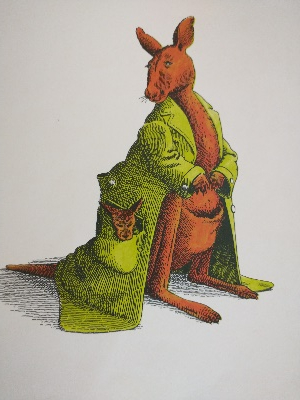
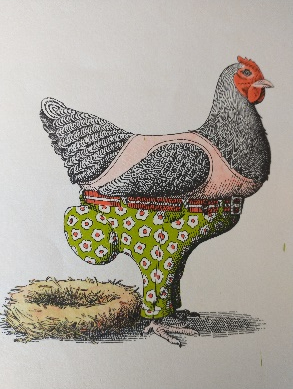
We began our lesson by watching a video reading of a children’s book entitled Animals Should Definitely Not Wear Clothing.  Here are my favorite illustrations from that book.

***Animals should definitely not wear clothing . . . . . . it would be disastrous for a porcupine, because a kangaroo would find it quite unnecessary, because opossums might wear it upside down by mistake, because it might make life hard for a hen.

. . .because it would be disastrous for a porcupine,

. . . because a kangaroo would find it quite unnecessary,

. . . because oppossums might wear it upside down,

. . . because it might make life hard for a hen.

We agreed the animals should not wear clothing because they just don’t need them.

We then moved on to a story entitled Fair is Fair. In this story a hare, a giraffe, and an elephant are friends in a zoo. One day they discover that the zookeeper gives them vastly differing amounts of food. They decide that’s not fair. So, they decide to take all their food put it together and divide it equally. Soon the hare is buried deep in rotting food, the giraffe is so fat she finds it hard to move around her enclosure, on the elephant is turning skinny and grumpy. The zookeeper makes this statement, “Fairness isn’t everyone getting the exact same thing. Fairness is everyone getting exactly what they need.”

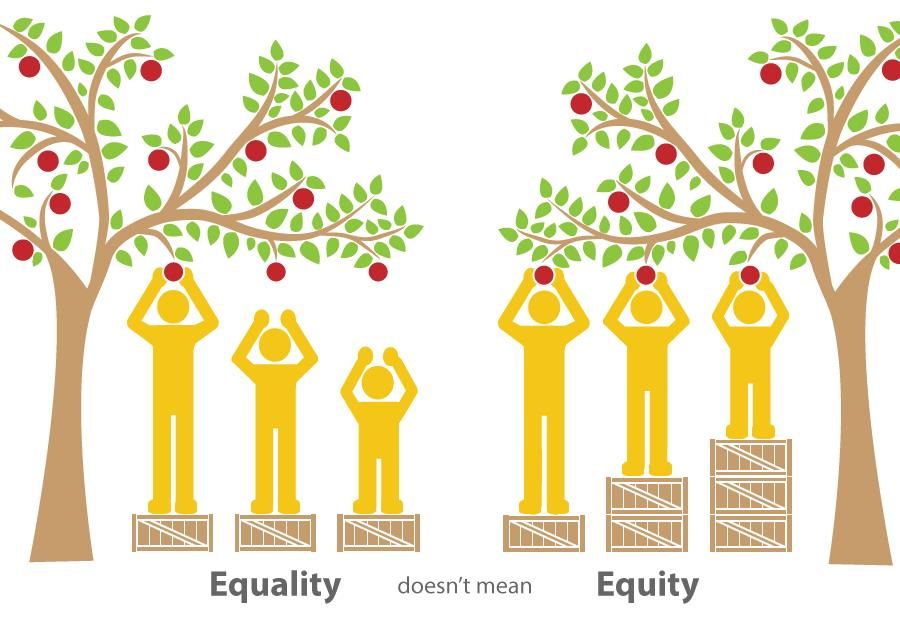
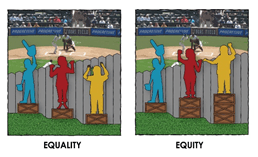
The next step in the lesson was to note the difference between equality, giving everyone the same thing, and equity, giving everyone what they need, using some familiar illustrations.

The first illustration shows people of differing heights. For each to be able to pick apples, the people need different sized boxes to stand on in order to reach them.

The second illustration shows people of the same height trying to watch a baseball game over a fence. This time the people are all the same size but the ground is uneven. We had a great conversation about all the different ways that life brings us uneven ground

We then watched the following video which extends the concepts to include sensitivity to differences and the idea of privilege.

*** www.youtube.com/watch?v=hRiWgx4sHGg

At this point in the lesson everything was going great, everyone was on track, we were moving right along. The younger kids were excused and we moved into a discussion about the parable of the vineyard owner and workers from Matthew Chapter 20. In this parable a vineyard owner goes early in the morning to hire workers. The early morning workers agree to work a full day for a fair day’s wage. He returns for more workers four more times during the day. The last group works for only an hour. At the end of the day the workers gathered to receive their pay. The workers hired last were paid first. They received a full day’s pay. Those workers that were hired first then expected to receive greater pay because they had worked longer hours. This was not to be. All the workers received the same day’s wage. The workers complained to the vineyard owner. ***The parable states.

“He replied to the one speaking for the rest, ‘Friend, I haven’t been unfair. We agreed on the wage, didn’t we? So take it and go. I decided to give to the one who came last the same as you. Can’t I do what I want with my own money? Are you going to get stingy because I am generous?’”

The great thing about parables is that they allow for a wide variety of interpretations and our interpretations reflect our worldviews. Our discussion of this parable certainly did that.  AND THEN I shared the following blog post on the parable. Before I share it with you, I would like to offer the disclaimer that I shared it because I thought it was interesting.  I was not necessarily advocating this point of view.  Here is what I shared from a blogpost entitled The Partially Examined Life:

Jesus’s political philosophy would fall between social democracy and communism. There’s a hint that exists about his (Jesus’) approach to equality and fairness. “You have made them equal to us” the first workers grumble (v. 12), which is ironic because the landowner has not actually treated them equally. In a society based on treating everyone strictly equally, workers would be paid an equal wage for their work, and this would only be equal if it was in proportion to how much work they had done. But that isn’t what happens in the parable. Likewise, an ideal of equality would require that the landowner be equally generous to all the workers, paying the first twelve times what he pays the last (assuming they worked for twelve hours). Hence, although there is an egalitarian thread running right through Jesus’ philosophy, it’s clear that with this parable he’s not calling for an economy where people are treated strictly equally.

“Luck eqalitarianism” is an approach to fairness that strives for equality of opportunity (rather than equality of outcome) by equalizing the effects of luck, on the rationale that distinctions of luck are arbitrary, having no moral import (Anderson, 154-5_. In the case of the prarble, this theory holds it fair that the last workers are paid the same as the first, because they were all trying to work for the day, it is just that the first were lucky enough to be hired earlier.”

Peter Hardy, partiallyexaminedlife.com

What followed sharing this blog was an impassioned discussion that led to one person becoming visibly upset, choosing to leave the meeting. Instead of walking carefully to avoid the disruption and discomfort of our political diversity, we chose to address it directly.  Our friend, Stephen, sent the following message: “Hey, good people, there’s an old saying that you should never discuss religion or politics in polite company. Since we ain’t about “polite company”, and we’ve already broken the religion rule, maybe we should dive into politics this Wednesday?”

We agreed and at our next time together discussed the following queries which were quite helpful:

What is one aspect of our political system that you find beneficial and helpful?

What is one thing you would like to see improved?

In what way do these preferences reflect your values?

Where is it important for you to have an influence on political decisions and why?

We had other good queries, but our sharing around these first ones motivated my thoughts for today. Several persons shared that their primary value was personal freedom. Freedom was definitely a theme in the discussion. I came away with the need to dig deeper into this topic.

I began by reviewing some of our nation’s historic documents.

***The Declaration of Independence states: We hold these truths to be self-evident, that all men are created equal, that they are endowed by their Creator with certain unalienable Rights, that among these are Life, Liberty, and the pursuit of Happiness.

***The Preamble to the Constitution of the United Sates uses the phrase “secure the blessings of liberty to ourselves and our posterity”.

***The first time we see the word “freedom” in the U.S. Constitution is in the Bill of Rights, or the first ten amendments to the Constitution.

The first amendment states, “Congress shall make no law respecting an establishment of religion or prohibiting the free exercise thereof; or abridging the freedom of speech, or of the press; or the right of the people peaceably to assemble, and to petition the Government for a redress of grievances.

***Abraham Lincoln in the Gettysburg address described our nation as “conceived in liberty and dedicated to the proposition that all men are created equal.” He ended his speech with the hope that, “this nation shall have a new birth of freedom and that government of the people, by the people, for the people shall not perish from the earth.”

Liberty and Freedom. Are they the same thing?

***The Oxford language dictionary defines liberty as the state of being free within society from oppressive restrictions imposed by authority on one’s way of life, behavior, or political views.

***The same dictionary defines freedom as the power or right to act, speak, or think as one wants without hindrance or restraint.

Professor Butler Shafer from Southwestern Law School who is known for writing libertarian books states,

“Freedom is the condition that exists within the mind. It’s the inner sense of integrity. It’s an inner sense of living without conflict, without contradiction, without various divisions and so forth. Liberty is a condition that arises from free people living together in society. Liberty is a social condition. Freedom is the inner philosophical and psychological condition.”

When wrestling with a subject, particularly one with ethical implications, I often turn to the Bible. It’s in my soul. So much of my upbringing was centered not so much on WWJD (What would Jesus do?) but WDTBS (What does the Bible say?) It was so clear way back then. Despite the complexities and ambiguities of faith in my life now, I still find the Bible a reliable reference point for ethical quandaries. So, I came with the question, ***“How might I think about personal freedom and civil liberties as one seeking to follow Christ?”

I found great guidance in the book of Galatians. I’m going to read the verses that seem to summarize how this book connects to the topic of equality, equity, fairness, and freedom. I’ll be reading mostly from chapter 5 without much commentary. Though the book of Galatians is addressing people compelling others to adhere to the mosaic law, I see parallels to our current deeply divided politics. I am reading from The Message version of the Bible.

I, Paul, and my companions in faith here, send greetings to the Galatian churches. …I greet you with the great words grace and peace! (Gal 1:1,3)

This section from chapter 3 summarizes the context of the book of Galatians.

 You crazy Galatians! Did someone put a hex on you? Have you taken leave of your senses? Something crazy has happened, for it’s obvious that you no longer have the crucified Jesus in clear focus in your lives. …Let me put this question to you: how did your new life begin? Was it by working your heads off to please God? Or was it by responding to God’s message to you? …

Answer this question: does the God who lavishly provides you with his own presence, his Holy Spirit, working things in your lives you could never do for yourselves, does he do these things because of your strenuous moral striving or because you trust him to do them in you?…

Until the time when we were mature enough to respond freely in faith to the living God, we were carefully surrounded and protected by the mosaic law. … But now you have arrived at your destination: by faith in Christ you are in direct relationship with God.

Paul is contrasting here a life of religious and moral obligation to a life of free-flowing union with and in the Spirit of God characterized by grace and peace. The next chapters elaborate on some of the characteristics of this life in the Spirit.

In Christ’s family there can be no division into Jew and non-Jew, slave and free, male and female, among us you are all equal. That is, we are all in a common relationship with Jesus Christ. (Gal. 3:28,29)

Christ has set us free to live a free life. So take your stand! (The NKJV translation says,” Standfast therefore in the liberty by which Christ has made us free.” Gal. 5:1)

For in Christ, neither our most conscientious religion nor disregard of religion amounts to anything. What matters is something far more interior: faith expressed in love. (Gal. 5:6)

It is absolutely clear that God has called you to a free life. Just make sure that you don’t use this freedom as an excuse to do whatever you want to do and destroy your freedom. Rather, use your freedom to serve one another in love; That’s how freedom grows. For everything we know about God’s word is summed up in a single sentence: love others as you love yourself. That’s an act of true freedom. If you bite and ravage each other, watch out – in no time at all you’ll be annihilating each other, and where will your precious freedom be then?                (Gal. 5:13-15)

My council is this: live freely, animated and motivated by God’s Spirit then you won’t feed the compulsions of selfishness. For there is a root of sinful self interest in us that is at odds with a free spirit, just as the free spirit is incompatible with selfishness. These two ways of life are antithetical, so that you cannot live at times one way and at times another way according to how you feel on any given day. Why don’t you choose to be led by the Spirit and so escape the erratic compulsions of a law dominated existence? (Gal. 5:16-18)

Since this is the kind of life we have chosen, the life of the Spirit, let us make sure that we do not just hold it as an idea in our heads or a sentiment in our hearts, but work out its implications in every detail of our lives. That means we will not compare ourselves with each other as if one of us were better and another were worse. We have far more interesting things to do with our lives. Each of us is an original. … Make a careful exploration of who you are and the work you have been given, and then sink yourself into that.  Don’t be impressed with yourself. Don’t compare yourself with others. Each of you must take responsibility for doing the creative best you can with your own life. (Gal. 5:25-6, 6:4-5)

The creative best I can do right now is to embrace the wonderful and annoying diversity that exists in my faith community and the world at large without judging the people that hold viewpoints that differ from my own as better or worse, worthy or unworthy. I can choose to view each person and viewpoint as valuable and necessary. I can hold the ideals of liberty and freedom as precious understanding that the most helpful exercise of each holds at its roots selfless love for my neighbor. ***In each political discussion and decision, I can lean into the Spirit’s guidance asking: How are equality and equity represented in this issue? How are a person’s needs being met in this moment or with this decision? (What’s fair here?) Is this an issue where personal freedom, civil liberties, and love of neighbor are out of balance? If so, what is needed to care for my neighbors?

Closing Queries:

What are the values that inform your political viewpoints  and guide your conversations around contentious issues?

How  do  you understand freedom in the context of your faith?

This message was delivered to Spokane Friends Church by Leann Williams on Sunday, June 13, 2021.

Posted in Sermons | Comments Off on Equality, Equity, Fairness and Freedom by Leann Williams

God So Loved the World . . . by Ruthie Tippin

I’m so glad to be with you again…

The very first thing I want to tell you today is that God loves you.  More than you can imagine, more than you would ever think possible – God loves you.  No matter how you name God in your life, or even if you don’t, I am here to tell you that the Divine, the Creator, Christ Jesus, the Spirit, God, loves you.  How can I say that?  How do I know this?  This I know from my experience of God about myself, about you, about all of life.  If you can’t believe that God loves you, I will hold it for you until you can.  And if you doubt it, you can always say, “I’m not sure that God loves me, but Ruthie is, and she told me so.  She’s holding on to that for me.”  And I will be.

‘God so loved the world that he gave his only begotten son that whosoever believeth in him should not perish but have everlasting life.  For God sent not his son into the world to condemn the world, but that the world through him might be saved.’  John 3:16-17

God so loved the world.  God so loves you.  God so loves me.  God loves us all so much.

When was Jesus in Jerusalem?  How many times?  The first time was when he was eight days old… Scripture tells us that “when it was time to circumcise the child, he was named Jesus, the name the angel had given him before he was conceived.  When the time came for the purification rites required by the Law of Moses, Joseph and Mary took him to Jerusalem to present him to the Lord (as it is written in the Law of the Lord, “Every firstborn male is to be consecrated to the Lord”. [Luke 2:21-22]

And for Passover?  Every year!  “Every year Jesus’ parents went to Jerusalem for the Festival of the Passover. When he was twelve years old, they went up to the festival, according to the custom.” [Luke 2:41-42]

This Sunday, as we gather in Meeting for Worship, I wonder what Jesus would have been thinking about so long ago on this very day.  Perhaps he would be anticipating Passover.  It starts at sunset this coming Saturday evening. 

God with us – Emmanuel – came to live among us many years ago, after centuries of speaking directly to and through us, doing God’s slow work of salvation through various people, *patriarchs, judges, kings, prophets, and then through the life and ministry of Jesus, whose name literally means ‘to save’.  When Hebrew people heard his name – as Mary heard it from Gabriel – it wasn’t ‘Jesus’ they heard, but ‘Yeshua’… like ‘Joshua’ to us, and it means ‘salvation’. 

Jesus loves us.  Jesus saves us. 

Jesus’ ministry was his second career.  He had grown up in Nazareth, working in the family business – his dad’s shop.  Like a lot of his friends, he would have learned his father’s trade and taken it over as his dad aged out, becoming the carpenter his father once was.  Joseph would have taught Jesus how to build very simple pieces – a shelf, a bench, a box, and steadily brought him more and more challenging work to do – first with him and then on his own.  We’re not told much at all about his life, but this young man didn’t strike out on his own until his early 30’s.  And then, it was to do something that had been lingering in his heart and mind since he was a young boy.  How do we know this?  Because Jesus ran away.

Well, lots of kids run away.  Our son Matt ran away at a shopping mall in Iowa City when he was three, and the clerks found him giggling under a round rack of clothes at JC Penney’s.  Jesus ‘ran away’ by staying put at the Temple, talking to the rabbis, while his parents went on their way home after Passover.  And what was it he said to his mother when Mary found him there?  “Wow mom – where else would I be?”  Remember – he wasn’t a little boy anymore – he was twelve, middle school age, and by then, pretty independent and probably figured his folks would know what he was up to.  Some kids like screen time, some hang out with their friends, some head to the ball field.  “Didn’t you know I’d be at the Temple?”  That must have been quite a trip back home.

When Jesus left home, he moved from the family business to his Father’s business – his second career.  Ministry – preaching, healing teaching.   His cousin, the Baptizer, blessed him.  God ordained him with the sign of the dove, and he began the torture and testing of seminary in the desert!  And then…

Jesus didn’t begin his ministry to teach us how to make real life stop.  Christ, the Rabbi, ministered among us to teach us how to live!  To transform our lives – to save our lives from indifference and to live in pursuit of purpose, with heart, soul, mind, and strength governed by love.  Lives filled with love – everlasting, never ending, always available, love.  This life is not an easy life to live, nor is it an easy life to choose, and Jesus knew it.  He preached it, taught it, and lived it out. 

Jesus had seen the example of this life as a little boy in Joseph’s carpenter shop.  An inert piece of wood became a table leg.  A table leg became a part of a table.  A table became a serving place.  A serving place became a gathering place.  A gathering place became a space for the exchange of ideas.  Ideas became action.  Action brought change.

That piece of wood, that table leg, had been carved, shaped, and fit for a purpose.  That table had been moved across many a room, perhaps many a mile.  That table had served many meals, many gatherings.  It had been pounded on, argued over, dreamed, and caressed over, spilled over.  Ideas had been drawn out on that table.  Plans had been made.  Decisions had been reached on that table.  That piece of wood did not stop being a piece of wood.  But by being transformed into something beyond only a piece of wood, it became something much more than one might expect.   

This is the power of a transformed life.  We don’t stop being who we are.  We become more than we had ever imagined.  Our lives are saved from indifference and instead, we are changed into people with purpose.  How does this happen?  Through the power of God in us.  The same power that was in Jesus, lives in us – is alive in us – and transforms us. 

This is the power of God in a twelve-year old boy, who twenty years later returned to Jerusalem for yet another Passover that meant his death.  Where was God in that?  A dead Jesus can’t save anyone.  Where was God’s power in that?    It was God who raised Jesus from the dead.  [Romans 10:9-10] Not Moses, Not Elijah, not his mother, or his disciples.  Not Mary Magdalene at the tomb.  It was God.  The power of God.  And that same power lives in us – is alive in us – and transforms us. 

This is what we believe as Friends… that the power of God, the Spirit of God, lives in us just as it did in Christ during his ministry so many years ago…  And, the same power of God that changed peoples lives then changes our lives now.  That message and power transforms us, and through the power of God in us, God changes the world. 

There are a lot of people, a lot of Christians who don’t believe this.  They think they must die in order to see God, and experience God.  That change will eventually come.  That their work now is to be saved – to become, as it were, the leg of a table – but they remain unattached, ready for the transformation of life with God only in heaven.  That is not the Quaker way of experiencing God! 

The experience of God is present and active in the life of Friends. God is with us now, loving us, lighting our way, empowering us, urging us on, in the living of our lives, both in inward devotion and in outward action. We believe and hope to live into our testimony as Friends that ‘every person is enlightened by the divine light of Christ.’  [Barclay’s Apology, 1676].  Not just the chosen, the perfect, the rich, the blessed, but everyone.  What was it Jesus said?  ‘The poor, the brokenhearted, the captives, the blind, the bruised….

Who are these people?  What is God asking us to do?  Do we wait until we see God in heaven to work out our salvation?  Or do we rise up, remembering that the power of God is within us – both as individuals and corporately.  Do we challenge ourselves to be what Jesus called the Kingdom of God at hand?  

Just imagine the power of God unleashed in our world today!  The power of love.  The power of life.  The power of life over death.  The power of transformation.  This was God’s intention, and I believe God meant it to happen through the power of God’s Spirit in us.

O Lord, thy kingdom come.  Thy will be done on earth, as it is in heaven.

This message was given by Ruthie Tippin to Spokane Friends via Zoom on Sunday, March 21, 2021.

References:  Cooper, The Gospel According to Friends, Friends United Press, Richmond, IN 1986

                      Morrison, The Way of the Cross, Pendle Hill Pamphlet #260, 1985

Posted in Messages | Comments Off on God So Loved the World . . . by Ruthie Tippin

A Cup of Cold Water — Bring What You Have by Tim Jackson

It is so great to be here and to see all of you. Our lives have been intertwined for many years and we are so blessed to be with you today.

Today marks the end of a year of meeting remotely as spiritual communities in North Carolina. I bet it is much the same for you as we all have had the pandemic woven into our lives for this year. It has been a challenge but also a door to ministry in new ways.

This morning I want to talk about a few reflections on this past year, but before we get there I would like to share this story. Don’t you find that stories are the stuff of our lives as we ply our way in this world? One of mine unfolded some years ago; in fact, it was 10 years ago now that I experienced a heart attack. That heart attack led to a six-way bypass which is, thankfully, still holding well today. Suffice it to say that I am a miracle of modern science and a miracle of God’s blessing as statistics show that one in three die from their initial cardiac event. I share this story because as I laid in bed after surgery I awakened to the medical staff removing the respirator from my airway. I remember how parched was the feeling in my throat. I had had nothing to drink for days. “Would you like a cold drink Mr. Jackson?”, the nurse asked. I nodded and she handed me a cup of ginger ale. Nothing had ever tasted so wonderful as being alive to that cold drink. The nurse, to this day I am sure, does not know how much that meant to me. It was metaphorically the cup of cold water of Matthew chapter 10. It brought an awareness of life and that I am still here and I am alive. I know and trust she is blessed and rewarded where ever she is, and of the one who savored that drink I can say I am blessed as well.

Looking again at the scripture Jonas read in Matthew 10:40-42:

40 “We are intimately linked in this harvest work. Anyone who accepts what you do, accepts me, the One who sent you. Anyone who accepts what I do accepts my Father, who sent me. 41 Accepting a messenger of God is as good as being God’s messenger. Accepting someone’s help is as good as giving someone help. This is a large work I’ve called you into, but don’t be overwhelmed by it. It’s best to start small. 42 Give a cool cup of water to someone who is thirsty, for instance. The smallest act of giving or receiving makes you a true apprentice. You won’t lose out on a thing.” [Message Bible]

Jesus says, “We are intimately linked in this harvest work;” and then goes on to say “This is a large work I’ve called you into, but don’t be overwhelmed by it. It is best to start small. Give a cool cup of water to someone who is thirsty, for instance. The smallest act of giving or receiving makes you a true apprentice. You won’t lose out.”

Today, I want to affirm the many acts of grace and blessing I am seeing all around us in this time of the coronavirus. Acts for which I know you are participants along with countless of our fellow travelers. To use the metaphor, cups of cold water are going out everywhere. You are bringing what you have and sharing it with folks in the Meeting and the wider community. I am reminded of those stories of how God uses what seems to be the smallest of things and multiplies them greatly. Like the boy with 5 loaves and 2 fishes there seems to be enough. Charmin is abounding where needed. Here are a few things I know you have been doing:l

You are still wearing masks to honor and keep safe your fellow human beings.

You are staying 6 feet apart when being out.

You have been sharing recipes to use the food we have.

You know a friend is alone so you call or write or both.

You are alone but then you hear from a friend.

You are sharing links to Zoom services with the wider community and far-flung friends who want to be in your lives.

We miss being together but know we are expressing our love by distancing for this time.

Take just a minute. What else would you add to this list of gifts of cold water – either giving or receiving?

I would add to the list the gift of prayer. Luke 18:1 says that we ought always to pray and not lose heart. As I said, we have been experiencing this time of the virus for at least a year and I sense some of us are growing weary and wondering when the heck with all this be over. As far as I can see no one knows exactly when that will be, but we know that vaccines are on the way, and the time of full in-person gathering is drawing nearer and nearer. So as a first resort, pray.

The Apostle Paul says: Let us not become weary in doing good, for at the proper time we will reap a harvest if we do not give up. So, for all who are growing weary, we hear you, and will continue to encourage you as we make our way. We ask you to encourage us as well.,

Speaking of hearing, I encourage all of us to be the best listeners we can be. If we are heard, we know we are someone of value. This is something we need at all times and especially now.

I asked around in our community about this question. What are we learning from this pandemic time?

Here are some of the answers I got:

The value of relationships. Even if we are not together we find strength in our family, our Meeting, our community.

Essential workers are heroes.

Being alone is boring and hard but sometimes required. Learn to be content with quiet.

Don’t lose your sense of humor.

For example, recently a restaurant in South Carolina opened its doors but with inflatable dolls seated at half the chairs to create a warmer environment while still ensuring patrons sit at least 6 feet apart. A national publication had a contest to ask what would be an appropriate name for the new socially distanced restaurant chain that fills its chairs with inflatable dolls?

The Winner was:                   “IPOP”

Second Place went to:          “Chick-fil-Air”

And my favorite:        

Third Place went to:              “Dollive Garden”

A sense humor is essential in this time.

I close with two queries to take into open worship: What are you learning in this time? How is God speaking to you in this time?

Thank you to all of you for bringing your cup of cold water. Let us pray.

O, Lord, in this time of pandemic be with us. Thank you that we are not alone and thank you that nothing can separate us from Your love. Amen.

This message was given to Spokane Friends by Tim Jackson via Zoom on March 7, 2021.

Posted in Messages | Comments Off on A Cup of Cold Water — Bring What You Have by Tim Jackson

Listen to Jesus by Nick Block

Along with being Valentines Day, according to the Narrative Lectionary, today is Transfiguration Sunday. It’s the day when we commemorate Jesus inviting three of his disciples to go away with him for a time of prayer. When I was approached about being with you today, it was near the end of the four week long season of Advent. In recent decades Friends have paid little attention to the historic and quite intentional Quaker disdain for the keeping of the seasons. Most of us have found it convenient to allow the lectionary to move us through the Christian year. And like most Christians, as we decorate for Christmas, we include lighting colored candles during Advent. Like the majority of the church the season of Advent has become the season of pre-Christmas. We put up Christmas lights, do our Christmas shopping and decorate our Christmas trees. We act like Christmas starts at midnight on Christmas Eve and by sundown Christmas day we are ready to take down the tree. But according to the perspective of orthodox liturgy, the season of Chistmastide has just begun and and it continues until February 2nd, Ground Hog Day, not a universally acknowledged religious holiday.By the time Punxsutwney Phil is pulled from his lair, we’ve long since taken down all the Christmas decorations we put up during the season of Advent.

Traditionally Advent is not about the birth of a child in a manger. Its purpose is to reinforce the belief that it is Jesus’ intention when he returns to slam the door on the current period of human history. The time when Jesus will return has been given many names: the Second Coming of Christ; the Day of the Lord, the end time and the Parousia. Friends embrace a scriptural understanding of Christ’s return that is quite distinct from the orthodox perspective embedded in the Advent focus. That accounts for why Quakers, early on, refused to follow the liturgical calendar.

In the first chapter of Acts: starting with the fourth verse the text reads: And being assembled together with them, He commanded them not to depart from Jerusalem, but to wait for the Promise of the Father. “which” He said “you have heard from Me; for John truly baptized with water, but you shall be baptized with the Holy Spirit not many days from now.” Therefore, when they had come together, they asked Him, saying “Lord, will You at this time restore the kingdom to Israel?”And He said to them, “It is not for you to know times or seasons which the Father has put in His own authority. But you shall receive power when the Holy Spirit comes upon you; and you shall be witnesses to Me in Jerusalem, in the all Judea and Samaria, and to the end of the earth.

After two-thousand-plus years since the writing of the Book of Acts, the majority of the Christian community continue to live in anticipation of a future return of Christ. Friends have held to a simpler understanding. When Jesus told his disciples that they should stay in Jerusalem because he would return soon, that is exactly what he did. For Friends Christ’s spirit returned at Pentecost, as promised, and that Spirit continues to inspire today.

This was the heart of the Gospel for George Fox and early Friends. Underlying Fox’s message of good news was the firm understanding that ‘Christ has come to teach his people himself.’ No intermediator, like a priest or teacher, nor the institutional church was needed to communicate what Christ had to share with his people. Of course in the 17th century this got early Friends in trouble with churchmen of all stripes. This is the core of Quaker faith, that Christ can and does speak directly to us. Quakers have held that we need not live fearing some other shoe to fall on creation. The second coming occurred two thousand years ago and we can live in that life and power today.

I can’t stress this enough. When the Holy Spirit was given it was given to the community of faith not to individuals. With the communitarian nature of the community of the faithful it is essential that we share our leadings with one another and feel the responsibility of giving each other feed back to clarify or challenge the leading one may have.

As I said before, according to the Narrative Lectionary this Sunday is the commemoration of Jesus’ Transfiguration. We find it reported in all three of the Synoptic Gospels, Matthew 17:1-8; Mark 9:2-9; Luke 8:28-36; and referred to in II Peter 1:16-18. The simplest report is that in the Gospel of Mark.

After six days Jesus took Peter, James and John with him and led them up a high mountain, where they were all alone. There he was transfigured before them. His clothes became dazzling white, whiter than anyone in the world could bleach them. And there appeared before them Elijah and Moses, who were talking with Jesus. Peter said to Jesus. “Rabbi, it is good for us to be here. Let us put up three shelters—one for you, one for Moses and one for Elijah.” He did not know what to say, they were so frightened. Then a cloud appeared and covered them, and a voice came from the cloud: “This is my Son, whom I love. Listen to him!”

According to the record provided to us by the evangelists Jesus had been extraordinarily busy, doing one healing after another, the last, the raising of a young woman thought dead brought back to service. Despite the miraculous, there was also his human need for rest and restoration. We have stories of Jesus going off, alone, to pray. But not this time. This time he conscripts Peter, James and John to go apart with him.

Jesus’ intent was clear, this was to be a prayer meeting. A meeting for worship.

Evidently in that meeting their heads weren’t bowed and their eyes weren’t closed because they reported what took place. It most certainly would have been awe-inspiring to be in Jesus’ presence while he was praying. But beyond that these disciples saw Jesus in the company of two extraordinary spiritual leaders, a visitation by the two most celebrated persons of their faith, Moses and Elijah.

Hebrews 12 speaks of our being “surrounded by such a great cloud of witnesses…”  I have to wonder when we gather for worship whether we have that sense of being in the company of extraordinary spiritual guides? That small Meeting for worship became enveloped in a cloud. Is that anything you’ve experienced before? The sense of having a cloud descend and settle on the group; closing in around you, shortening your horizons like a dense fog. Some Quakers have described meetings for worship that feel like that as having been ‘gathered’.

Words failed the disciples. In both the Gospels of Mark and Luke the evangelists admit they didn’t know what to say, and when they did speak they suggested that three shelters be built; one for Jesus and one for each for the two spiritual visitors. The idea was turned down. What happened next in that gathered meeting is important “A voice came from the cloud, saying, “This is my Son, whom I have chosen; listen to him.” This is the essence of worship. Not a sermon or a liturgy, not an anthem or a praise chorus. “This is my Son, listen to him”.

Christopher Robin speaks with Pooh Bear. He says “Say, Pooh. Why aren’t you busy?” Pooh replies “Because it’s a nice day” Christropher started to say, “Yes but…” and Pooh interrupts him saying, “Why ruin it? “But” Christopher Robin says “you could be doing something important”. “I am” said Pooh. “Oh? Doing what? To which Pooh replied “Listening.”


I once heard Howard Thurman say that “it is out of silence that all sounds come”. Soren Kierkegaard wrote: “If I were a doctor and were asked for my advice, I would reply: “Create silence! The Word of God cannot be heard in the noisy world of today.”

That’s a lesson Jesus’ disciples learned on their trip up the mountain. When we come to worship, it’s tempting to build structures and follow patterns that memorialize the past, and unfortunately it is as real a problem for Quakers as it is for others. The challenge is to follow the words of the Gospels, “This is my Son, whom I have chosen, listen to him”

David Steindl-Rast wrote what for me is a blessing and a benediction:

May you grow still enough to hear the small noises earth makes in preparing for the long sleep of winter, so that you yourself may grow calm and grounded deep within.

May you grow still enough to hear the trickling of water seeping into the ground, so that your soul may be softened and healed and guided in its flow.

May you grow still enough to hear the splintering of starlight in the winter sky and the roar of the earth’s firey core.

May you grow still enough to hear the stir of a single snowflake in the air, so that your inner silence may turn into hushed expectation.

This message was given to Spokane Friends Meeting via Zoom by Nick Block on 14 February 2021. During that service we also sang the song below:

 Teach Me to Stop and Listen

Teach me to stop and listen, teach me to center down,

Teach me the use of silence, teach me where peace is found.

Teach me to hear your calling, teach me to search your word,

Teach me to hear in silence things I have never heard.

Teach me to be collected, teach me to be in tune.

Teach me to be directed, Silence will end so soon.

Then when it’s time for moving. grant that I may bring,

To every day and moment, Peace from a silent spring.

Posted in Messages | Comments Off on Listen to Jesus by Nick Block

Resurrection, Reconciliation and Revolution by Helen Park

Good morning.  My topic today is Resurrection, Reconciliation and Revolution. WHAT? You may be wondering what those three things have in common. That’s easy, they all start with “re” a Latin word root meaning “again.” Things happen again and again. To my mind, resurrection, reconciliation and revolution are all things that are repeated: we rise again, we forgive again, and we turn in great circles, again and again.  

Resurrection. The word implies death. Christ had to die in order to be resurrected. Death is necessary. We know every physical body dies, but haven’t we all experienced the smaller deaths that leave us shattered and crushed? How do we rise from those?     The meaning of Christ’s Resurrection has been discussed and debated over the centuries, but right now, let’s think about YOUR resurrection, and mine.  It’s the dark night of the soul: cold, desolate, we are lonely, we fear going mad. We throw our prayers out into a silent Universe, hoping Someone will hear them. But we’re not sure there IS anyone who hears these imploring, raging, grieving thoughts that hammer our hearts. The darkness is crushing. We feel so alone. The struggle, the fear, the surrender, and finally the death, those quiet endings that break our hearts again and again in life. We are forced at last to give up whatever it is that we don’t want to let go of: the relationship, the dream of success, the health and abilities of our youth, the treasured beliefs, the addiction, the hopes. We say goodbye to them and they die at last, and we go into that dark night.

What is left when a cherished part of us has died? We realize that we are helpless, and there’s nothing left we can do, what happens then? It is by grace, by the infinite Love of God that sees us when we can see only nothingness, that we finally perceive the Light has been there all along. The gleam of light may be subtle at first. It only happens when we stop fighting the darkness. That Light in the darkness is the Resurrection. It is the Christ re-enacting His most powerful miracle within us. It is God is reborn in our souls. Here is a poem that speaks of this rebirth.

Love Lens

Being born and dying are the same experience

      On either side of a blink.

There are so many births and rebirths

        Like waking up and not knowing where you are

                   Or really, where you have been.

There are so many little dyings

        Like sorrow, sinking into acceptance,

                 A sigh, a nod, and release.

If there is anything, like a magic glass,

               To bring into focus what is happening,

                          It is Love.

Love is Mother at birth.

         It is the Heavenly Father at Death.

Only Love can soften our fears

            Of what we don’t understand.

            Not explaining, only soothing.

It is Love that brings that smile of peace

             Peace, eternal joy, if only for a moment.

Being born, and dying,

             They are the same experience:

             A blink in the vision of Love.

by Helen Park, 1978

This spiritual resurrection may feel different for each person, maybe it’s a wave of comfort, or the words of a song or a prayer that just appear in our minds, or an image, a silent reassurance, or a feeling of relaxing, of being held. Then we know that we are not alone, and there is a Light, there is life. We are reborn, but we are changed.  We don’t fit the old life anymore. We have to face the new reality without that part of the old self that we let go of. And we undoubtedly have work to do.

What does God want us to do? That’s the big question. We read in the 6th chapter of Micah: 6With what shall I come before the LORD and bow down before the exalted God? Shall I come before him with burnt offerings, with calves a year old? 7Will the LORD be pleased with thousands of rams, with ten thousand rivers of olive oil? Shall I offer my firstborn for my transgression, the fruit of my body for the sin of my soul? 8He has shown you, O mortal, what is good. And what does the LORD require of you? To act justly and to love mercy and to walk humbly with your God

God does not tell us WHAT to do, God just tells us HOW to do it: with justice, mercy and humility, we act, love and walk with God over the Earth. This is exactly the required skill set for reconciliation! Whatever our work, our identity, our culture or our situation, we are all called to the challenge of Reconciliation. It means forgiving each other and ourselves, making things right between us again, and experiencing the peace that passeth understanding.

In Africa, Latin America and Europe there are wonderful models of society-wide Truth and Reconciliation projects. And how important that first part is: Truth! Just as resurrection requires death, reconciliation requires hearing the truth with new ears. We have to have courage to hear the truth. The truth is, there IS injustice in the world, in our country, in our own lives. We have all acted selfishly, we have all taken more than our share, we have all lied about it and tried to justify it. We all have amends to make. If we won’t face the truth about the injustice around us, we can’t ever reconcile with our neighbors, let alone love them as we love our selves.

In Quaker circles, we will often say, “I’ll hold you in the Light.” It’s our way of saying “I’ll pray for you. I’ll ask God to give you comfort and healing.” But early Friends had a different interpretation. They understood that the Light revealed everything: every weakness, every sin, every fear and every anger. You can’t hide anything in the Light of God. Your soul is bared and you are known intimately. There’s a sign in the parking lot of University Friends Meeting in Seattle that’s reads: “Handicapped Parking Only. Violators will be held in the Light.” How true it is.

And once we have done that excruciating work, we have to forgive ourselves, and we have to forgive everyone else who has been unjust, who has treated us badly, who has mocked, humiliated or despised us in our lifetime. We have to forgive as completely as a loving parent forgives the beloved child, just as God forgives us. Indeed that is how we are forgiven. We pray every day: “Forgive us our trespasses AS WE FORGIVE those who trespass against us.” Forgive us as we forgive, they both have to happen. How can we be forgiven if we are carrying around the hurt and anger and fear of our brothers and sisters? Those unresolved, unacknowledged grievances are exactly the thing that makes us behave badly, and then we are ashamed and want to hide. But forgiveness, a powerful form of unconditional love, releases us. We see each other with new eyes. Now we are really not alone. Just as resurrection reestablishes our relationship to God and the Life of the Spirit, reconciliation reestablishes our relationship to our sisters and brothers, and all hatred and fear dissolve in love and mercy.  And it has to happen again and again. Once is not enough, seven times is not enough, seven times seven times is not enough. God is constantly forgiving us, as we forgive those who trespass against us and all around us.

Now we are ready for Revolution!  Just as we need a new relationship with God, and with our fellow human beings, it is time for a new relationship with the world. Revolution means “Again turning.” The Earth makes a revolution around the Sun in 365 days. Human consciousness makes revolutions more slowly than that, but we come around to it. Things have to change: the Earth is changing, and we are part of that. It is time to wake up! All over the world climate is changing. Land forms are changing. The ocean is changing. The very chemistry of the air is changing. The microbes in our bodies are changing. Suddenly we are recognizing that we are as vulnerable as glaciers and salamanders and honeybees. A revolution is a coming around to way of thinking that may be new to some of us, but that is very old in traditional societies.

Native peoples in cultures all over the Earth have known these truths: We are all connected, the Earth, the plants, forests, the animals, the waters of the rivers, oceans and skies, all of it, connected to us. To our beating hearts. To our vibrating souls. To our very existence. One web of Life.

This is the next revolution of human consciousness: the re-turning to an awareness of that intricate, indissoluble connection.  We cannot drop a piece of plastic on the ground that won’t affect myriad life-forms that reverberate in our own life, in the life of our children, in the precious beautiful world that is our home. We can and do expand our great Love, the Love of God, to ourselves, to our brothers and sisters, and to every part of Creation.

This is the next revolution of human consciousness: the re-turning to an awareness of that intricate, indissoluble connection.  We cannot drop a piece of plastic on the ground that won’t affect myriad life-forms that reverberate in our own life, in the life of our children, in the precious beautiful world that is our home. We can and do expand our great Love, the Love of God, to ourselves, to our brothers and sisters, and to every part of Creation.

And we are not alone. We are all together in this. God is right here with us, in every thought, every breath, every heartbeat, with you right now. With me. I will close with this final poem, then let us settle into silence and listen.

This spiritual resurrection may feel different for each person, maybe it’s a wave of comfort, or the words of a song or a prayer that just appear in our minds, or an image, a silent reassurance, or a feeling of relaxing, of being held. Then we know that we are not alone, and there is a Light, there is life. We are reborn, but we are changed.  We don’t fit the old life anymore. We have to face the new reality without that part of the old self that we let go of. And we undoubtedly have work to do.

What does God want us to do? That’s the big question. We read in the 6th chapter of Micah:

6With what shall I come before the LORD and bow down before the exalted God? Shall I come before him with burnt offerings, with calves a year old? 7Will the LORD be pleased with thousands of rams, with ten thousand rivers of olive oil? Shall I offer my firstborn for my transgression, the fruit of my body for the sin of my soul? 8He has shown you, O mortal, what is good. And what does the LORD require of you? To act justly and to love mercy and to walk humbly with your God

God does not tell us WHAT to do, God just tells us HOW to do it: with justice, mercy and humility, we act, love and walk with God over the Earth. This is exactly the required skill set for reconciliation! Whatever our work, our identity, our culture or our situation, we are all called to the challenge of Reconciliation. It means forgiving each other and ourselves, making things right between us again, and experiencing the peace that passeth understanding.

In Africa, Latin America and Europe there are wonderful models of society-wide Truth and Reconciliation projects. And how important that first part is: Truth! Just as resurrection requires death, reconciliation requires hearing the truth with new ears. We have to have courage to hear the truth. The truth is, there IS injustice in the world, in our country, in our own lives. We have all acted selfishly, we have all taken more than our share, we have all lied about it and tried to justify it. We all have amends to make. If we won’t face the truth about the injustice around us, we can’t ever reconcile with our neighbors, let alone love them as we love our selves.

In Quaker circles, we will often say, “I’ll hold you in the Light.” It’s our way of saying “I’ll pray for you. I’ll ask God to give you comfort and healing.” But early Friends had a different interpretation. They understood that the Light revealed everything: every weakness, every sin, every fear and every anger. You can’t hide anything in the Light of God. Your soul is bared and you are known intimately. There’s a sign in the parking lot of University Friends Meeting in Seattle that’s reads: “Handicapped Parking Only. Violators will be held in the Light.” How true it is.

And once we have done that excruciating work, we have to forgive ourselves, and we have to forgive everyone else who has been unjust, who has treated us badly, who has mocked, humiliated or despised us in our lifetime. We have to forgive as completely as a loving parent forgives the beloved child, just as God forgives us. Indeed that is how we are forgiven. We pray every day: “Forgive us our trespasses AS WE FORGIVE those who trespass against us.” Forgive us as we forgive, they both have to happen. How can we be forgiven if we are carrying around the hurt and anger and fear of our brothers and sisters? Those unresolved, unacknowledged grievances are exactly the thing that makes us behave badly, and then we are ashamed and want to hide. But forgiveness, a powerful form of unconditional love, releases us. We see each other with new eyes. Now we are really not alone. Just as resurrection reestablishes our relationship to God and the Life of the Spirit, reconciliation reestablishes our relationship to our sisters and brothers, and all hatred and fear dissolve in love and mercy.  And it has to happen again and again. Once is not enough, seven times is not enough, seven times seven times is not enough. God is constantly forgiving us, as we forgive those who trespass against us and all around us.

Now we are ready for Revolution!  Just as we need a new relationship with God, and with our fellow human beings, it is time for a new relationship with the world. Revolution means “Again turning.” The Earth makes a revolution around the Sun in 365 days. Human consciousness makes revolutions more slowly than that, but we come around to it. Things have to change: the Earth is changing, and we are part of that. It is time to wake up! All over the world climate is changing. Land forms are changing. The ocean is changing. The very chemistry of the air is changing. The microbes in our bodies are changing. Suddenly we are recognizing that we are as vulnerable as glaciers and salamanders and honeybees. A revolution is a coming around to way of thinking that may be new to some of us, but that is very old in traditional societies.

Native peoples in cultures all over the Earth have known these truths: We are all connected, the Earth, the plants, forests, the animals, the waters of the rivers, oceans and skies, all of it, connected to us. To our beating hearts. To our vibrating souls. To our very existence. One web of Life.

This is the next revolution of human consciousness: the re-turning to an awareness of that intricate, indissoluble connection.  We cannot drop a piece of plastic on the ground that won’t affect myriad life-forms that reverberate in our own life, in the life of our children, in the precious beautiful world that is our home. We can and do expand our great Love, the Love of God, to ourselves, to our brothers and sisters, and to every part of Creation.

And we are not alone. We are all together in this. God is right here with us, in every thought, every breath, every heartbeat, with you right now. With me. I will close with this final poem, then let us settle into silence and listen.

There is One

By Helen Park, 1985

There are so many births and rebirthsThere is One

who is speaking to thy condition,

Now. One who is with thee.

If you would move mountains,

be empowered with your rightful power,

There is One who is inspiring you.

However you stand in relation to the world

is irrelevant.

If you would let go of suffering,

and fear,

and all doubt,

There is one who would touch your eyes

that you may see,

Who would unstop your ears

that you may hear.

If you would be an instrument of peace

there is one who would play you like a violin

filling the atmosphere with the music of peace.

If you would find peace,

and live in peace,

There is One

who is speaking to thy condition.

This message was given by Helen Park to Spokane Friends Meeting (via Zoom) during Sunday morning worship service on December 13, 2020.
Posted in Messages, Sermons | Comments Off on Resurrection, Reconciliation and Revolution by Helen Park

How Will We Treat Each Other Now? by Jon Maroni

Good morning friends, I am excited to be back in the meetinghouse for the first time in many months for me. Hello and greetings to everyone who is in person here today, and thank you for what you all do to make this meeting possible.

I also want to say hello to our virtual friends, I am normally among you and I am stealing that idea of virtual friends, which one of my MBA professors used to describe students who were taking the class online and I loved that title of virtual friends. So greetings to our virtual friends as well.

On behalf of my family, which now includes our daughter Mila Rose, thank you for your prayerful support during our time as new parents. Some of you know that Krista and I have been on the adoption journey for several years. You have journeyed with us as we became foster parents, cared for the twins, Kylie, and then waited for 18 months to finally have Mila come into our world. It has been hard, stressful, full of heartaches and joys but so worth it. Mila has successfully had her cleft lip repaired which you can see on the screen, and she’ll have her cleft palate repaired when she is about 1 year old. 2020 has been full of hard stuff, but Mila has been a constant source of light for us.

I want to re-read the scripture that is central to my sermon today. Ephesians 4:32. “Be Kind and Compassionate to one another, forgiving each other just as in Christ God forgave you.”

I’ll be honest I didn’t know the actual definition of compassion until I looked it up in preparation for this sermon. It means “a feeling of deep sympathy and sorrow for another who is stricken by misfortune, accompanied by a strong desire to alleviate the suffering.” I want us to hold that definition in our minds as we talk about this today. I am going to challenge each of us to treat the people in our lives who frustrate us most with compassion. To understand that each of us suffers in our own way, and I think that Christ is calling us to exercise compassion with those around us.

Yesterday was a historic day in many ways; it looks like we will have a presidential transition. We will likely soon have our first female vice president, our first female African-American Vice President and our first female Asian-American Vice President. As the father of a Latina daughter, I am hopeful that these next four years will provide her with a sense of opportunity, that she can rise to any office or position that she feels called to fill.

However, what this election season truly revealed is that we are a deeply divided nation, even more so than anyone expected. For many people this weekend was not one that they celebrate but rather one causing stress and trepidation about what the future may hold for them. Whether we can imagine that for ourselves, that is what some people are experiencing.

I’ll admit that it is difficult for me to exercise compassion on a consistent basis. I certainly did not at this time four years ago and if the election had not gone how I hoped it would, I think I would have struggled to exercise compassion now. In fact as I have reflected on this election season, it has revealed a distinct lack of compassion within myself.

Krista helped me come up with a query that is appropriate for this time:  “What have I learned about myself during this election season? How have I exercised compassion to those with whom I disagree? Am I more pleasant to be around because my candidate was the victor? Why?”

As I reflected on who is the ultimate example of compassion, I wanted to highlight someone who offered compassion to someone who had personally harmed them in profound ways, and who still offered that compassion to them. The story of Corrie Ten Boom is one of the most powerful living examples of this type of forgiveness and compassion.

Corrie Ten Boom was a Dutch woman whose family risked everything to assist Jewish refugees escaping from the onslaught of racism coming from Nazi Germany. She was trained as a watch maker, her family ran a legitimate watch making and repair business, and their home served as a safe house for Jewish families seeking safety and asylum. In Corrie’s bedroom there was a secret room built behind a false wall, essentially the size of a large wardrobe, in which six people could stand huddled and hide during Gestapo searches of the home. It was called the hiding place and eventually became the title of her memoir. If you haven’t read it you absolutely must, her’s is an incredible story. In February of 1944 Corrie and her family were betrayed by a fellow Dutch citizen who informed on them to the Gestapo. Corrie and her sister were sent to Ravensbruck concentration camp; her sister perished but Corrie survived.

In 1947 Corrie found herself preaching at a church in Munich, Germany, and at the close of the service, a balding man in a gray overcoat stepped forward to greet her. Corrie froze. She knew this man well; he’d been one of the most vicious guards at Ravensbrück, one who had mocked the women prisoners as they showered. She wrote:

“It came back with a rush, — the huge room with its harsh overhead lights; the pathetic pile of dresses and shoes in the center of the floor; the shame of walking naked past this man.”

And now he was pushing his hand out to shake hers, and saying: “A fine message,  Fraulein! How good it is to know that, as you say, all our sins are at the bottom of the sea!”

And I, who had spoken so glibly of forgiveness, fumbled in my pocketbook rather than take that hand. He would not remember me, of course — how could he remember one prisoner among those thousands of women?

But I remembered him and the leather crop swinging from his belt. I was face to face with one of my captors, and my blood seemed to freeze.

“You mentioned Ravensbrück in your talk,” he was saying. “I was a guard there… But since that time,” he went on, “I have become a Christian. I know that God has forgiven me for the cruel things I did there, but I would like to hear it from your lips as well. Fraulein” — again the hand came out —“will you forgive me?”

And I stood there — I whose sins had again and again to be forgiven — and could not forgive. Betsie had died in that place — could he erase her slow terrible death simply for the asking?

The soldier stood there expectantly, waiting for Corrie to shake his hand. She “wrestled with the most difficult thing I had ever had to do. For I had to do it — I knew that. The message that God forgives has a prior condition: that we forgive those who have injured us.”

Standing there before the former S.S. man, Corrie remembered that forgiveness is an act of the will — not an emotion. “Jesus, help me!” I prayed. “I can lift my hand. I can do that much. You supply the feeling.”

And as I did, an incredible thing took place. The current started in my shoulder, raced down my arm, sprang into our joined hands. And then this healing warmth seemed to flood my whole being, bringing tears to my eyes.

“I forgive you, brother!” I cried. “With all my heart.”

For a long moment we grasped each other’s hands, the former guard and the former prisoner. I had never known God’s love so intensely as I did then. But even so, I realized it was not my love. I had tried, and did not have the power. It was the power of the Holy Spirit.

Was there anything super human about Corrie? No, and while I can’t speak for any of the rest of us, I personally have never experienced any wrong at any level of magnitude compared to what Corrie suffered. Yet despite this she chose to act with compassion and treat this man well. I am challenged by this story.

Which leads me to how this applies to us:  We would be well served to follow Corrie’s example, especially in this post-election season — regardless of political party, affiliation etc. We can always make a different choice.

To wrap up, I would like to share some ideas on how to handle hard conversations. This comes from Valencia College:

1.Create a hospitable and accountable community. We all arrive in isolation and need the generosity of friendly welcomes.

2. Listen deeply. Listen intently to what is said; listen to the feelings beneath the words. Strive to achieve a balance between listening and reflecting, speaking and acting.

3. Create an advice-free zone. Replace advice with curiosity as we work together for peace and justice. Each of us is here to discover our own truths. We are not here to set someone else straight, to “fix” what we perceive as broken in another member of the group.

4. Practice asking honest and open questions. A great question is ambiguous, personal and provokes anxiety.

5. Give space for unpopular answers. Answer questions honestly even if the answer seems unpopular. Be present to listen, not debate, correct or interpret.

6. Respect silence. Silence is a rare gift in our busy world. After someone has spoken, take time to reflect without immediately filling the space with words. This applies to the speaker, as well – be comfortable leaving your words to resound in the silence, without refining or elaborating on what you have said.

7. Suspend judgment. Set aside your judgments. By creating a space between judgments and reactions, we can listen to the other, and to ourselves, more fully.

8. Identify assumptions. Our assumptions are usually invisible to us, yet they undergird our worldview. By identifying our assumptions, we can then set them aside and open our viewpoints to greater possibilities.

9. Speak your truth. You are invited to say what is in your heart, trusting that your voice will be heard and your contribution respected. Own your truth by remembering to speak only for yourself. Using the first person “I” rather than “you” or “everyone” clearly communicates the personal nature of your expression.

10. When things get difficult, turn to wonder. If you find yourself disagreeing with another, becoming judgmental, or shutting down in defense, try turning to wonder: “I wonder what brought her to this place?” “I wonder what my reaction teaches me?” “I wonder what he’s feeling right now?”

11. Practice slowing down. Simply the speed of modern life can cause violent damage to the soul. By intentionally practicing slowing down, we strengthen our ability to extend nonviolence to others—and to ourselves.

12. All voices have value. Hold these moments when a person speaks as precious, because these are the moments when a person is willing to stand for something, trust the group and offer something they see as valuable.

13. Maintain confidentiality. Create a safe space by respecting the confidential nature and content of discussions held in the group. Allow what is said in the group to remain there. Do not post about face-to-face conversations online.

My simple exhortation to us this morning is to be compassionate to one another, and especially to those who test the limits of our compassion. This election season will reveal who we really are, and as friends of Jesus let’s reflect his example.

This message from Jon Maroni was begun on Nov. 8 during Sunday worship at Spokane Friends, but was interruped by a wide-spread service outage by Comcast. So Jon was asked to repeat his message on Nov. 15, so that Zoom attenders could hear it in its entirety.

Posted in Messages | Comments Off on How Will We Treat Each Other Now? by Jon Maroni

Nuturing Hope by Leann Williams

There have been a few times in my life within the last two decades that I have pursued a study on the topic of hope. The first study came out of a time of conflict. I was deeply troubled and reading scripture for guidance and comfort. I stumbled on Romans 5 where I read that we can glory or rejoice in tribulation or sufferings because they produce patience or perseverance which in turn produces proven character and character produces hope.  And the hope produced is the kind that does not disappoint because God’s love gets poured into our hearts in the process. Getting from trouble and trials to hope. That is a message we need today.

We come to worship on this Sunday before our national election in the context of hope and fear. Our current political and cultural environment is and has been more contentious than any in most of our memories. This presidential election cycle seems to have brought about attitudes and behaviors that serve to deepen the divide among us on many issues. Whatever the outcome of the election there will be rejoicing for some and lamenting for others. Oh, yes, there is the Coronavirus pandemic too. Fear abounds. It’s hard to find hope today.

I have been considering how we can nurture a hope that does not disappoint in times like these. I’m not alone. I’ve read a book, listened to sermons and read many articles blogs from widely differing perspectives on the topic of nurturing hope. Some have had helpful suggestions. Most work with a definition of hope that is less than satisfying to me.

Here are several definitions of hope I’ve found:

From the great scholar Google: A feeling of expectation and desire for a certain thing to happen.

Most of us hope that the election will have a certain outcome. For slightly less than half of us, our hope WILL disappoint us. So, that definition is not about a sustaining hope.

From the Center for Loss and Life Transition: Hope is an expectation of a good that is yet to be…It is forward looking yet experienced in the now.

Miriam Webster states: before the 12 century the meaning of hope was trust or reliance.

Dictionary.com offers: A person or thing on which one may base some hope, a source of hope.

This would be the meaning in the cry, “Help us, Obi-Wan Kenobi. You’re our only hope!” This comes closer to the archaic and biblical understanding of hope as a trust or reliance.

In Psalm 42 and 43 the Psalmist is giving himself a good talking to and says, “Why, my soul, are you downcast? Why so disturbed within me?  Put your hope in God, for I will yet praise him, my Savior and my God.” Hope that does not disappoint is hope IN something or someone reliable, not hope FOR a particular outcome. I hear this thought in Romans 15:13 where Paul prays,May the God of hope fill you with all joy and peace as you trust in him, so that you may overflow with hope by the power of the Holy Spirit.”

Here are some of the Old Testament verses that talk about this kind of sustaining hope.

Psalm 33:20 We wait in hope for the Lord; he is our help and our shield.

Psalm 33:22 May your unfailing love be with us, Lord, even as we put our hope in you.

Psalm 62:5 Yes, my soul, find rest in God; my hope comes from God.

Micah 7:7 But as for me, I watch in hope for the Lord, I wait for God my Savior; my God will hear me.

I hope IN God. I trust that God is, that God sees and knows all of us, and that God is with us. In troubled times I rely on that foundation to guide me through tricky decisions. That foundation leads me to rest, trust, or have faith IN God. And God is love.

SO, here, today, in the middle of our muddled and troubled times, how do we nurture a sustaining hope in God?

I John 4 tells us. “God is love. Whoever lives in love lives in God, and God in them. This is how love is made complete among us so that we will have confidence on the day of judgment: In this world we are like Jesus. There is no fear in love. But perfect love drives out fear because fear has to do with punishment. The one who fears is not made perfect in love.”

One of the practices that nurtures hope in me stems from this juxtaposition of love and fear. Love casts out fear. Fear stops the flow of love. When I find myself reacting to ideas, words, or events in this perplexing environment, I ask, “Does this thought, line of reason, discussion, or action come from or lead to love or fear? Particularly in addressing my own reactions, the simple question, “Does this reaction come from love or fear?” has been helpful. At first, I thought the question too simplistic. My reactions come from many places. But in sitting with the question I have found that underneath other emotions such as anger, frustration, confusion, and hurt often lies fear. It has also helped to ask this question when I encounter opinions or perspectives that seem hurtful or antagonistic to me. Is this line of thought motivated by love or fear? Is this person doing their best to address what they understand from love or fear? Either answer evokes compassion in me.

A similar practice comes from the Ignatian spiritual principles of consolation and desolation. A state of consolation moves us toward God and community with other people. It moves us toward faith, hope, and love. It brings life and creative energy. A state of desolation moves us inward and away from God and others. It saps our joy and energy and evokes negative emotions such as fear, resentment, or anger. In my reductionist vernacular I ask myself, “Is this life giving or life sucking?” People, thoughts, activities, etc. may be classified this way. If something is life sucking, stop it! What brings you life and joy? What brings you closer to God and others? Do that!

1 Corinthians 10 contains instructions that seem particularly helpful for our times. I read, “For though we live in the world, we do not wage war as the world does. The weapons we fight with are not the weapons of the world. On the contrary, they have divine power to demolish strongholds. We demolish arguments and every pretension that sets itself up against the knowledge of God, and we take captive every thought to make it obedient to Christ.” Taking our thoughts captive is a way of nurturing hope.

One way of taking our thoughts captive is to look for the good and beautiful in the present moment. This is a tool for practicing mindfulness, being present to what is right before us in each moment. Though not as fun as looking for the good and beautiful, looking for what is true about our condition which is sometimes dark or ugly is also helpful. Naming our condition such as, “I’m exhausted. I’m disappointed. I’m afraid. I’m mad.” can also be a starting place to take our thoughts captive by acknowledging our condition.

I think a lot of us are experiencing the grief of loss these days. Loss of freedom, loss of routine, loss of life-giving practices, loss of those we love, loss of community as we have known it, loss of almost everything familiar. How are you holding this loss and grief?

When we practice evaluating our thoughts and experiences and how we invest our time and energy, we are moving ourselves into spaces of life, truth and rest that nurture hope. Does this thought or action come from or produce love or fear? Is this activity or line of reasoning life giving or life sucking? What is my condition right now?

The notion of sabbath rest, taking a day to restore our energy and focus on our spiritual life, can nurture hope. It is a life-giving practice. Jesus took time away from the constant demands of people to be alone and pray. Even a short break for a walk or a nurturing conversation that reconnects us to someone can nurture hope. Psalm 121 begins,” I lift up my eyes to the mountains— where does my help come from? My help comes from the Lord, the Maker of heaven and earth.”

The practices of prayer and worship can nurture hope that sustains and grounds us. Isaiah 40:31 states, “Those who hope in the Lord will renew their strength.” Is also translated, “Those who trust in the Lord” or “Those who wait on the Lord.” The Hebrew word translated hope, wait, and trust is qavah. It is a primitive root word literally meaning to bind together such as in twisting fibers to form yarn or rope. Figuratively it means to expect or look for, wait on. It carries the notion of gathering. When we gather with others in the presence of God, wait on God together, or individually engage in practices that bind us together with the Holy One, we can find hope that renews our strength. Worship restores our perspective by lifting our eyes from our current struggles to a larger picture where we can be grounded in grace and love. Prayer allows us to release our anxieties and reminds us that we are not alone. It is a place of internal rest in God that creates an opportunity for hope to arise within us.

Some days, however, it all just seems too much. Hope is elusive because our energy has been consumed by figuring out how to navigate life right now with integrity. Our compassion has been exhausted by the barrage of information bringing yet more bad news. The pandemic, the climate, fires, floods, hurricanes, earthquakes, politics, we just can’t take it anymore. I like this idea from Alan D Wolfelt who writes about grief and loss. He says, “If hope feels out of reach right now consider borrowing a little to get you through.”

Solomon in Ecclesiastes 4 stated, “Two are better than one, because they have a good return for their labor. If either of them falls down, one can help the other up. But pity anyone who falls and has no one to help them up. Also, if two lie down together, they will keep warm. But how can one keep warm alone?”

How do we borrow hope from one another? I think that happens when we share our stories. I grew up in a church that met Sunday morning, Sunday evening, and Wednesday night every week. Sunday night services always included a testimony time. We told our God stories to one another. I heard old ladies recount the many ways God had faithfully provided for them. I heard crusty old guys tell stories of God’s protection with teary eyes and grateful hearts. I tested my own thoughts and experiences of God as a child and young person and had a loving community that willingly listened to my words. Of course, one did not stray too far from the doctrinal guidelines without being called aside for correction.

As the demonstrations relating to racial justice turned violent in recent months, television images triggered my memories of the protests and civil unrest of the 1960’s. I had no one to help guide me through the emotions those images provoked as a child and young person. It occurred to me that many of the young people in our faith community today may be feeling similar fear and confusion. I took the opportunity to tell my stories from the sixties to them  and how though it felt like the end of the world, it was not. I was lending hope, if not borrowing it.

Scripture often called God’s people to set up monuments, create holy days and celebrations to remind each other of the stories of God’s provision and faithfulness upon which their faith rested. Jesus himself instituted the Lord’s supper and instructed, “This do in remembrance of me.” What practices do we have now that remind us where to find hope? How do we practice the borrowing and lending of hope today?

In the last two weeks we have had a family adventure with the coronavirus. This journey has brought to my attention a few realities. Despite our best efforts and intentions, we can’t control what happens. We CAN choose the attitude with which we respond. I had more symptoms than most of my family members who had tested positive for Covid. Yet, I tested negative twice. Didn’t I talk about liminal spaces last time I spoke for Spokane Friends? That not knowing is hard. Eventually my Dr. made a Covid diagnosis despite the tests. In the process I realized that I have done pretty well giving up the need for control. I have NOT given up the need to understand. The doctor who did contact tracing with our family said we would probably not figure out how the virus came to us. It was simply a gift from the community at large.

There are lots of things I do not understand right now. I do not understand why people do what they do. I do not understand how people can think what they think. I do not understand why as a country we seem to have given up on civility. It is easy to lose hope. However, we can choose hope. Here are some questions that help me navigate confusing times and lead me toward hope.

  • Where is the truth? (In this report/conversation/discussion/comment)
  • How could this change or be transformed to the good?
  • What can I be grateful for?
  • What does love look like in this situation?

Here are three suggestions about what love may look like from Romans 12. Bless those who persecute you. Bless and do not curse.  Rejoice with those who rejoice; weep with those who weep.  Live in harmony with one another. 

If I am rejoicing in the next few weeks, how will I weep with those who weep? What will love look like in that situation? If I am weeping in the next few weeks, how will I rejoice with those who rejoice? What will love look like then? What posture or act of love will allow me to live in harmony with those around me, even when I feel persecuted?

I have been intrigued with the statement in 1 Corinthians 13, the chapter on love that ends, “And now these three remain: faith, hope and love. But the greatest of these is love.” Here are three things that can be trusted in or relied on. How do they relate to one another?

In Colossians 1:3-5 Paul writes, “We always thank God, the Father of our Lord Jesus Christ, when we pray for you, because we have heard of your faith in Christ Jesus and of the love you have for all God’s people— the faith and love that spring from the hope stored up for you in heaven.” In Paul’s thinking faith and love spring up from the ground of hope.

This notion seems correct to me. Hope is forward looking. Without a grounding in trust or reliance in God, or some other basic good, how can we love? If I don’t trust in some greater grace or benevolence, what would I have faith in?

So, in the days and weeks before us, some will be rejoicing and others lamenting. Our hope is not in the results of this election or any other outcome. Our hope is in God. How do we nurture that hope?

  • We choose love over fear.
  • We choose life-giving activities over life-sucking ones.
  • We engage in sabbath rest.
  • We gather in personal and communal worship and prayer.
  • We tell the stories that remind us what we place our hope IN.
  • We choose hope.

This message was given by Leann Williams to Spokane Friends Meeting (via Zoom) on Sunday, November 1, 2020.

Posted in Messages | Comments Off on Nuturing Hope by Leann Williams

Taking Quakerism Public

During the 2019-2020 year, Interim Pastor Paul Blankenship encouraged the Meeting to consider ways to let the public, both Spokane and beyond, know more about Quakerism in general and this Meeting in particular. Early projects included having street meetings in Spokane, delivering care packages to our members and neighbors during COVID restrictions, establishing a relationship with Faith and Values Spokane (FaVS), and advertising there and in Fig Tree our Peace Month presentations on learning about other faiths.

More recently we have surveyed our members and attenders to ask what values, projects, etc. were important to them and should be shared with the public at large. We were assisted in this by Walter Simon whose professional life has involved organizing media exposure for clients. From the survey results, Walter crafted a sumary of material to use in various media, devised a timeline, and made a preliminary budget for publicizing Quakerism and Spokane Friends Meeting.

Walter’s first draft for this project appears below

Presentation to Monthly Meeting for Business, October 18, 2020            
[The results of the Survey allowed me to digest many of the values and abilities of the Friends’ community, also to build a comprehensive campaign for you to consider, one I anticipate will increase membership, treasury and provide significant social interactions centered on your community issues.  
          The success of reaching the goals of the SF community is up to you. Consider these three questions: Do you want it; when do you want it; what will you do to make it happen?  
          What I cover today needs to be tightened, the next step After review or this presentation, the next step will be to tighten it into a comprehensive campaign for your stated goals.
          1. POSITION & SUPPORT
          2. MEDIA
          3. COMMON BONDS
          4. RELATIVE CONNECTION
          5. SIGNIFICANT VALUES
          6. COMMUNITY ISSUES
          7.  FRIENDS REPRESENTED
          8.  SF/WEBSITE: MEMBERSHIP ESSAYS
          9.  COUNSIL OF CHURCHES   
          10. Action Committee:  Outreach & internal focus 
        
NOTES: The Package for Process
  A CONSIDERATION BETWEEN GOALS AND PUBLIC REACH
(Identifying more action, support, publicity and outreach.)

STEPS: PUBLIC POSITION AND MEDIA SUPORT:
Research (in progress) --  elder approval – get non-profit (vital) status – establish a speaker’s bureau  -- association of other religious organization – kick off media reach for new members – purchase  access and reinforce with PR distribution – use releases and word of mouth.

Application: Media released by the quarter:  (Timetable needed)
  January – March          2021          …basic concepts and events
  April – June                   “               … values and events 
  July -  September           “        … community issues and events
  October – December     “               …seasonal issues and events

Media access preferred: (print and radio/Use TV for special guests.)
          Inlander*                                         
          TV: commercial & public,*
          Public Radio*                                
          Facebook*
Others considered:  Spokesman Review,   Gonzaga outlet 

Common Bonds among Spokane Friends: Difference Internal appreciationlove),Social Awareness, Connections  
 
Other connections: 
          Theolog & political view
          Self-decision
          Soft Landing (SFC)
          Quaker Enthusiasm
          Self-decision
          Common vision
          Faith community 
          Community support*
          Nonviolence                                    
          Equality
 
2/SF
Significant Values:  (*noticed preference)
          Community (*)                                
          Justice
          Peace (*)                                         
          Environmental justice                   
          Act on beliefs
          Honesty 
          Transparency        
          Compassion/love                           
          All welcome
          Participation 
          Concentrated outreach
          Focused                                           
          Kindness
          Equality
          Non-violent 
          Christ centered
          Gradual growth 
          Transformation/Renewal         
          Encouragement
          Quaker process
          Values Well Represesnted             
          Community*
          Outreach
          Justice                                                  
          Theological respect
          Equality                                     
          Challenge & renewal  
          Acceptance                                    
          
Community Issues:
          Spiritual support 
          Help Working Poor          
          LGBTQ support (community)
          Homelessness                                 
          Racism*                        
          Non-violence
          Struggling parents                 
          Tutoring children
          Internet for neighbors (?)             
3/SF
Representing Friends:
          Doing the best with given means 
          Ground up leadership
          Diversity/ecumenical; love*
          Longevity of thought
          Manageable and sustainable
          Non-profits
          Advocacy for the vulnerable
          Public Speaking
          Refuge for seekers and weary
          One local  issue to act on
          More racial/ethnic diversity
          Attending and learning from other faith communities

Website Changes Considered:
          Keep the basic structure but add on screen right topics of interests and essays that represent community issues and support as written by membership and other noted articles that represent SF    VALUES. Draw from AFSC and other like writings.  Original work from SF members. Report a reflective thought from pulpit speakers.   
Form Council of Churches:  (something to think about)
    Add substance and political reach in our region.  Have quarterly     meetings to discuss and report on salient issues and release to      local press and sympathetic internal and external community organs.
Form Action Committee:  Select leaders -  4 Public Speakers noted  
4/SF
NOTES:
          Growth of membership, need children for longevity
          Completing non-profit status (alternative considered).
          Establish budget for a 1-year campaign;
          Present a direction from elders to membership for approval;
          Determine starting point of campaign;
          PBS seems a significant medium for Spokane Friends;
          Make modest additions to SP WEB site;
          Establish strong connection with other community churches;
          Open to suggestions sent to SF office;
          Use advertising connection to get in on their social n                       network through receptions.  Pass out cards;
          Argue for the need of an advertising budget until community                              issue well established;
          Design one-column 2-inch ads: 10 pica column/12- pica reach
          Suggestions for SF to move the project along.
          Back-up PR replacement
          Select Action Committee to direct and represent campaigns
 

This action plan was presented to Spokane Friends by Walter Simon during Monthly Business Meeting on October 18, 2020.

Posted in Local Ministries | Comments Off on Taking Quakerism Public