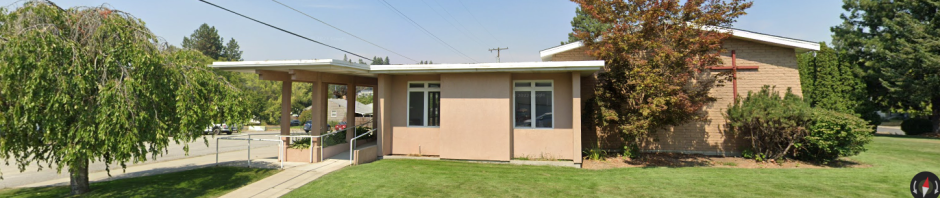
The Stories We Tell Ourselves . . . by Deborah Suess

Text John 14:8-12

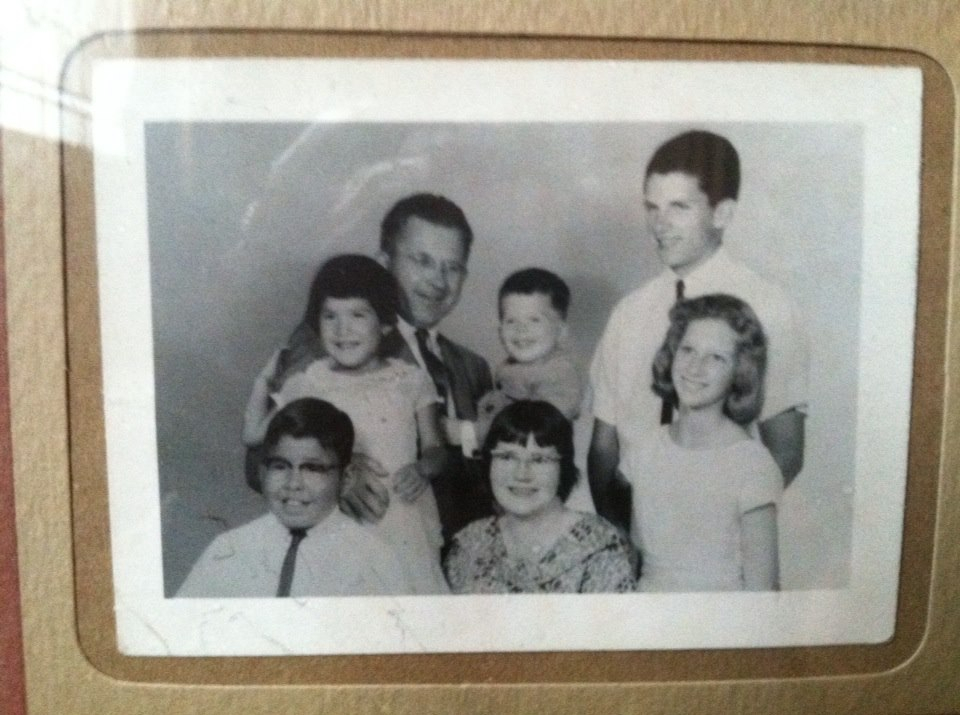
My father’s name was Martin Suess.  And while I always loved my dad, it took some growing up on my part to fully appreciate him.

As a 12 year old, Daddy didn’t exactly match my image of the perfect strong All-American father — which in my mind was a cross between John F. Kennedy and Captain James T. Kirk of the Starship Enterprise.

Instead, Dad was a tender-hearted, thoughtful and rather eccentric micro-biologist who promoted his back-to-nature philosophy by refusing to mow our front lawn in order to grow native prairie grasses; that is, until the neighbors wrote a strong letter of complaint which  totally and utterly embarrassed his youngest daughter.

Thankfully, I grew out of that embarrassment stage and learned to genuinely appreciate him — eccentricities and all.  After his death, I mentioned to my Aunt Vera that while I loved his tenderness, I wished I had seen more of his strength.  Vera replied she saw my father as a man of great strength and courage, and she shared a bit of story that my sisters and I had never heard before.

Background: In 1936, as a young Jewish teenager, my father escaped Hitler’s Germany and landed in Chicago.  When he turned 19, he was drafted by the U.S. Army. So Dad’s first return to his native country was as a non-combatant soldier and his primary job was to serve as a translator.

What I hadn’t known, was that one day when he was translating for an interrogator, Dad was asked to curse at and demean an innocent young German girl.  My father refused to translate that degrading message and as a result (among other things) he was demoted in rank.

That was integrity and courage.  And again helped me rewrite the story I told myself about my father.

Some of you know the work of Dr. Brené Brown, a social worker who has done research in the area of shame and vulnerability.  Her research suggests that it’s vitally important to be aware of the stories we tell ourselves.  She illustrates this by describing a time when she and her husband Steve decided to take a swim across a beautiful Texan lake one summer morning.

They are swimming together when halfway across the lake, Brené looks at her husband and is so grateful to be there with him in that moment. So while treading water, she decides to get vulnerable and says to Steve:

“Honey, I’m so glad I am with you and that we decided to do this swim together.”

Her husband replies: “Yep, water’s good,”

Brené feels hurt by his response but decides to make another bid for connection. A few minutes later she catches Steve and says:

“Steve, This is so great! Right now I feel so close to you.”

He answers: “Yep, water’s good,” and then swims away.

Now Brené is thinking: What’s going on? I don’t know if I’m supposed to feel humiliated or hostile.

By the time they arrive back at shore, she is furious but she takes a big breath and then tells him,  “I’m not sure why you kept blowing me off today. But the story I’m making up right now is that one of two things just happened,”

“Either you looked over at me and thought, ‘Yikes, she’s gotten old and doesn’t know how to really free-style swim anymore’.

“Or, you looked over at me and thought ‘Jeez man – she sure doesn’t rock a speedo like she did twenty years ago.”

Steve listened as she spoke. And then replied that he was not trying to be distant but during the whole swim he was focused on fighting off a panic attack. So much so that he had no idea what she even had said to him.

With some embarrassment he went on to explain that the night before, he dreamt that he and their kids were rafting on the lake when a speedboat came screaming toward them, and he had to pull the children into the water so they wouldn’t get killed by the raging vessel. As a result, all  he could do in the water that morning was count strokes and keep swimming to keep the panic attack at bay.  Steve had no idea what she had said to him.

Then it all made sense and Brené thanked him for speaking vulnerably. To which Steve replies, “Oh no — don’t start quoting your shame and vulnerability research to me.

Here’s what you really want: when the speedboat comes raging, you want the guy who takes all six kids and throws them onto the shore, woosh, woowsh, woosh.  And then swims so fast that he lands on the shore and catches them all. And then he looks across the lake and goes, Don’t worry, little lady, I’ve got this[Superhero Steve}

As Brené and Steve realized, they each were telling themselves a story. For her it was about body image, which so many of us struggle with. And for Steve it  was the need  to be a super hero.

Brené Brown concluded that it is vital for all of us to become aware of the stories we are telling ourselves.

Which brings me finally to the whole God thing. So — just as I had to mature in my understanding of who my father was, I have to also keep growing up in my understanding of the Divine.  Or to put it another way, I had to look (and keep on looking) at the stories I tell myself about God.

As a youngster it was really comforting (and probably age appropriate) to imagine God as a combination Santa Claus and Superman.  But (by age 16 or so) that story no longer worked for me, as I faced into the inevitable ups and downs of everyday life.

Indeed somewhere along the way, I began to let go of God as Santa/Superman, and instead decided to let Jesus introduce me to God — introduce me to the One whom he called Father.  I began to look for God as revealed in the person of Jesus.  For as Jesus said to his disciple Philip, “If you’ve seen me, you’ve seen the father.

So the question I offer this morning is: Who or what do you see when you see Jesus? How does seeing in that manner impact your understanding of God and the story about God that you tell yourself?

For me, among other things, I see a prophet bravely speaking truth to power. I see a kind healer who is unafraid to touch those considered “untouchable”.  I see a man who is constantly ticking off religious leaders by asking hard questions.  And I see him lovingly shaking his head and trying again, when his disciples (including me) totally miss the point.

And I see in Jesus, One who kept speaking the truth, even when he knew it would lead to the cross.

So Friends, as we move into open worship, I invite you to consider:

  1. What happens when you see Jesus? Who or What do you see?
  2. How might seeing/knowing Jesus influence how you see and know God?
  3. And How does that seeing impact the stories you tell yourself and others??

My prayer on this Father’s Day is that we be reminded that God so loved the world that God gave us the beloved: Jesus, who in turn calls us to help write a new story of what it means to live out Love.  Here. Now. Today. Amen.


This message was given by Deborah Suess to Spokane Friends Meeting on Sunday, June 21, 2020, during Worship Service

Posted in Messages | Comments Off on The Stories We Tell Ourselves . . . by Deborah Suess

The Will to Love and the Wind of Friendship by Paul Blankenship

I am a cosmic ball of emotional energy, sitting in the world of my mind, the world of my office, the world of homelessness, the world of academia.  

There is excitement. In a few short hours, I will see my committee members from Berkeley and Stanford and defend my dissertation on the spiritual lives of people experiencing homelessness in Seattle, which I call “Soul Woundedness.” It will be a helpful conversation, I think. It is a rare gift to have compassionate and brilliant minds so devoted to you, your development, and your work.

There is fear. I have heard horror stories: of people failing their defense, of being sent back to the library, of some unexpected disruption. I have worked a very long time for this degree—eight years—and much as I try to convince myself otherwise, it would hurt my ego and my pocketbook to fail or step backward. Very much.  

There is also the peace that comes from a deep call. I did not go to graduate school to get two fancy letters and a period next to my name (fancy in some worlds, I should say, but repulsive in others). I did not go to graduate school to become an expert at something. A divine call pulled me into graduate school, I believe: a call to love: a call to listen to the wounds of the world: a call to work for social healing through understanding, study, dialogue, and spiritual practice. In a sense, I went to graduate school to become a better novice: a person possessed by good questions and a healing presence.

So, two weeks ago, as I sat in my office chair, getting ready to defend my PhD at the Graduate Theological Union, I am all of these things. Excited. Afraid. At peace. A cosmic ball of energy between worlds.

Anyway, I could not remain sitting down. I felt the need to get out of my chair and do something in the hours before.

So, I grab Veronika’s rainbow hammock. I take one of my favorite books down from my bookshelf—Teresa of Avila’s The Interior Castle—and put it in my Carhart backpack. I think it will do this cosmic ball of energy some good to cool off, sit beside the river, sway, and read something pleasant.

I also feel called to perform a spiritual practice I’ve been developing. There is no one definition of spiritual practice but, with the help of Elizabeth Liebert, who has written extensively on the subject, I am thinking of spiritual practice as something we do consciously and repeatedly to help us burn more fiercely into the Divine Fire. I can think of nothing I’d rather be than a torch of divine fire in a world darkened by suffering.

I step outside. I begin walking down, down to the river to pray.

I see a brown bird. I wonder what kind of bird it is and I wonder about how much there is to learn about the world. I wonder at wonder.

I am reminded, too, of a passage from the Gospel of Luke in which Jesus likens himself to a mother hen who longs to make people safe under her wings.

The first step of my spiritual practice is to remind myself that—whether I walk through the valley of the shadow of a dissertation defense or just to the Spokane River in a Lilac Spring—God is with me. Paul puts it well in Romans:

“Do you think anyone is going to be able to drive a wedge between us and Christ’s love for us? There is no way! Not trouble, not hard times, not hatred, not hunger, not homelessness, not bullying threats, not backstabbing, not Covid.

None of this fazes us because Jesus loves us. I’m absolutely convinced that nothing—nothing living or dead, angelic or demonic, today or tomorrow, high or low, thinkable or unthinkable—absolutely nothing can get between us and God’s love because of the way that Jesus our Beloved has embraced us.”

With the divine presence in mind, I keep walking: down by the river to pray.

After a few blocks, I pass an immense patch of yellow wildflowers. Wildflowers or weeds, I don’t always know the difference—or when the difference really matters. Maybe one man’s weed is another man’s wildflower.

I stop and stare for a while. Here is a second dimension of this spiritual practice: I observe what is present and marvel at how beauty grows in the world without my having anything to do with it, and what a delight it is to meet Beauty on the journey.

Then I do something I fear is violent, but which I imagine the wildflowers allow out of love for me, our species, and the world we share.

I pluck one yellow wildflower from its home and ask it—not because it speaks like a human but because, like me, it is alive and does communicate—if it will accompany on my journey.

I keep walking: down to the river to pray.

Step after step, I hold the yellow wildflower before my eyes. I breathe into it. I also give the yellow wildflower a name: Friend. I ask Friend to hold my thoughts and my feelings about my defense: my excitement, my fear, even the call I feel has led me here and will lead me further on. Friend is carrying what has been carrying me as we walk together.

I reach People’s Park, one of my favorite places in Spokane. I stop and look at the bridge.

Looking at the bridge.

Looking at the bridge, I am reminded of the young woman experiencing homelessness I met on the Monroe Street Bridge, more than a year ago, who was thinking of killing herself. I remember my promise to this young woman as her legs hung from the bridge and somewhat free from the weight of the world: that things would be okay if she stayed, that the world would help heal the social wounds ravaging her life, that the rocks she would have surely broken her head open on would not have been kinder to her than the world I asked her to come back to.

Looking at the bridge, thinking of this young woman and my promise to her, I am reminded that I need to live my life faithful to that promise. Come what may. I hope my dissertation—though a scholarly project—is also a love letter to the woman I met on the bridge and the world that has wounded her.

Friend and I walk to the bridge. Like the young woman I met, we lean off the bridge and look down at the river.

Throwing the flower in.

Many of you know that we have been reading The Book of Joy by Douglas Abrams, the Dalai Lama, and Desmund Tutu. One thing I have learned from the book, and our Zoom conversations, is the importance of non-attachment. To be non-attached is to avoid suffering and welcome joy; it is to live life without violently clinging to it; it is to be free to move as the divine wind blows. While non-attachment is usually considered a Buddhist practice, I think it is also a deeply Christian one. It is a place, as Veronika once told me, where Christianity and Buddhism hold hands.

In Matthew 6, Jesus says:

“If you decide for God, living a life of God-worship, it follows that you don’t fuss about what’s on the table at mealtimes or whether the clothes in your closet are in fashion. There is far more to your life than the food you put in your stomach, more to your outer appearance than the clothes you hang on your body. Look at the birds, free and unfettered, not tied down to a job description, careless in the care of God.”

Proverbs 3 invites us to live our lives in pursuit of love and loyalty and wisdom, step into the unknown, and trust God:

1-2 Good friend […] it reads,

5-12 Trust God from the bottom of your heart;
    don’t try to figure out everything on your own.
Listen for God’s voice in everything you do, everywhere you go;
    the divine beloved is the one who will keep you on track.
Don’t assume that you know it all.”

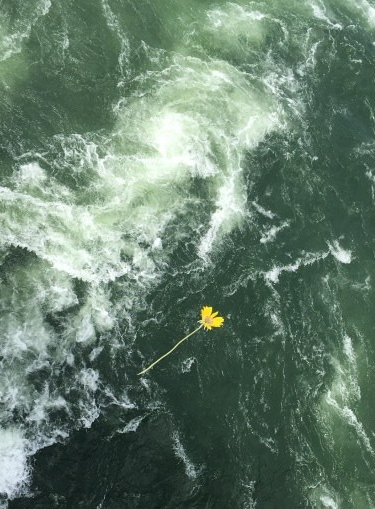
I am in the middle of the bridge now, holding Friend in my hand. I imagine, again, that I have placed my attachments inside of her: the emotions, the immediate outcome of my defense, even what comes after as I step into a terrible job market in higher education. Friend helps me practice non-attachment and deep trust in God. She teaches me how to become more free to love and open to the divine wind. I tell Friend my wish—to pass my defense, get a job, and, most important of all, love the wounded lovingly—and then I toss Friend from the bridge.

Delicately, Friend lands in the river and moves along with the current. Friend asks me, as I imagine it, to watch her fade from sight and continues to teach me to let go, step more confidently and calmly into the unknown, and entrust myself to The River of the Good.

It may not always seem like it, Friends, but I have faith that our world is always moving in the River of the Good. The question is how to become more aware of that and allow its eternal current—fierce but gentle—to guide us.

I went closer to the river, hung Veronika’s rainbow hammock between the trees, and did some reading and some swaying. I read and swayed too long, actually. I lost track of time and had to run all the way home to make it to my defense on time.

Before I signed on to Zoom, and as the waters of fear began to rise once again, I checked my text messages and email. I found a wind. I found a Wind of Friendship. There were emails and texts from many of you: telling me that you are thinking of me, praying for me; encouraging me and guiding me. Your Wind of Friendship helped me step confidently and calmly into my defense—and understand how important it is to ensure that people always have a wind of friendship at their back.

Queries

A few weeks ago, Leann Williams invited us to experience COVID as a liminal time ripe with powerful opportunities for personal and social transformation. Last week, Paul Anderson invited us to listen deep for how God might be calling. This morning, I invite you to consider what spiritual practices help you cultivate trust in God’s presence. I am throwing yellow wildflowers into the river and reading encouraging notes from friends. How is God inviting you to splash into the River of the Good and create a wind of Friendship at someone’s back?  

This message was given by Paul Blankenship to Spokane Friends Sunday Meeting for Worship on May 24, 2020.

Posted in Messages | Comments Off on The Will to Love and the Wind of Friendship by Paul Blankenship

You Feed Them by Gary Jewell

Matthew 14: 13-21 

Some of us were raised with a whole host of very clear and explicit rules in our families; and for some of us the rules were a little less explicit.  I suspect most of the rules in our families were more “caught than taught”.  But one explicit rule in taught by my mother relates to the gospel story for this morning.  She taught me that, if you were eating something in the presence of others, it was extremely rude to not share.  Whatever you had (usually a snack), it was forbidden to not share what you had with those around you.  I don’t think she was thinking of the story of the loaves and the fishes, but essentially it was the same principle.

In some ways this concept of sharing, in particular sharing of elements essential for life, i.e. food, is the basis of human civil society.  All human social structures, from the earliest tribal societies to the most modern and urban ones, depend upon this principle of sharing for the very sake of long-term survival.  Over a few short millennia, humans have moved from tribal groups to city-states to nation states.  Now we stumble toward a new and unknown era of global and ecological interdependence.  Eight billion people on the planet….  And not unlike the original disciples asking Jesus about how to deal with 5000 plus hungry people, we too ask, “Who will feed them?”   And granted, none of us know where these new challenges are taking us, but one thing is certain, without the basic practice of “sharing” and “enough” all of life fails to thrive…. and the gospel calls the world toward thriving! IT ALWAYS CALLS THE WORLD TOWARD THRIVING!

And while the principle of sharing isn’t original concept with Jesus, in this story it is an essential one.  Jesus, in the best fashion of rabbinic instruction, is not just telling his disciple about sharing, he commands them, by faith, to demonstrate it.  He says, “You feed them.”

The basic problem of hunger was presented to him, “Rabbi, send them away so that they can go into the villages and get something to eat.”  And I suppose Jesus could have sighed, and said, “O.K. Look.  Sending folks out to the nearby villages to find food is not realistic.  Where you going to find enough, even in the villages, to feed this many people?  I’ll tell you what.  I’ll take care of it.  Give me what you have, and I WILL DO IT.  I will perform the miracle!”  But Jesus doesn’t say this, does he?  He says, “You give them something to eat!”  What an astounding reply.  It’s like he is saying, “Don’t pass this on to me.  Through the power of faith and the “limited” resources you have, you have the power to feed the hungry!”  This is essentially what Jesus is saying, isn’t it?

Now this little lesson about the power of sharing and our personal responsibility to work the magic of sharing, isn’t an original interpretation of this story.  Many preachers and writers of  commentaries have noticed this lesson on personal responsibility and sharing.  In fact, on the outside of the Bread for the World building (an ecumenical Christian organization dedicated to feeding a hungry world) is this quote from Jesus to his disciples, “You feed them!”

In some ways this story challenges us to redefine what is an actual miracle. Yes, walking on water is a miracle.  Raising from the dead is a miracle.  Giving sight to the blind is a miracle.

But this “miracle story” of the loaves and fishes is a bit different in nature.  While this event takes place through the instruction of Rabbi Jesus, it actually is performed by the human action of the disciples themselves, and their willingness to take what seemingly little they have and, by the simple act of giving thanks and sharing, they satisfy the basic problem of physical human hunger.  A miracle indeed.  Magic happens through the act of sharing — even if it appears that we don’t have enough..

Food and sharing of food are basic principles we see time and again in the biblical narratives.  When it seems there are limited resources and not enough to go around, through the act of giving thanks and sharing what is available, abundance happens.  The fruit of satisfaction is enjoyed by all.

Remember the story of Elijah and the starving widow and her son told in 1 Kings 17.  A famine is in the land. Elijah meets a widow and her son preparing to eat the very last of their food and then simply to give up and die.  But in the act of her sharing what she had with the great prophet, the miracle of provision got them through.

Other stories – Moses and manna in the wilderness.  Jesus changing water into wine.  The story of Great Banquet.  All these biblical stories point us toward this one magical truth about faith and abundance …. when we share what we have with those around, life thrives.

Now we live in a capitalist society. And most of the world currently does. Even China, a supposed communist society, works out of the principles of capitalism. And while many wonderful benefits happen from this economic system,  as followers of Jesus, we have to wrestle with the fact that our corporate-based, capitalistic system rests on the economic mindset of scarcity and competition.  Supply and demand.  Acquisition and, quite frankly, greed.  Socially, without deep concerns for justice and equality, it degenerates into “survival of the fittest.” Not merely in terms of business survival, but more essentially in terms of people survival.  (Precious brothers and sisters created in God’s image).  Whatever the economic structure is (capitalist, socialist, or some kind of blend), from a Christian perspective, the message of the “loaves and fishes” story has to be accounted for …. those powerful final words to the story….“they all eat and were satisfied.”

Whenever we are seeking to gain insight into scripture, especially when reading the Gospels, it is important to read the stories that surround it.  In other words, context is always important.  Proceeding this story of the Feeding of the Five Thousand is the story of the beheading of John the Baptist.  The powerful, disconnected, and urbane Herod is having a birthday party and is so delighted by his step-daughter’s dance performance that he pledges to give her whatever she asks.  At the bidding of her mother, she asks for the head of John the Baptist, who up to this point has been in prison for speaking truth to power.  Herod reluctantly complies.

Interesting contrast!  The violent, fearful, corrupt, and socially disconnected Herod living isolated in this palace in Jerusalem on one hand.  And Jesus in the countryside, speaking with the common folks who are desperately hungry for hope, inspiration, wisdom, leadership, and ….. food.

One of the ways that the Bible speaks and teaches is by showing us the contrasts of false paths and true paths.  Paths of destruction juxtaposed with paths of truth and hope.  This is one of those places in scripture.  It is not coincidence. Herod lives in the world of scarcity and fear.  Jesus lives in the world of abundance and faith.  Herod lives in a world where the strong prey upon the weak.  Jesus lives in the world where meek share what they have and kingdom belongs to peacemakers.  Herod lives in isolation and loneliness.  Jesus gathers a community of sharing and abundance.

The truth of the Gospel is this…. we have enough!  The truth is God gives us a world in which it should be easy to imagine everyone doing well.   It is easy to imagine because it is totally possible…. we just refuse engage in the first part – the imagining.  You ask most people, and they would say that creating, or even working toward, a world where all are satisfied is delusional at best.  Naïve. Ridiculous.  Liberal idealism.

But I say this…. I don’t think I exaggerate to say that we as an American society have gravitated more toward Herod’s world of fear and scarcity, and away from Jesus’ world reality of plenty and enough.

Many in the “evangelical” world go along with Herod’s view.  “Turn away the immigrants (legal or otherwise) and close down the borders….we don’t have enough!”  “Cut programs that help lift people out of poverty… we don’t have enough!”  “Cut Meals on Wheels… we don’t have enough!”  Ignore the growing injustices of wealth disparity and then treat homelessness as a problem rather than a symptom of a much deeper problem of a broken economic system.

If I could faithfully preach the gospel, and not make reference to political and economic systems, I would.  But I can’t.  Preaching requires that we relate the gospel to our current lives.  And I’m talking not of ridiculous partisan rancor, I’m talking about what any self-respecting, God fearing preacher needs to be talking about, and that is human dignity and well-being.

Jesus cared not one ounce for partisan parties or religious loyalty… he only cared about the well-being of God’s precious creation….and especially for the lost and vulnerable human beings.

We need to question any systems that teaches us that scarcity, not “enough,” is the way the God has set up the world.  We need to question the mentality that suggests that we don’t have enough.

“Not enough” is the devil’s lie! The truth of the Gospel is WE DO HAVE ENOUGH!  The challenge of the Gospel is we don’t have to hoard or deny or withdraw.  The hope of the Gospel is that when we come together and share what we have, God will meet our needs.   Faith challenges us to move beyond the mentality of scarcity and toward the mentality of abundance.

I’m sure that you share in abundance.  You share of your time.  Of your money.  Of your attention.  You share in your prayers and your words of nurture. When it seems you don’t have enough, you give it anyway and God is glorified. I don’t say this to flatter you or win favor, but I know for a fact that this is a very generous congregation.   In many ways I am preaching to the choir.  So this is a sermon meant to say; 1) keep up the good work.  2) keep that good work going and go further with it if you can because God does provide!

The story of the “loaves and fishes” should recall to us that: a) the Gospel is about abundance, not scarcity. b) We can’t expect Jesus to do the work alone, but we need to let Jesus do the work through us;  And finally, c) life is fleeting and brief, and we take nothing with us, but what we leave behind  (our generosity, our kindness, our sharing, our wisdom).

In these times when many social and political systems around the globe seem to be governed by fear, cruelty, cynicism, lies, and malevolence,  I want to end with the prophetic and hopeful words from Isaiah 55.

“Come all you who are thirsty.  Come to the waters.  And you who have no money, come, buy and eat.  Come, buy wine and milk without money and without cost.  Why spend your money on what is not bread, and your labor on what does not satisfy?  Listen, listen to me, and eat what is good.   As the rain and the snow come down from heaven and do not return to it without watering the earth and making it bud and flourish, so that it yields seed for the sower and bread for the eater, so is my word that comes out from mouth: it will not return to me empty, but will accomplish what I desire and achieve the purpose for which I sent it.”

I declare to you this morning with utmost confidence…. “This is the Word of the Lord!


This message was given to  Spokane Friends during Meeting for Worship on Sunday, May 11, 2019


Posted in Messages | Comments Off on You Feed Them by Gary Jewell

Be Not Afraid by Walter Simon

PROLOGUE: “Most people are playing nice right now managing this virus,
the wreckage, pain and anger it will leave behind requires solidarity
and healing.”  New York Times, 4/20/2020
“. . . a Quaker is a friend who helps you find your own way home: home within yourself and home within the world as you leave yourself and live courageous- courageously into an unknown, beautiful, hurting world.” Paul Blankenship.


Good morning.   I have asked for the opportunity to speak to you today, to address recent concerns… those that linger over COVID-19, a virus that immediately affects life and death, and induces worries about our longevity.   My approach is from a Shakespearian perspective considering the questions:  Who are we; why are we; what are we?  That is to address feelings of confusion and helplessness, believing “from its’ darkest hours” -for democracy dies in darkness-  to suggest our nation will emerge stronger, more resilient, as a triumph of courage. Hopefully in this regard the glue that holds us together is love.

I address you as an 84-year old who has lived through wars, abhorrent social transitions, blessings and opportunities, at times events violent and unappreciated.

Optimism is the theme I offer you today. It is not a narrative of fear, but one of hope. However, the year 2020 will be remembered as a profound period bouncing between life and death. I hold as a biological prospect that the purpose of life is to survive, which seems a reasonable goal in face of calamity!

As for purpose –let me add salvation is a personal matter, a journey more inherent– the individual process we share as members of a Quaker society.

A contemporary aspect of being an American, in a democracy, is to suggest we are presently in a war on truth. Please do not allow recent events to silence your voice or weaken your resolve.  If you find yourself confused by divisive rhetoric to explain misfortune, now is a good time to think not so much of our everyday life, but of the welfare of our children and their children, thriving in future days.

We need to find within ourselves the strength and hope to recall and focus on our inheritance as Americans.   What you think and how you vote in the November election is critical. Vote your conscience for what you believe is the best path for the future of our nation. Your vote is your business, but I warn you to step beyond the present polemic bluster to understand we are at a critical point in our history, marred by propaganda and misinformation. This is a good time to look in, but in these critical times… watch out!

As to where we are right now:  While the corona virus pandemic is affecting us all differently depending on how we think, considering financial stability and basic health, I include as a pivotal curiosity one universal to consider… that is the difficulty of finding toilet paper. Recall the symptoms of COVID-19 are primarily respiratory.

Consider this trend: “Freudian, being tied to a need, obsessive compulsive tendencies, which get triggered when people feel threatened.”  Add to this an economic crisis, the stock market a roller coaster.  I am advised not to let fear dictate our actions.

Thousands of Americans are dying in recent months. People are worried about their safety and that of their families, as well jobs and opportunity. Questions abound about how the crisis got to this point? Issues that will generate an indelible memory in our conscious thought.

At the same time fissures have surfaced as dystopian national divisions: between those taking social-distancing measures seriously and those who view them as resulting from government overreach, between those who would support a prolonged economic shutdown and those who would be willing to trade additional casualties for a faster return to normalcy.

No matter your view,  or sub rosa Faustian deals, we’re going through a public health crisis. I assert this is not a time for academics, the lesson is that reality is what happens! Therefore, what are you going to do about it in an era of deep uncertainty, diverging policy and raging disinformation?

I offer hope:  “During a crisis, heroes come to the forefront because many of our basic human needs are threatened, including our need for certainty, meaning and purpose, self-esteem, and sense of belonging with others,” so notes Elaine Kinsella, a psychology professor at the University of Limerick in Ireland.

Be a hero for the sake of yourself and your family,  and the future of our nation. Your time is now!

Be brave, stand tall, not afraid and together we prosper. This is a time for tears, for insight, for strength, this is our time, and we have the obligation to embrace our faith and sustain confidence in our future.

Pray for answers, it’s a given… questions abound! 

A SECOND THOUGHT:

A few years back I toured performing Walt Whitman’s work, to hear America Singing, and from this naive experience I learned the country seemed out-of-tune.  I included an epilogue, a poem written as a statement of confidence in our future as a nation: to mirror the best, not exacerbate the worst in us!    It’s my hope to humanize, not politicize our state of mind.

                                               PROLOGUE

                                      I hold                                                                                                                                        you in my heart                                                                                                                         the nation is you.                 


     BLESSED THESE EYES 

           Blessed these eyes                                                                                                                           plainly overexposed,                                                                                                                     as a country in disbelief                                                                                                               given doubts for tomorrow;

          I’d like to pass                                                                                                                                 float the eternal                                                                                                                               believing in you . . .                                                                                                                         you… and you;    

          To embrace in kindness,                                                                                                                all that life offers                                                                                                                            to capture in place                                                                                                                          this armor, a conviction;

           My tears are for you                                                                                                                       and to each a caution                                                                                                                    as we wallow                                                                                                                                    in tides of progress;


            To invite the change                                                                                                                    and think of many spirits,                                                                                                             as a passing celebration                                                                                                                 that bonds the day-to-night;

              Your blessings are you                                                                                                                   each breath a guardian                                                                                                                  for healing  wounds                                                                                                                           this voice an intimate touch.                                             7/11/13                                                                                                                                Eugene, Oregon                                          


This message was given by Walter Simon to Spokane Friends Church during Meeting for Worship via Zoom on May 10, 2020.                                                       


Posted in Messages | Comments Off on Be Not Afraid by Walter Simon

Unmasked by Deborah Suess

Luke 24:13-35

My wonderful Aunt,  Bunny Gillin, lives at Friends Homes, a retirement community here in Greensboro.  When the plea went out a few weeks ago for homemade masks…. she got busy making masks for anyone in need.

As her niece, it has been my job to be a guinea pig for her various experiments as she figures out the best pattern to use.  So I have been wearing a lot of masks these days… which may be why the theme of masking and unmasking keeps showing up for me in today’s scripture passage.

The scene opens with two of Jesus’ friends: one named Cleopus and the other is unnamed.  Many scholars today believe that the two were probably a married couple – who had simply come to their end of their rope and were heading home to Emmaus.

According to Biblical scholars, we don’t know where to look for a literal Emmaus on the map, it’s never been found. But really – don’t we all know what it’s like to journey on the Emmaus road.?  It’s the road we walk on when our heart are breaking because of deep grief. Or when our hope feels so so far away …. Thomas Keintert writes that  “Emmaus is where we go to walk away from what we cannot forget.”

Thankfully these two had each other for that dreary walk home. For companionship often helps when you’re in deep grief— to have someone who gets it because they are going through the same thing.  And so while the couple walked, they kept rehearsing the story over and over again.  They had been so sure that this Jesus was the real thing … until he wasn’t.

As they were processing all of this, a stranger walked up  and asked : “What are you discussing so intently? ” Their response? verse 17 :  They stood still, looking sad.  So poignant.

Through their tears, they did not recognize him — Jesus was (in a sense) masked to them.  Luke writes they were “kept from recognizing him.”  What do you think kept them from seeing Jesus?  Was it their hurt? Their disillusionment? Their certainty that he was just plain gone?

But they invite this clueless stranger to walk with them. After all,  it gives them a chance to go over the whole story once again. And they really need to talk. So they tell this stranger all about Jesus’ life: this amazing rabbi who healed and preached.  They told him all about Jesus’s ministry and miracles and then his triumphal entry into Jerusalem and then  … his arrest, his crucifixion, his death and burial.  And then they offer what Nadia Bolz Weber calls the 3 saddest words in scripture: They say to this stranger:  “We Had Hoped.”   We had hoped …. ….

While Jesus might have been hidden from them, those two disciples were fully unmasked. They poured out their broken hearts to this Stranger. (Sometimes it’s easier, isn’t it, to tell your most vital feelings to a stranger whom you will never see again?) Notice: They didn’t try to make the story nice or make excuses for anyone. They didn’t conclude with … but of course … it could have been worse.  Or … maybe it was just meant to be. 

 They told the story with a sense of raw honesty and destroyed hope.

And I so appreciate that raw-ness. Especially now. In these difficult days of the pandemic.

It is my hope that all of you have someone with whom you can be as raw as needed. Someone with whom you need not make nice. And the good news is – here at Spokane Friends there is your pastor and elders and just so many who are wonderful listeners.

On that road to Emmaus, I imagine Jesus listened intently to that grief-filled story.  And then, when it was his turn to speak,  he went for it! He began to unmask the scriptures for them.  I wonder if, as listeners, it was both exciting and jarring to hear these familiar texts interpreted in brand new ways?

But even then, the two didn’t recognize Jesus.

As the couple neared their destination, Jesus began to say his goodbyes.

But Cleopas and his wife would have none of that, saying: “Stay and have supper with us. It’s nearly evening; the day is done.”

And when they gathered at the kitchen table, Jesus took the bread, blessed and broke it and gave it to them. And at that moment, in the breaking of the bread, they recognized him.

I find that scene so moving. I love that it was at an ordinary kitchen table, in the ordinary act of sharing a meal, that the mask fell away and they recognized Jesus.  And I imagine that in that moment, a seed of hope was reborn.

But before they could rush in for a bear hug, Jesus disappears.  And without a second thought, Cleopas and his wife head back to Jerusalem to share their experience of the Resurrected Christ.

There is a lot in this passage.  And I would love to know what speaks to you this story? So here are some queries for you to consider:

What speaks to you or challenges you in this story? What gives you hope?

When have you experienced an “unmasking” … of Scripture? of God? of yourself?

How has the Living Christ walked with you on your Emmaus Road?

This poignant story reminds me that the Easter message of Resurrection runs parallel to our Good Fridays and Holy Saturdays.  It invites us to be present to one another,in both our fears as well as our hopes.  And it is a reminder that hope that can indeed be born and die and then reborn and again and again — in our lives individually and in our lives together.

The Easter story is also about  a faith that recognizes that God is still at work in us and among us.   A reminder that the Light of God shines in the darkness and the darkness cannot, cannot, cannot overcome it!

For Christ is Risen… Christ is Risen Indeed!

Resources:  Nadia Bolz Weber, Molly Baskette, Thomas Keintert

This message was given to Spokane Friends Meeting on April 19, 2020, by Deborah Suess (via a Zoom worship service during the COVID-19 restrictions.)

Posted in Messages | Comments Off on Unmasked by Deborah Suess

Easter Sunday feels more like Holy Saturday by Paul Blankenship

It doesn’t feel like Easter. Not to me, anyway. Not right now. Let me be honest.

On Easter, Jesus emerged from the tomb. He put two feet on the ground. He took fresh air into his lungs. He gardened, I think. Jesus told Mary, who came to care for his dead body but found him living, to spread the good news: the power of death could not hold our beloved; our True Friend breathes. Later in the day, Jesus stood before his friends. They were in the same house. He preached peace through a wall of fear. Jesus breathed on his friends, breathed the power of courageous life into them.

In a way, I feel like we are being called into Jesus’ tomb today. Much of our world is closed. Many of our streets are empty. Few dare ride the bus. No basketball, no spring training. No school. No happy hour at Clinker Dagger. No Bloomsday in spring. People are in hospitals, struggling to breathe. Over a hundred thousand have died of Covid-19. Millions upon millions are losing their jobs. Millions more are going hungry. And fearful. How will we pay for rent? The car? The energy bill? If we are lucky to have a home, we are ordered to stay there. Tragically, home is not always a safe place. When we do go out, we live afraid to touch people we love, to breathe on strangers at the grocery store. We are wearing masks. Physical distancing has become a ministry of compassion. Who would have thought?

Some of us are glued to our TV sets and radios, waiting for good news from far off places. Is Wuhan up and running again? Has the curve flattened? Is there a treatment? When will there be a vaccine? When can the kids go back to school? When we can return to our Meeting House, sit in our beloved pews, hug, and see our banners. Hope, Peace, Joy, Love.

Today, we live waiting for good news and for new life. It doesn’t feel like Easter Sunday. Not to me, anyway. Not right now. Let me be honest.

To me, today feels more like Holy Saturday. Holy Saturday is a day in the church calendar that’s easy to forget. We prefer to hide Easter eggs and drink spiked punch than attend to the spiritual reality of Holy Saturday. Holy Saturday is a liminal time between Jesus’ death on Good Friday and his resurrection on Easter Sunday. It is a day of heavy mourning, dizzying confusion, and traumatic separation. According to the Christian tradition, Holy Saturday symbolizes the time Jesus descended into hell after his death. Why Jesus descended into hell—and what hell actually is—is a complicated theological question good people debate. The reason is clear as day to me, though: Jesus’ descent into hell on Holy Saturday is a symbol for the spiritual fact that there is no place Love will not go; that Christ waits in solidarity with those who hunger and pine for the breath of new life. Holy Saturday is a reminder that even life as we know it cannot contain the power of Christ’s Love.

So, yeah. If I am being honest: today feels more like that. More like Holy Saturday than Easter Sunday. I feel like I am in a tomb, not outside of one. Today it feels like our invitation is to create physical distance but refuse to allow fear and suffering to separate us; to practice compassionate spacing but still go where Love is calling; to wait patiently with Christ and all of creation for new life. Holy Saturday invites us into a query, I think. How, today, shall we wait for new life? What must we lie die? And what kind of life do we want to live once Covid-19 is finally yesterday’s news?

Why is a Christian a Christian? Easy answer, you may say: A Christian is a Christian because a Christian believes Jesus was really God and a Christian is a Christian because a Christian lives as Jesus lived.

I think it’s true that Jesus showed us who God is, and where God is, but I think we think too much about Jesus as God. Looking for God, we stare too long at the sky and the stars and into the great beyond. Searching for Christ, we look too hard into the slow, fascinating, and complicated book of history. We forget that Jesus came not just to reveal God but also to reveal us to ourselves. That Jesus was the True Human. That Jesus shows us what is like to be really alive as a person. That Christ is in the mirror in the morning, looking at you when you look at yourself.

Being truly human, Jesus shows us still, means washing stinky feet, comforting the sick, feeding the hungry, and visiting the prisoner. It means setting the captives free. Being truly human, Jesus shows us still, means speaking truth to power, bringing peace in storms of fear, and experiencing the joy. To be truly human and really alive is to dance among the lilies of the field, drink wine and feast with one’s friends, and laugh until hurts. True worship is the sound of a big belly laugh in the midst of Covid-19.

Jesus’ life also shows us that being truly human means accepting a kind of death as a natural part of life. It means learning to love the tomb and greet death as a caring brother. But Jesus’ life also shows us that love is stronger than death. Within a kind of tomb, Jesus shows us how to die and wait for new life to emerge. To be truly human is to wait in faith, hope, and love.

Signs of new life. Last week, I saw a couple dancing on the sidewalk across the street from my apartment. Their hands were in the air, swaying to a song. The guy was laughing and shaking his booty. The woman was smiling. The sun had been out all day. It felt cool out. Yellow daffodils were shooting up from the soil, announcing spring.

It may not feel like Easter, but it is. As Quakers, we are mindful that every day is Easter because Christ’s presence is our true and abiding reality. Christ is the sun that does not go down. We are the yellow daffodils, always shooting up and announcing the spring.

Life is coming alive all around us. Let us fall down on the grass and be truly happy. There is no place Love will not go. We are never alone, not even in the tomb. Joy is the final word. Big belly laughter is our home. But let us not rush past this season in which we are called into a holy waiting and a holy dying so that we can create a better, more beautiful life on the other side of the curve: not just for ourselves, of course, but for all who yearn for the sun. And friends, we all yearn for the sun. God is breathing in all of us as we shoot up from the soil.

Let us enter into a time of waiting worship now. If God calls you to share a word of edification for our meeting, please be faithful to that call. If God gives you a word for just yourself, please remember to savor that word as a true gift within yourself as we sit in extended silence.

This message was given by Paul Blankenship to Spokane Friends on April 12, 2020, via Zoom, due to COVID-19 restrictions.

Posted in Messages | Comments Off on Easter Sunday feels more like Holy Saturday by Paul Blankenship

What is Holding You? by Paul Blankenship

Good morning, Friends. It’s good to be with you in Zoomland and to be traveling through this unusual, transformative, and deeply unfortunate time with The Beautiful People of the Divine Light.

Sigmund Freud, the father of psychoanalysis, helped transform the way we experience our minds. We can thank Freud, or perhaps curse him, for making people so very aware that our innermost and sometimes secret thoughts really matter. Freud helps us see that the thoughts we have make a big difference in our

In a recent book, Buddha’s Brain, the American psychologist Rick Hanson agrees with Freud: the way we think is super important. And he has this really helpful metaphor that makes the point. Hanson says that our minds are [slow] like Velcro to negative experiences and Teflon—or a gloriously slippery, nonstick pan—to positive experiences. What Hanson means is that, unfortunately, our minds have a “negativity bias”: bad thoughts are stickier than positives ones and it takes hard work to marinate in a pan of positive thinking.

The Apostle Paul didn’t need a book or a sermon on the power of positive thinking. He already knew this—about two thousand years ago. In the book of Romans (12.2), Paul wrote the following:

“Do not copy the behavior and customs of this world, but let God transform you into a new person by changing the way you think. Then you will learn to know God’s will for you, which is good and pleasing and perfect.” Let me repeat the first part: let God, the True Light, transform you into a new person by changing the way you think.

In Philippians, which some people call the happiest book in the Bible, Paul says this:

“Summing it all up, friends, I’d say you’ll do best by filling your minds and meditating on things true, noble, reputable, authentic, compelling, gracious—the best, not the worst; the beautiful, not the ugly; things to praise, not things to curse. Put into practice (x2) what you learned from me, what you heard and saw and realized. Do that, and God, who makes everything work together, will work you into Her most excellent harmonies.”

Let me make a proposal. We never stop being held. Even after we learn to walk—even after we move away from home—something in the world is always holding us. Here is another proposal. We are held by the images in our minds and, during the challenging time of COVID-19, the friendship we have with ourselves, the world, and God will be greatly impacted by the images that hold us. Our light will flicker, fade, and rage based on the images that hold us.

Veronika waking up early to provide free childcare to medical workers. A gorgeous sunset from the Monroe Street Bridge. My dog’s face. People at Caritas handing out food to the increasing number of people who can’t afford any. Democrats and Republicans working together to care for the vulnerable, the sick, the indebted, and the unemployed. Throwing my TV in the river, never to watch the news again. Everyday people staying home to practice social distancing and compassionate spacing. Lois working tirelessly in the Meeting House to sow a few seeds of Quaker Friendship.

These, Friends, are some of the images holding me. What images are holding you? And how can we practice holding good things together as we’re holed up in our homes?

Forgive me. Let me make one more proposal before we begin Waiting Worship—our virtual quiet in which we seek God’s voice and makes space for others to share how God might be moving them for the edification of the meeting. Good thinking is a spiritual practice that takes real and repeated work. And God actually shows up when we try to think good thoughts. God, actually, I think, is the hidden pull toward good thinking and the warm fire that burns in our hearts when we find ourselves held by The True Light.

This message was given to Spokane Friends by Paul Blankenship on April 5, 2020, as we met for the first time via Zoom, since we cannot meet in our own building due to COVID-19 restrictions.


Posted in Messages | Comments Off on What is Holding You? by Paul Blankenship

Constantine by Paul Blankenship

Needle Hill

It is a cold winter evening in Seattle. A light rain is falling on my beanie, on my shoulders. Grey clouds fill the sky. Loud horns and unapologetic sirens envelope the soundscape. I can barely hear myself think. There is hardly an inch between people on the sidewalk. Somehow, there seems to be no space at all between the cars on the street. I love busy street life and downtown living but today was the kind of day that made me want to just get away –catch a plane headed to a sunny island in Hawaii or Costa Rica. I wanted to soak up the sun on a quiet beach, sink my toes in the sand, maybe read a Stephan King novel and have a good scare.

Still, I walk the streets of downtown. I have research to do and, eventually, a dissertation to write.

As I move between people on the sidewalk, I run into a man named Sky. We are in front of Dick’s. I trust you know the burger joint. Sky is a young adult experiencing homelessness. He and I had been talking about getting coffee, so I ask Sky if he might want to grab a cup and chat someplace quiet. ‘I’d like that,’ he says, ‘but I need to get well first. Do you want to come to Needle Hill?’

For Sky, “getting well” has a particular meaning. It might not be what you expect. Sky is addicted to heroin. He tells me that heroin addiction is a medical condition that, right now, anyway, he can only treat with more heroin. Sky hates his heroin addiction, but he feels trapped and afraid that he’ll never get out of it. ‘Anymore,’ Sky tells me, ‘I don’t even get high.’ Now Sky uses heroin—or “black,” as it’s called on the streets—just to keep the agonizing, excruciating, maddening symptoms of withdrawal at bay. That’s why Sky calls using heroin ‘getting well’ as opposed to ‘getting high.’

I tell Sky that’ll I’ll go with him to Needle Hill. I actually feel honored that he trusts me enough to bring me into the underground drug culture. But I am also afraid. Needle Hill is not a safe place. Stepping onto Needle Hill is like stepping onto another planet. It’s like getting off of a plane and being in warm and quiet Hawaii instead of cold and busy Seattle. It’s like going to bed one night when everything is okay and then waking up and suddenly the world has COVID-19.

The suffering on Needle Hill is palatable. Everywhere there are human bodies bleeding, bleeding for healing. There is violence. Last week, two men died on Needle Hill by gunshot. They don’t keep record of how many people have died of an overdose or the less visible but more pervasive forms of structural violence. It is called Needle Hill because people buy heroin there and because of how many used needles are on the ground. If you are not extremely careful, you could easily step on a used needle. Or sit on one.

Sky and I ride a bus from downtown Seattle to Chinatown. We walk a few blocks and reach Needle Hill. We walk through tents and gravel and needles. ‘Wait here,’ Sky says. Sky walks away from me. He goes out of sight. I stand alone on Needle Hill and people start looking at me kinda funny. I gulp nervously and, for a moment, regret coming here. Though I dress to “pass” as a person experiencing homeless, not everyone is convinced. Some can see clearly that I am a “housie”: that is, someone who’s lucky enough to live inside where it’s warm. And safe. Maybe it was only a minute, but it felt like ten hours before Sky came back. ‘Thanks for waiting,’ he said. ‘Let’s go to my tent and talk.’

Sky and I walk through Needle Hill. Finally, we reach his tent. It is one blue tent in a sea of blue tents. ‘Have a seat,’ Sky says. ‘Make yourself at home.’ Sky realizes that he doesn’t have any more “cleans,” which means clean needles he can use to shoot heroin with. Sky looks down at his feet. He finds a used needle. Sky reaches into his backpack and pulls out a piece of cotton, a spoon, and a lighter. He lights the lighter and places the black on the spoon. He puts the flame underneath his spoon. And I watch the black transform.

‘So,’ he says, ‘let’s talk. You are studying spirituality, right?’ ‘Yeah,’ I say, ‘I am trying to understand how people on the streets think about spirituality – and practice spirituality, if they have one.’ ‘Let me be honest with you,’ Sky says. ‘I am not a very spiritual person. So, I don’t think I’ll be much help. There are a lot of spiritual people out here, as I am sure you know,’ he says, ‘but I am not one of them.’ Sky tells me that he used to have a relationship with God, but now he’s not so sure God exists. ‘I don’t know,’ Sky says, ‘maybe there is a God. If there is a God,’ he goes on, ‘he’s probably like a cruel and ignorant and spoiled little kid with an ant farm. It,’ Sky says, ‘is like we’re his ant farm.’ Sky laughs. ‘It’s like sometimes he shakes us up once in a while just to mess with us. It’s not a nice thought,’ Sky says, ‘but it’s genuinely how I feel.’

The heroin is warm enough now. ‘Cooked,’ Sky says. I watch Sky pull the heroin into the needle. I watch as he searches for a vein. I watch as he finds a vein and shoots the heroin into his body. I watch as the heroin moves through his body. I watch as Sky’s suffering stops and a kind of peace moves through him. I listen as Sky thanks me for being present with him, just hanging out. He slurs his words saying thank you for not judging me. ‘It almost helps me feel human again,’ he says.

‘By the way,’ Sky says, as he leans toward me and begins to nod off on my shoulder, ‘what do you think about God?’ Sky slips into sleep and I wonder about how many young adults experiencing homelessness told me that God, if God exists, is like a crazy alien or a spoiled child or a real but negligent and aloof creator.

Constantine

I call her Constantine. She and I talk almost every day. I call her Constantine, but you might call her the Spokane River.

It might seem silly, and a little bit crazy, but I befriended Constantine. I also asked Constantine to become my teacher. I asked Constantine to become my friend and teacher because I think it’s important to have friends and teachers in the nonhuman world. Living beings in the nonhuman world love us and teach us how to care for ourselves, one another, the world. They help us understand that everything is connected and, whether we realize it or not, in conversation.

Constantine and I talk about a lot of things. We talk about our histories, for example. I tell her that I once had a dog named Snoop like the rapper Snoop Doggie Dog. I learn from the signs in a park next to Constantine that she used to provide food and fun to the Native Americans who once slept beside her, whose sleeping places and sacred land were stolen in the name of money and bad religion. We also talk about our wounds, Constantine and me. I tell her about the abuse I experienced as a child. I imagine that she tells me about some of the wounded people that have jumped into her from the Monroe Street Bridge – and drown – and I wonder how many wounded humans she has held inside her over the years. We also talk about what we love, our joys. I think about a time an older homeless gentleman on the bridge told me that Constantine has saved his life thousands of times. He told me that he just dips his face into Constantine when it’s warm enough and how, even on his worst days, he emerges from Constantine feeling like a new person. I tell her about all of you, how it brings me joy to hear your joys and see them living in you. I imagine—and let me stress that my conversation with Constantine is both real and a work of my imagination (lest you pick up your phone and start calling for a doctor …)—that she told me to tell you that it brings her joy to hear about your joy from me. She told me to bring a few rocks here today to say thank you, thank you for your joy.

Asking Constantine about God

Lately I have been talking to Constantine about God. I told Constantine what Sky said about God on Needle Hill and how it made me hurt, hurt to know someone thinks of God like that, experiences cosmic abandonment, that a hurting person is not aware that there is a divine river of goodness and care forever running in their soul. I told Constantine how hard it is to talk about God. How God is bigger than the word God or any word we might associate with the word God. How talking about God can feel like listening to a beautiful orchestra going on in the dark and which maybe you can’t hear but you still know is making the most wonderful sound. It’s like 1 Corinthians 13, I say: how see God now as in a mirror, dimly.

Yesterday I watched small snowflakes fall onto Constantine. They disappeared, immediately, and, in the process, actually became Constantine.

‘I don’t know,’ I said to Constantine. ‘What do you think about God?’

 Peace

At first, it was a like busy Seattle evening in my mind. I heard nothing but noise. Then I took a breath and asked Constantine if I could toss my thoughts into her. ‘Of course,’ she said. I let Constantine carry my thoughts away, carry them away until we were sitting together in silence, until we were ready to talk about God.

Peace. I felt peace. A peace beyond understanding, a peace that is never sold out at the grocery store. Peace is what I think Constantine said about God. In that moment, I felt like one of Jesus’ disciples when he came to them on the water, battled by the waves in the storm, in a boat that might sink, in the dark, when they were desperate for food for tummy and spirit, when they were petrified, and when Jesus told them to fear not, to have courage, to be at peace. To get in the boat of peace, the boat that will always remain, to remain in the boat of peace when it is scary, and there find yourself in the arms of Christ, safe in the storm.

From where I sat, which was under the Maple Street Bridge, Constantine was moving quickly. So, I queried the pace of peace, how it moves in the world. There are times in which it is standing still. Peace is like a person that greets us quietly on a Sunday morning. Peace lives at the door like Bill or Pam or Wade or Linda or any other of our peaceful greeters.

A block away, Constantine is very still. Hardly moving. Like a slow poke you might want to honk at. There are other times, however, in which Constantine moves fiercely. Now is one of them. As I query the pace of peace, I imagine that she says: ‘the peace of God moves fiercely, too. It’s like a strong, moving river that calls us into places of fear and places of pain and places of violence, calls us into peace to bring peace even become peace.

Maybe we should always ask what the heck a Quaker is. And maybe we will always get different answers. But maybe there is one answer that will remain constant: a Quaker is someone who befriends peace to become peace. The peace of Christ, the presence of eternity that lives wildly, freely in the present. And teaches us that peace is not a commodity you can buy, a doctrine you can etch into a permanent stone, that peace is not a weapon used to win an argument or gain power over another, that peace can only be understood by letting go and being grasped—being held by the gentle, humble, empowering silence of loving always and knowing only sometimes in the dark.

I named her Constantine because she reminds me of God, because she invites me into peace to become more like God for a fearful world, for a world that can trust that there is a constant peace. A boat at your shore. A boat you can always get in. No matter what. Whether you’re on Needle Hill, whether you’re in rehab, whether you’re moons away from the sun and where you want to be, whether Mother Time is about to click-clock you into Her Arms, whether the world is fretting over and suffering from a disease called COVID-19.

Peace is here. It is real. Let’s get in the river. Let’s get in and bring peace to the world and to the people that most need it.

Query:

That, anyway, is what Constantine told me about God. What might God be saying to you this morning?


This message was given by Paul Blankenship during Sunday worship service on March 15, 2020.  It was the same Sunday we learned that Sunday worship has now been canceled until further notice because of the COVID-19 outbreak.

Posted in Messages | Comments Off on Constantine by Paul Blankenship

A Fool’s Journey into Quakerly Friendship by Paul Blankenship

Tarot

Rob lights a match. He reaches into a small yellow pouch and pulls out a gathering of dried lavender. He breaks the lavender, gently, and tears off a small piece. I am absorbed in the sound it makes, the little crack. Rob places the broken lavender above the match. It catches fire. He blows on the fire, blows out the fire and the match. The lavender burns slowly, and smokes. A kind, friendly aroma fills the room.

The room is different now.  The match, the breaking, the smell. I am different now. Different now in this different room.

Rob shuffles the deck. Cut it, he says. Rob spreads the Tarot cards on the carpet, in front of my knees. He hovers the burning lavender above the cards. The smoke is wild now, wafting and filling the room.

The cards are blue and green. On the back of each card is an image of a large eye. I am looking at something looking at me, something with some kind of life. Rob tells me to pick a card. Pick the card that is pulling you toward it, he says.

The end of all things

I wasn’t supposed to be there. In that room with Rob, or at all. In the first place, the world should have ended some time ago. 5 years ago, if my math is correct. And Tarot cards: they were a tool of the devil, a titillating snare to seduce weak souls. Magic from the dark side.

I began learning about the end of all things in elementary school. In between math and science lessons, as the weather held rather steady at 75 degrees in San Diego, we’d watch videos of people disappearing into thin air on their way to church or the grocery store. We called it the rapture. God took good Christians to heaven. He raptured them. He left sinners behind. Sinners would wonder where their friends went. They would panic when they realized what happened. Sinners had to learn how to survive on earth as its oceans turned to blood, swarms of locusts filled the air, and the Antichrist rose to power. We called that the tribulation.

By the late 1990s, things got particularly intense in my religious world. People were buying land in far off places in case God’s wrath started dripping down, early, from the heavens and causing catastrophic earthly scenes. In Bible class, I wrote the entire Book of Revelation in red ink. I addressed it to an “unsaved friend.” Dear Mark, it read. God loves you. Please read this book and you will be saved. Something to that effect. I wish I still had the book. I would frame it, frame it to remind myself that beautiful people come to believe ugly things, that we are all beautiful people who sometimes believe ugly things.

Problem was, though: I wasn’t at all convinced that I’d be raptured. I sinned. A lot. And I liked sinning. Sinning was fun. So, I spent my youth between rebellion and a tragic religious imagination. I built tree houses I could survive the tribulation in. I kissed girls and asked them to get on their knees with me to repent—lest God come back mid smooch. So, I was kinda weird. I listened to secular CDs – and then burned them in the desert when I got on a spiritual high. In the middle of the night, I’d wake up in terror. Please God, I’d pray, don’t leave me behind. Don’t leave me to drown in bloody water, get eaten by locusts, and marked by the Beast. Come back if you have left, please come back.

All of this was very real to me. During my senior year of high school, when the whole rapture thing started to seem ridiculous and like a real form of child abuse, our campus pastor told us during morning announcements that the end of all things is immanent. Here. The stock market is going to crash, he said. Iran has nuclear missiles pointed at us. Are you ready to go? Will you be saved? Where will you spend forever? Is your heart white as snow? On the last chapel before Christmas recess, the whole school held hands. Pastor encouraged us to say goodbye. He said this could be our last time seeing one another until heaven. The year was 1999. We were weeks away from Y2K. And Al Gore, many speculated, was the antichrist.

The Fool

So, it is strange to be here. Strange to be in the room with Rob, strange even to bring you into the room with Rob. But here we are.

I pick a card. I pick the card that is pulling me, the eye that compels me. I take a deep breath and breathe the lavender in, the lavender that has filled the room with a friendly aroma. A holy smoke. I turn the card over.

You picked the fool, Rob said. You, he said, are the fool.

I didn’t like that. I felt cheated. I wanted to pick another card. I wanted to be a sage, not a sucker. Who wants to be a fool? Especially then. I had just signed divorce papers. I had also just started a PhD program. My colleagues came from Harvard and Yale, Stanford and the University of Chicago. Where’d you get your master’s degree, they’d always ask. Nobody ever heard of my small, historically Pentecostal school in Orange County. I needed a card of strength, not silliness. A cure for the imposter syndrome.

Rob saw my discontent. He knew I didn’t want to be the fool, that I wanted to pick another card. He laughed. He laughed because he understood, because he felt that way too.

A fool isn’t an idiot, he said. A fool is brave. A fool isn’t weak, he said. He is courageous. A fool is willing to live humbly before the journey into the unknown, humbly before the mysterious force of good that pulls her toward faith, hope, and love. He said that 1 Corinthian encourages all Christians to become fools. To become fools for Christ, fools for the Gospel, fools for the Good News. To give up everything for faith, hope, and love.

Now I like being a fool. I’d rather be a fool than a king or a sage. I like seeing myself on a journey. I like trusting the wind and the love that moves the sun and the other stars. I like being humble and the fact that I don’t have all the answers. That I have just a few answers and that my answers are mostly questions. Questions about how to love a wounded world, sow peace amid great violence, and experience joy.

And I like that my fool’s journey has brought into a Quakerly Friendship – that, though I still wander in diverse religious wonder, I feel called to make a home among the Society of Friends. Today I celebrate that call. Let me tell you why. There are one million and one reasons why Quakerism has called me home, but here are five, written very briefly, so that we can soon ease into a time of Waiting Worship before our Beloved, before the Light that burns in and all around us. Each Quakerly call home is related to a spiritual practice I have learned among Friends—that is, different ways I have seen Quakers struggle to make real the deep dream of Friendship with Christ and one another.

The first time I entered a Quaker church felt like a homecoming. I can’t tell you exactly why I felt at home in a place I’d never been. It’s odd. There are reasons, and there aren’t reasons. It was at Camas Friends in Washington. I came at the request of the pastor, Matt Boswell, to speak about my research with people experiencing homelessness.

Matt is gentle. You can hear it in his voice. You can feel it in his handshake. You can see it in his eyes. Matt did not tell me what to say when I came to Camus Friends. Instead, he just invited me to share what God put on my heart. I found that gentle. And the meeting itself embodied a gentleness. No one came up to me after the service and asked what I believe. They did not feel the compulsion to determine if I was an insider or an outsider. I did not feel the subtle violences so pervasive in religious congregations and social interactions. The Quaker church first called me home because it practices a spirituality of gentleness.


I came to Spokane Friends about a year and a half ago. My first memory is listening to Linda Nixon share a concern about her animals. It struck me as deeply lovely. I loved that she cared for her animals enough to ask us to pray for them. I also loved that we made time to listen to Linda. I love that we share big and small things at Spokane Friends during our joys and concerns. I love that we try to listen to each other with nonjudgmental devotion. The Quaker church calls me home because it practices a spirituality of compassionate attentiveness to our everyday joys and concerns.  

George Fox taught that there is that of God in everyone. He taught that there is a divine light that burns within each one of us regardless of who we are and what we have done. He taught that we don’t need a special mediator to discover and discern The Light. There is no need for a preacher or a priest, a prophet or a queen, a sage or a fool. Galatians puts the radical proposition well: all are one in Christ. Jon Maroni spoke profoundly about this last week in his sermon. Robert Barclay described the Quaker meeting as a place where there are “many candles lighted in one place.” In the Quaker world, no one has a better, more powerful light than anyone else. Everyone’s light is beautiful, everyone’s light is important, everyone’s light is needed. We are all needed. Everyone has a place. Everyone is worth fighting for. That is one reason we practice Open Worship. In Open Worship, we listen to that of God in ourselves and each other because we all need each other to see ourselves. So, when we feel moved by the Beloved to do so, we speak. We read Psalms. We sing a song spontaneously. We cry. We breathe. Or we just let our silence speak, our language perhaps most fitting for godly things. Quakerism calls me home because it tries to embody a spirituality of shared power, communal discernment, and a deep listening to that of God in everyone. In a world of rampant and outrageous abuses of power, I can hardly think of a more critical spirituality to learn.

Life is hard. It is not for the faint of heart. It is no easy stroll through generous woods and enchanted forests. Our bodies are finite. They grow old, become ill, die. Despite our best effort, our dreams perish and fall to the ground like a wounded bird. It rains on the just and the unjust. Social suffering is unevenly distributed. Go downtown. See how we care for the mentally ill on our streets. See how we imprison and punish rather than rehabilitate and restore. It is easy to buckle under the weight of suffering in our world, to succumb to despair, bitterness, and hopelessness. We should always remember: George Fox converted because of joy. Margaret Fell converted because of joy. Quakerism spread like wildfire because of joy, because people came to experience the Living Flame of Beauty and Gentle Power. In his Journal, Fox wrote: “And when all my hopes in … all men were gone, so that I had nothing outwardly to help me, nor tell what to do, then, on then, I heard a voice which said: ‘There is one, even Christ Jesus, that can speak to thy condition,’ and when I heard it my heart did leap for joy.”

I see joy all over our meeting—it is on the wall, of course, but it is also living in our members. I experience it in Lois as she works diligently to prepare our Bulletin, our Newsletter. In how she loves this meeting. I see it in Bill when he speaks about his love for horses. In how he loves animals and how animals care for us. I heard in John last week as he shared about his passion for Quakerism and how it helped him overcome the spiritual sickness of rigid judgmentalism. I see it in Sue Keenan when she talks about a good book. In how she loves talking about a good book with good friends. Quakerism calls me home because its members demonstrate that real joy is real thing.

orgive me for saying this, but Quakerism be danged. I think George Fox and Margaret Fell would agree. Quakerism itself is not what really matters. It can die and strangle itself on fear and rigidity like any other religion. The history of Quakerism is important, but it is not what really matters today. What really matters about Quakerism is of course not the famous Quakers Oats Man or any other famous Quaker person. What really matters about Quakerism is the compassionate, Christ-like friendship that we develop with one another. And with our community. You have all, each of you, taught me that kind of friendship. By inviting me into you’re your homes, taking me out to lunch, sharing a beer, a conversation. By generously supporting me in my journey through higher education. What matters, though, is not just how friendly you are with me. One of the most beautiful expressions of friendship I have seen recently is when, last month, we brought people of different faiths to our meeting to share what we might learn about their faith and how we can develop a kind of public friendship with them. Quakerism calls me home because it shows me that real spiritual friendship is possible, that real spiritual friendship is in fact one of the most beautiful things we can experience in this life. Good friendship makes me shake, bring me joy. It causes my Inner Fire to move from a small flicker to raging flame.

What the heck is a Quaker? There will be as many answers to that question as there are Quakers. For me, a Quaker is a friend who helps you find your own way home: home within yourself and home within the world as you leave yourself and live courageously into an unknown, beautiful, hurting world.

Everyone needs a place. A place to stand, sit, sleep, sing, rejoice, cry, listen, and learn. A place to heal. A place to make a mistake. To confess. To make amends. We all need an anchor. A dwelling. A home. The Quaker church feels like home because of all of you, because of that of God in you: because of your gentleness, your loving attention, your empowerment, your joy, and your friendship. Thank you for helping a fool find his way home by being faithful to the call of love Our Beloved. There are many fools out there, many people looking for a way home. Try to always be who you really are to them.


This message was given to Spokane Friends Meeting by Paul Blankenship on February 16, 2002.

Posted in Messages | Comments Off on A Fool’s Journey into Quakerly Friendship by Paul Blankenship

Light and Darkness by Ruthie Tippin

What is your first instinct – your first act – when you walk into a dark room?  Mine is to find a light switch… to turn on a light!  I want to know where I am, to see where I’m going.  I want to be able to find my way.  In the creation story, the first thing God did was to flip on a light switch.  God spoke, and light came.  The earth was formless, dark and empty, and God spoke light into being.  “God called the light Day and the darkness God called Night.”  And then, in the dome of the sky, God “made two great lights – the greater light to rule the day and the lesser light to rule the night – and the stars… to give light upon the earth… to separate the light from the darkness.  And God saw that it was good.” God did not do away with darkness when light came.  God separated the two.  Each had it own purpose.

Light and darkness are always a part of our world – a part of our experience – a fact of life.    They’re made even more present with Daylight Savings Time/Standard Time adjustments as we try to chase the light and elude darkness throughout the year.  Each has its gifts.  This past summer, the Kalama Library, where I volunteer, had 75 children and their families, some in their pajamas, peering through a telescope at Mercury, Saturn and various constellations in almost total darkness, as we celebrated “A Universe of Stories” in our Summer Reading Program.  Darkness shows us some things we cannot see in the light of day.

But we were not meant to live in total darkness.  Else why would God have given us light?  We long for light, for someone to “turn the light on,” when darkness overwhelms us.  Our lives, the lives of those around us, speak of this truth.  Scripture is full of these longings – and the need for and recognition of God’s light, even in deep darkness.  The flawed but faithful King David sings in 2nd Samuel and is quoted again in Psalm 18, “It is you who lights my lamp; the Lord, my God, lights up my darkness.”

The prophet Isaiah spoke of this mystery [Isaiah 8 & 9] when he said “those who walk in darkness will see a great light.”  This wasn’t just any darkness… Isaiah described distress, gloom, anguish, even thick darkness.  Some would say that Isaiah could have been speaking to us,  just now!  Homelessness, sickness, death, poverty, war, political upheaval… Aren’t we living in darkness? Hasn’t darkness been pervasive?  Haven’t these things been true throughout history?

Richard Rohr, a contemplative Franciscan priest, writes this:  “The darkness of the world will never totally go away.  I’ve lived long enough and offered spiritual direction enough to know that darkness isn’t going to disappear, but that, as John’s Gospel says, “the light shines on inside of the darkness, and the darkness will not overcome it” (1:5).

What is this ‘great light’ that Isaiah foretold that shines on those like us who walk in darkness, those that live in a land of deep darkness?  Where the yoke, the bar, the rod, the trampling boot will be broken and burned?  What is this light that John spoke of that shines on inside of the darkness – that will not be overcome by darkness?

Listen to God’s Spirit speak through Isaiah and John… “In the beginning was the Word, and the Word was with God, and the Word was God.  He was in the beginning with God…”  “The Word became Flesh and lived among us, and we have seen his glory.”  “For a child has been born for us, a son given to us; authority rests upon his shoulders.” “Wonderful Counselor, Mighty God, Everlasting Father, Prince of Peace.” “And they shall call his name Emmanuel, which means, “God is with us.”  “All things came into being through him and without him not one thing came into being.  What has come into being in him was life, and the life was the Light of all people.”

The principal founder of what became the Religious Society of Friends, George Fox, claimed that he had a direct experience of God.  Having explored various sects and listened to an assortment of preachers, he finally concluded that none of them were adequate to be his ultimate guide. At that point he reported hearing a voice that told him, “There is one, even Christ Jesus, that can speak to thy condition.” He felt that God wanted him to teach others that they need not depend on human teachers or guides either, because each one of them could experience God directly and hear his voice within. He wrote in his journal, “I was glad that I was commanded to turn people to that inward light, spirit, and grace, by which all might know their salvation, and their way to God; even that divine Spirit which would lead them into all Truth, and which I infallibly knew would never deceive any.”[14]  Fox taught: that Christ, the Light, had come to teach his people himself; that “people had no need of any teacher but the Light that was in all men and women” (this, the anointing they had received); [14] if people would be silent, waiting on God, the Light would teach them how to conduct their lives, teach them about Christ, show them the condition of their hearts… they loving the Light, it would rid them of the “cause of sin”; and soon after, Christ would return in his glory to establish his Kingdom in their hearts. Fox called the Light destroying sin within as the Cross of Christ, the Power of God.

Early Friends were often called ‘The Children of Light’.  The Inward Light, for early Friends, evoked an image of people being illuminated by the light of God or Christ, rather than having a light of their own inside them.  In the darkness of England’s Civil War, the Interregnum, the heavy tithes of the Church of England, and the misery of life as it was, the Inward Light of God’s presence broke into their darkness.  And they did not have to rely on God’s presence or power coming from priest, prince, or pastor.  God’s presence, God’s light, had come to them directly.

They carried God everywhere they went!  They carried God within them.  The same is true for us all today.  We are filled, illuminated, by the Light of God within us.  The Light of Christ is known in us.  Each one of us is God’s Lantern.  We are God’s Children of Light.

Do we tend the light?  Do we pay attention to it?  Do we wait for it to rise in us?  When we enter dark places in our lives, do we look for the light of God?  In that experience? In that person?  Do we ignore the spark of God’s loving light in ourselves – in others – that might create a greater light even yet?

Friends emphasize that “what has come into being in Christ was life, and the life was the Light of all people,” as John wrote in his Gospel.  We are not exclusive owners of the Light.  Christ’s light is extended to all people – not the few, but the many.  Not the only, but the other.

In our hymn this morning, Bernadette Farrell tells us that while there is a longing for God to come and be active in bringing hope and peace to the world, we share responsibility.  Our desire to live into God pushes us to become a voice for those in trouble or despair.  Hope, peace, joy, love… all those beautiful gifts of God to us, come.  But Farrell sings to us that we have a responsibility to speak and shine light into the darkness.

Longing for peace, our world is troubled.  Longing for hope, many despair.                    Your word alone has power to save us.  Make us your living voice.

But, how do we do that?  Again, from Richard Rohr:  “The power of suffering is surely our creative and courageous relationship to it. Laws rush us to judgment instead of the slow sifting of prayer, context, and motivation. The most common way to release our inner tension is to cease calling evil what it is and to pretend it is actually not that bad. Another way to release our inner tension is to stand angrily, obsessively against evil—but then we become a cynic and unbeliever ourselves. Everyone can usually see this but us!

Christian wisdom names the darkness as darkness and the Light as light, and helps us learn how to live and work in the Light so that the darkness does not overcome us.  If we have a pie-in-the-sky, everything is beautiful attitude, we are going to be trapped by the darkness because we don’t see clearly enough to separate the wheat from the chaff. Conversely, if we can only see the darkness and forget the more foundational Light, we will be destroyed by our own negativity and fanaticism, or we will naively think we are completely apart and above the darkness.

Instead, we must wait and work with hope inside of the darkness, even our own—while never doubting the light that God always is, and that we are too (Matthew 5:14).”

Do we do this alone?  Absolutely not.  This is why we are meant to gather.  To be strengthened and nurtured by our togetherness with others.  As Paul wrote to those in Corinth, each person has their own strengths and gifts.  What light do you carry?  What gifts do you have to offer?  What spark can you ignite in another, or can others ignite in you?  When is it time for you to rest, and when is it time for you to act?  These are gifts that attending to the Light that lives within each of us brings when we gather. This is an essential teaching of Friends.  We must attend to God’s Light as it guides us and all people, and allow that Light to be shared.

This message was given to Spokane Friends Meeting by Ruthie Tippin on December 15, 2019.


Genesis 1: 1-5, 14-19 Light/Darkness, Sun/Moon First Day and Fourth Day

Psalm 18:28 “It is you who lights my lamp; the Lord, my God lights up my darkness.”

John 1:5,9 “the light shines on inside of the darkness, and the darkness will not overcome it” (1:5) “the true light which enlightens everyone was coming into the world (1:9)

Isaiah 9:2 – “The people who walk in darkness will see a great light…” (NASB**)

Richard Rohr, Preparing for Christmas with Richard Rohr: Daily Meditations for Advent (Franciscan Media: 2008), 22-24.

“Christ, Be Our Light,” song by Bernadette Farrell; Upper Room Worshipbook, No. 114


Christ, Be Our Light; Song by Bernadette Farrell


  1. Longing for light, we wait in darkness
    Longing for truth, we turn to You.
    Make us Your own, Your holy people
    Light for the world to see.


Christ, be our light!
Shine in our hearts.
Shine through the darkness.
Christ, be our light!
Shine in Your church gathered today.


  1. Longing for peace, our world is troubled
    Longing for hope, many despair.
    Your word alone has pow’r to save us.
    Make us your living voice.


  1. Longing for food, many are hungry
    Longing for water, many still thirst.
    Make us Your bread, broken for others
    Shared until all are fed.


  1. Longing for shelter, many are homeless
    Longing for warmth, many are cold.
    Make us Your building, sheltering others
    Walls made of living stone.


  1. Many the gift, many the people
    Many the hearts that yearn to belong.
    Let us be servants to one another
    Making Your kingdom come.
Posted in Messages | Comments Off on Light and Darkness by Ruthie Tippin