In Quaker tradition, especially among unprogrammed Friends, bringing a meeting for worship to a close falls to the Clerk of Meeting who wordlessly turns, when it seems appropriate, to shake the hand of one sitting near them. In some Meetings that person is actually called the time keeper. That says that someone in the Meeting is keeping track of time. I personally think that at least, among programmed Friends, the person behind the pulpit should know what time it is. Before our recent reconstruction we had a small battery powered clock on the back wall. Recently Paul Puckett suggested that when we put a clock back in this room we should get one of an adequate size to be easily read. The big question for today is whether there should be a clock in the Meeting Room.
When we moved into the new Meeting House in Kokomo, Herschel and Mary Adams placed an enormous grandfather’s clock in the Meeting House foyer. It played quite a role in the life of the Meeting. On it’s chiming the half hour we would begin weddings, common wisdom being that a marriage should begin with the hands of the clock moving upward. On its chiming the full Westminster the casket would be rolled into the Meeting Room to begin a memorial service. And given that Meeting for worship began at 10:30 the full Westminster would chime and strike the hour at the mid point of worship which was usually just as we would center into silence. One unforgettable Sunday morning the whole meeting was disrupted when instead of striking eleven times after chiming Westminster, it struck thirteen times. As you might imagine, being a Friends Meeting, we had an on going dispute about whether the grandfather clock was a distraction from worship or an enhancement to worship. Some wanted to turn off the chimes as an irritant while others found them therapeutic. And by the way, when the clock was being fully utilized, everyone knew when I had preached too long..
There is that old story about the preacher who was admiringly regarded for always concluding worship right at noon. Always exactly at noon. Then one Sunday the impossible happened, he preached until 12:15. At the door after meeting one Friend asked “What happened to you?”. The preacher answered that for years he always put of candy mint in his mouth as Meeting began and that it was always gone at exactly noon. That way he never had to look at the clock or worry about what time it was. But this Sunday it didn’t go away and, he said, “I finally realized that I had put a button in my mouth”.
On this first Sunday of a new year, as we ponder whether we need to put a clock back in the Meeting Room, I’m reminded that preachers aren’t the only ones who have to keep track of time. We all do. There are bus drivers and bus riders who have to keep schedules. There are deadlines of all kinds that need to be met. Calendars and clocks have become masters in modern society. Jeremy Rifkin, in his book Time Wars says that this notion of the events in our lives being determined by blocks of allocated time is a relatively recent phenomena. It started with the Bendictine Monk’s concern that idleness is the enemy of the soul so every minute of the day needed to be filled. But it wasn’t until the 15th century that clocks begin to rival church bells in European town squares. It was the 17th century before those clocks were given minute hands. While we may have made gains in terms of productivity and organization by our dividing lives into hours, minutes, seconds and now nano-seconds I believe that some very important things have been lost. One great lose is our increasing separation from the natural rhythms of life. Guess what, it is winter, yet I can stop by the store on the way home and pick up a couple of tomatoes and a cantaloupe. O.K., given the tomato will taste like cardboard and be tough as boot leather and the cantaloupe will be so pale an orange as to look and taste like paste – but these are the fruits of summer – not winter.
We live at an increasing distance from the ancient but timeless understanding that each day, each moment, is an unearned gift from a gracious God, rather time is understood as a commodity to be traded or spent for something else. As our new year begins maybe we need to rethink time.
Our expert on time is called the preacher, this ancient Hebrew author of the Babylonian Exile, who the Greeks named Ecclesiastes. His understanding of time is quite different from the way we understand it. The experience of the Hebrew people in exile taught them that time should not be a tyrant that demands all our allegiance. Our reading for today catalogs twenty-eight seasons of life arranged in sharp contrast to one another – and yet each is an undeniable part of human existence. It begins with what is most fundamentally true – that one day, we are born into this world, and then, just an inevitably, our life in this world comes to an end.
To every thing there is a season, and a time to every purpose under the heaven: A time to be born, and a time to die; a time to plant, and a time to pluck up that which is planted; A time to kill, and a time to heal; a time to break down and a time to build up; A time to weep and a time to laugh; a time to mourn and a time to dance; A time to cast away stones and a time to gather stones together; a time to embrace, and a time to refrain from embracing; A time to get and a time to lose; a time to keep and a time to cast away; a time to rend and a time to sew; a time to keep silence and a time to speak; a time to love, and a time to hate; a time of war, and a time of peace.
I have seen the travail, which God hath given to the sons of men to be exercised in it. He hath made every thing beautiful in his time: also he hath set the world in their heart, so that no man can find out the work that God maketh from the beginning to the end. I know that there is no good in them, but for a man to rejoice, and to do good in his life. And also that every man should eat and drink, and enjoy the good of all his labour, it is the gift of God. Ecclesiastes 3:1-13 KJV
Hector Belioz once remarked that “Time is a great teacher. Unfortunately, it kills its pupils.” Ecclesiastes would agree, though he would have avoided the word unfortunately, seeing that things are just the way they are, set in motion by God, so that time and events unfold according to its own inner logic and seasons. Only God knows the why of things and we don’t need to waste energy railing against life. Rather, according to this ancient preacher, the best thing to do is to be happy and enjoy ourselves for as long as we can. We have so many things about which to worry and over which we have no control what we had better do is look for joy. Ecclesiastes other prescription for life is that we need to always and forever stand in awe of God, from whose mighty acts nothing can be added or taken away. God created time. God set the rhythm of our reality—the time to mourn, dance, gather in and the time to let go.
Knowing what time it is separates the wise from the foolish. Some us hold on for dear life to that which is already over and done. Church people have a morbid resistance to having funerals for programs that have been around long beyond their productive lives. “There is a time to build up and a time to break down, a time to be born and a time to die.” Some cling tenaciously to unhealthy and spent relationships that are no longer nurturing. Others tend as precious keepsakes the painful slights that they have received in life. The Dali Lama challenges Christians with the story of a Buddhist man who was imprisoned in Tibet and tortured by the Chinese. After he was released the man told the Dali Lama that on two occasions things had gotten really terrible in prison. Had he been close to death, the Dali Lama asked. “No” the man responded, “Twice, I almost hated the Chinese.”
The writer of Ecclesiastes acknowledges that there will be hatred and war in this world – not that he condones them–he is simply states a fact. Jesus was born into a world covered over with hatred and war, with injury and injustice, suffering and mourning. He came pointing us to higher ground, to the peaceable kingdom. This is what God originally intended and what Jesus came to restore. What was it that Jesus announced? “The kingdom of God is at hand.” He came to overcome all that could separate us from God and from one another. And whenever we sanction hatred in God’s name what we are doing is completely antithetical to our faith. So much hatred permeates the public conversation today that we dare not say “Well, that’s just the way things are.” If there is a time to kill, now is the time to kill the incivility in our public discourse and replace it with civility. If there was ever a time to sow seeds of reasonableness, the time is now. We need to know what time it is.
When Ecclesiastes tells us that there is “a time to heal” what we fail to grasp is that it is not one message but two. At one level, there is a clear sense is that we should care about the sufferings of others and that such caring carries an obligation to do something. On the other hand, it is equally clear that this pronouncement means that there’s a period of time in every human life when the process of being healed, of coming beyond my own woundedness, may itself be life’s greatest project. Who has not known what it is to be hurt by spite or neglect. Who has not known what it is to be the target of another’s scorn or rejection or jealousy or misinterpretation? What then is the process of coming to wholeness again? Often the first obstacle is our attachment to the pain. We have to want to be healed. I dare not forget the blows I have suffered in life but I must choose not to live under their power forever. Next is to entrust ourselves to someone else just when we think we cannot trust anyone or anything at all. Healing comes when I’ve told my story to death, until I have bored even myself with it. For this I need willing listeners who by taking me into the arms of the heart have let me cry. It is not the wounding that kills us; it is lack of understanding that paralyzes our soul. The final step in healing is a matter of time itself, to honor the fact that there is “A time for healing”. Time alone doesn’t heal. Left alone our bitterness simply goes beneath our skin and festers. And we can never heal ourselves, as much as we would like to declare ourselves whole. Ecclesiastes was surely right: in every life there is a time to heal. Why? Because it is only when we decide to become free of whatever it is that is tying us to the past that we can begin to live again, to live anew.
Jesus knew all there was to know about time. He knew that his time had come—and it would consume his life. He knew whom to trust with his life, with his own coming and going. When Jesus began his ministry he said: “The time is fulfilled.” As we hear that pronouncement today, another “now” is created. Now is the time of our salvation. This very moment is fertile with divine possibilities. This moment when Jesus reigns is the frontier between the old order and the new. Karl Barth, in his time, called his age the time of ‘great positive possibility.” It is no less so right now. This day, this month, this new year, this new decade is filled, overflowing, with great divine possibilities. And yes, we will continue to deal with the consequences of decisions made in our past – the past has not finished with us yet – but the new has truly come.
It’s my honor and calling to point you to Christ. When all the rest of us fail at listening and understanding, when joy is absent from our lives, it is this one Christ Jesus, as early Friends testified, who can speak to your condition. Fox wrote of it this way: And when all my hopes in them and in all men were gone, so that I had nothing outwardly to help me, nor could tell what to do, then, oh then, I heard a voice which said, ‘There is one, even Christ Jesus, that can speak to thy condition’, and when I heard it my heart did leap for joy.
Continue reading →
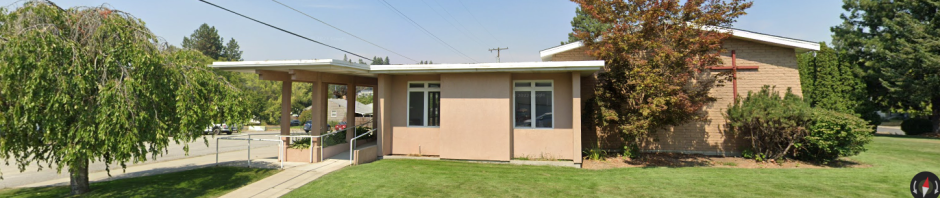
 Spokane Friends Meeting
You must be logged in to post a comment.