Blessings? by Linda Pierce

In the last few months I have developed a complicated relationship with the word blessed.  This bracelet that I often wear has the words, thankful, grateful and blessed.  I have no problem with thankful and grateful, and the bracelet encourages and reminds me to accept and reflect on these gifts.  But I am having more problems with the word blessed.  If I have been blessed — and looking objectively at my life I can say that I have been given a life that has had many blessings, a loving family, a church life and faith, a good education, friends, a wonderful husband, a job I enjoyed and economic security.  But to me blessed also seems to imply in some way that those blessings have been given because of some action on my part.  That I have done something to deserve them.  I find that hard to accept, there are so many in the world that apparently have not been blessed but I know their lives have been lived in honor to God and they are people of faith and belief.  Is my life “blessed” just because of my race, social and economic status?  As I began working through these thoughts it occurred to me that I was perhaps looking at blessed in too narrow and culturally centric view.  Did I believe as do those into prosperity gospel that blessings come down to economics?  Did I believe that my familial status was preferred and what others wanted?  Was I unwilling to look at what blessings were in new ways?  So my query is what does it mean to be blessed?

In conversation with my brother I also thought about the other aspects of blessings, that is to be the one blessing others.  With this thought I began thinking about what I do that offer blessings to others, what in my actions and life can bring blessings to others.  As we say it is better to give than to receive is it also better to be a blessing that to be blessed.  Can the act of blessing others be in some ways that best way of being blessed?  So my next query for myself is What is God calling me to do to bring blessing to others?  

As I contemplated that and did a little research on the concept of blessed and blessing I also began thinking about the gift of blessing that is defined by the verbal and occasionally physical offering of support. One definition of blessing is

BLESSING. Blessing is one of the most common religious acts in all belief systems.  Blessing nurtures hope and wards off fear; it is a companion and assurance in time of peace and a consolation and hope in time of crisis.

The act of blessing forms a bond between the supreme beings and the faithful. The contents of blessing reveal the hopes and fears of humankind.

When we offer a benediction, it is a blessing of the congregation; when we pray or offer comfort, we are offering a blessing to others and calling upon God to protect, comfort and support each other.  With words we can give hope and encouragement and invoke God’s presence.  With that in mind I would like to offer to you today some blessings that might help us get through these times of uncertainty, political unrest and unprecedented events.  One of my favorite books is John O’Donohoe’s To Bless the Space Between Us: a book of blessings.  I have chosen three blessings that I would like to share with you today.

The first is entitled For one who is exhausted.  I think that with the ramifications of COVID and our current status, it is easy to be emotionally, if not physically, exhausted and this blessing speaks to that.

For one who is exhausted

When the rhythm of the heart becomes hectic,

Time takes on the strain until it breaks;

Then all the unattended stress falls in

On the mind like an endless, increasing weight.

The light in the mind becomes dim.

Things you could take in your stride before

Now become laborsome events of will.

Weariness invades your spirit.

Gravity begins falling inside you,

Dragging down every bone.

The tide you never valued has gone out.

And you are marooned on unsure ground.

Something within you has closed down;

And you cannot push yourself back to life.

You have been forced to enter empty time.

The desire that drove you has relinquished.

There is nothing else to do now but rest

And patiently learn to receive the self

You have forsaken in the race of days

At first your thinking will darken

And sadness take over like listless weather.

The flow of unwept tears will frighten you.

You have traveled too fast over false ground;

Now your soul has come to take you back.

Take refuge in your senses, open up

To all the small miracles you rushed through.

Become inclined to watch the way of rain

When it falls slow and free.

Imitate the habit of twilight,

Taking time to open the well of color

That fostered the brightness of day.

Draw alongside the silence of stone

Until its calmness can claim you.

Be excessively gentle with yourself.

Stay clear of those vexed in spirit.

Learn to linger around someone of ease

Who feels they have all the time in the world.

Gradually, you will return to yourself,

Having learned a new respect for your heart

And the joy that dwells within slow times.

The next blessing is called for the Interim time.  We are caught up in a time when we don’t know what the future will look like, we are unsure of what direction our lives will take; this blessing speaks to that.

For the interim time

When near the end of day, life has drained

Out of light, and it is too soon

No place looks like itself, loss of outline

Makes everything look strangely in between,

Unsure of what has been, or what might come.

In this wan, light, even trees seem groundless.

In a while it will be night, but nothing

Here seems to believe the relief of dark.

You are in the time of the interim

Where everything seems withheld.

The path you took to get here has washed out;

The way forward is still concealed from you.

The old is not old enough to have died away;

The new is still too young to be born.

You cannot lay claim to anything;

In this place of dusk,

Your eyes are blurred;

There is no mirror.

Everyone else has lost sight of your heart

And you can see nowhere to put your trust;

You know you have to make your way through.

As far as you can, hold your confidence.

Do not allow your confusion to squander

This call which is loosening

Your roots in false ground,

That you might come free

From all you have outgrown.

What is being transfigured here is your mind,

And it is difficult and slow to become new.

The more faithfully you can endure here,

The more refined your heart will become

For your arrival is the new dawn.

The last one is called Blessing for Citizenship.  It seemed particularly relevant in light of our political situation.

For Citizenship

In these times when anger

Is turned to anxiety

And someone has stolen

The horizons and mountains,

Our small emperors on parade

Never expect our indifference

To disturb their nakedness.

They keep their heads down

And their eyes gleam with reflection

From aluminum economic ground,

The media wraps everything

In a cellophane of sound,

And the ghost surface of the virtual

Overlays the breathing earth.

The industry of distraction

Makes us forget

That we live in a universe.

We have become converts

To the religion of stress

And its diety of progress;

That we may have courage

To turn aside from it all

And come to kneel down before the poor,

To discover what we must do,

How to turn anxiety

Back into anger

How to find our way home.

So as we enter into more time of silence in the Quaker tradition, let us accept the blessings that have been offered and contemplate what we can do as individuals and as a community to be a blessing to others.

This message was given to Spokane Friends by Linda Pierce during Sunday worship service on September 28, 2020.
Posted in Messages | Comments Off on Blessings? by Linda Pierce

Life in a Procrustean Bed by Walter Simon

One of the great joys of my life was hearing Gilbert and Sullivan performed by the Doily Cart ensemble from London; and as prologue offer the lines from Iolanthe’s Nightmare song:

 When you’re lying awake with a dismal headache, and sleep is tabooed by anxiety, I imagine you may use any language you choose to indulge in without impropriety. 

Those who know me have noticed I look in, more than out.  I do not know what to say in exact terms, but think…  “It’s impossible to perfectly inhabit another person’s experience.” (Molly Worthen on Empathy NYT 2020.) I fail to assess the value of my life, leave the task to those who survive me!

However, my work reflects others, principles I find attractive, if not heroic. I think it difficult to be public, and my unexpected career happened without plan or reason.  

Because my nature seems eccentric to those who do not know me, it was easier for me to seek privacy, and frankly spoken never hope to rise above my middleclass goals, and blue-collar roots.  It’s what I am.

Creativity, a constant in my character, emanates from an amazingly simple thought process.  Though granted I do look in too much, once in a while take a peek at what’s real, and what is not. Stark reality scares me!

To dare introspection: I assume we are what we feel. I wish to be remembered as an essayist and poet. However, I have asked my biographer, who inherits the archive, an animator from Portland, Oregon, to turn me into a cartoon, when requiems fade.  That’s the kind of life I’ve lived, leaping from one weird boxed frame to the other.  

What is known: I have spent most of my life interacting in other people’s lives as performer, media grunt, documenter, and essay writer.

What you can trust in me is a sense of humor exploiting ironic twists. My close friends are performers and musicians. I’m cautious of intellectuals.           

I embrace Thomas Merton: often thought I should be a monk, away from the contradictions and foibles we encounter through life experience; and fantasized living in a cave, which seems not so normal for a kid born in Newark, New Jersey, a neighborhood of  tenant-housed immigrants.

During low moments in my writing career, I learned the meaning of the Greyhound Bus and sleeping on friend’s couches, but recently discovered no fulfillment in a stereotypic cave like room. I accept, indeed value inside plumbing and electricity. 

I’m studied in phonetics, kinesics, and aspects of social anthropology, have worked in children’s theater, know stage craft, aspects of Native and First Nation sovereignty, assorted American  poets, able to report on value systems and the social condition.   

My early insights came from elderly Jewish men with Russian accents, who grew up on dirt floors, somewhere off-the-edge of 1917, in the Ukraine, those who got out before the Soviet purge, also survivors of WW II German death camps. Lessons held  in my frame of reference. 

A simple person stands before you.  The roadmap to this state-of- mind is mostly inspired by,  as mentioned Thomas Merton, also include George Fox, E.B. White, Lao Tzu, Pope John XXIII, as well Korsevitzky, an early linguist. Lest I forget James Baldwin for soul, and Zane Grey for sentiment. I am a pacifist, a direct result of  my experience as a Korean War veteran. 

At the age of 14 was caught-up in serious media focus, given I was shot,  a street fight… front page material!  By age 15 the embedded trauma put me on the street, eventually the road to Maine and from Maine to California, working first on lobster boats and kitchens, as a pot washer, along the way, learned a trade –recipe by recipe.                   

In Berkeley age 17, by 1952 and road weary, hit a dead-end, so I enlisted in the Army –a reasonable step: food, dry roof, a chance for a high school diploma, and college opportunities. Unread, learned soon after enlistment, the Korean War was an existential threat.

As a great gift, while in the service, along came a kind gesture, a graduate from Haverford, a Quaker Friend, taught me to read with proficiency and write a simple sentence. In process owe gratitude to Carnegie libraries, indeed  interesting years followed, ones of  learning.    

 Events became more positive and eventually a high school (GED) diploma from Tombstone Union High School, a real achievement! I thrill to mention it

My readings in general include Greek playwrights ,   including Aristophanes,  progressed through Marlow and Shakespeare, to poets as Frost, Blake, the Browning’s’, Shaw. Also,  Sandburg for phrasing, Edna St. Vincent Millay for cadence, Dylan Thomas for a Welsh flow, and favor sentimental adventure chronicled by  Zane Grey.  I include the exotic Vachel  Lindsay, once a Spokane resident.

Lindsay, from Springfield, Illinois,  housed about two years at the Davenport Hotel in Spokane in the early-twenties, the guest of  Ben Keizer, a Spokane  attorney, a managing director of the Marshall Plan active in feeding the hungry following World War II in Europe. Ben’s daughter Carolyn, with ample exposure to Lindsay’s long vowels,  and his exquisite children poems, became a major poet, teaching in her later years at the University of California in Berkeley.  My writings on Lindsay and Carolyn Keizer were placed in Spokane Library archives in 1981.

 In passing, I know the desperate meaning of street riots; and equally the joy of surviving.  For personal insight, I am not capable of killing, though in ironic contradiction have griped a fly swatter in my impassioned hand on warm country days.  

Accept my interest in Quaker teaching, a justification which made me active through the ‘sixties, in association with American Friends Service Committee.

As to the journey, I’ve performed from the age of 9, mostly puppets which proved a career from the age of twenty working through King Feature and Paramount Properties,  voice overs, and theatre shows, two tours included, as a Popeye voice with puppets. Seeger’s cartoon creation was enjoying a renaissance from 1959, working out of New York City.  Yes, I play with dolls!

After two years on tour, took the money and went to a 2-year professional school in Boston, Leland Powers, and learned through phonetics to drop the Jersey accent, and developed a mid-western commercial voice, as well the technical and legal aspects of broadcasting.

By 1960 back in New York City, worked a few shows, some marionette, also technical work at Shakespeare in the Park –first season.  At that time, married a bright young lady with academic interest who was attending Rutgers as a freshman. 

A call from CBS, New York, got me a job in Seattle at KIRO TV, writing promotional copy, but transferred into marketing products in supermarkets. To exaggerate the point:  I’ve sold a million candy bars to unsuspecting children. Dentists liked me; mothers did not.  Maia maxima culpa.

By 1962 held a voice and management position for the Heritage Network, 7-stations on the West Coast, operating from Bellingham, Washington.

Along came the World’s Fair in 1962, and I became their public voice for 6-months, as an adjunct assignment.  My voice has been coast-to-coast, working local feeds out-of-Seattle, including the Seattle Symphony Orchestra. Was the voice of Public Television in Western Washington for 5-years.     

By 1967, my marriage dissolved, as the wife, now holding a PhD, went off to teach  Political Science at a Canadian University. Got the feeling I was an inconvenience. C’est la vie, mon Cherie

With enough money in the bank in my early thirties  I started at the University of Washington, supplementing, on income from PBS, and university radio, plus TV studio work, and commercial stage make-up –a development at the dawn of digital broadcasting. 

Out of college with post graduate work behind me, now studied in Anthropology and Archeology, with extra research at Columbia University, was hired at KING TV, NBC… Seattle, where I better learned TV production and script formats. This led to nighttime talk radio, an explosive venture, for it seemed the more I antagonized listeners, the better the ratings. Survived anonymous threats

As a promotional writer and commercial voice the ride lasted through a series of public events finally hitting my career peak writing on science at the Pacific Science Center. This job was earned, as the result of my personal interest re-constructing even toed mammals. Don’t ask! (artiodactyls)

At the Pacific Science Center my writing caught the interest and imagination of  colleagues working the wire services.  By 1975 my images were being published around the world, newspaper stories of leaping rats and tight-lipped mollusks, also illusions of-the-eye.  More than I would dare expect, leading to a conclusion I had too much influence, but lacked conscience. Commercial work has a way of rotting the soul.    

Big offers came in during that time, but now, middle aged,  understanding my gift, staggered by some of it, I had to make a choice between taking corporate bucks, or surviving as an independent. In simple terms, take the money, do the job, is for me, the same thing as saying, “Crawl in bed with dogs, and you are bound to get fleas!” .

My decision was to travel the northwest to polish my writing style. Gain insight. Hence from 1976 learned to interview and archive.     

By 1981, I stopped by KPBX FM, Spokane and was given a modest scholarship through Etna Life Insurance, a one year learning experience, though I confused a few listeners, annoyed some, I was writing poetry, frosting on the cake, such gave me money to travel backroads interviewing and broadcasting the interests of those I met along the way in Western Washington.

I appreciated that period in my life the most. The program was titled In Praise of People and produced 48-half-hour shows  over a years’ period.  It built confidence and polished technique.

During that time, I wrote my first volume of poetry in a Newport barn, my home for a year.  I now have volumes collected from the last 45-odd years.

This followed by a series of readings across the USA, sometimes Canada. The rest of my life has been easy by comparison. Mostly I covered Native American and First Nation sovereignty, the Inland Waterway, also the Gulf of St. Lawrence where I reported  the collapse of the cod industry off Nova Scotia, some work published in 4-languages.

Have dual citizenship, sustain residence in Montreal. I’ve learned to never let achievement and honors go to my head, understanding I’m only as good as my next job.   

 In this regard, I anchor myself to the earth on Quaker thought.  It’s how I balance that incessant voice in my mind, reflecting on childhood nightmares and the present chaos of American divisions, stimulated by unethical demagogues who exploit hopes, expectations, and violate constitutional protections.

My one great love of twenty odd years Martha Iuster had a stroke in 2016.  It remains too sensitive a story to tell.  We lived in Montana juxtaposing the Bob Marshall Wilderness, our neighbors were bears and later on our rural farm on the edge of Eugene, Oregon.  I live in her memory; learned from this dear woman the profound value of love. She remains an indelible figure in my life.

In summary, I’m a flag-salutin’ American who is grateful for all that has been offered and find myself mostly at peace in this role.

 As to family, thankfully my son, who prefers to be Canadian,  prospers as member of a well-funded non-profit foundation focused on neurotechnology, supported by the Canadian Government, in Montreal. 

To sum my life’s journey, along the way have skipped over puddles, but stumbled into a few potholes.  When asked, and it seems to happen frequently, how to define myself, simply offer my name.

I accept Quaker values to guide my life. Paraphrasing this morning, I’ve explained my meandered life’s journey, and report I’m pleased to know I’ve outlived my critics.

What have I learned?  Choose worthy goals, never act with bad actors, not ever exploit the vulnerable, be generous, that the tongue is the deadly enemy of the throat, if your puppets talk to you, get out of the business, most important you can’t eat awards, silence has many meanings, and one significant last thought–I embrace three powerful cravings in this world:  love, knowledge and a good corned beef sandwich!

            Be at peace Friends. Pacum en terrace. (Pope John XXIII)

This message was given to Spokane Friends Meeting by Walter Simon on Sunday, September 13, 2020.

Posted in Messages, Sermons | Comments Off on Life in a Procrustean Bed by Walter Simon

LaVerne’s Songline by LaVerne Biel

This is about my personal journey and hopefully is a chance for people to get to know me better.  I struggled with facts and timelines and quickly realized that those really didn’t define who I was or explain my worldview.  I loved Tina’s visual aids for her personal journey.  I realized that it is a little harder to do using Zoom. 

My walkabout is more of an Aboriginal Songline or Dreaming that meanders and intersects with inspiration and purpose (although you don’t know it at the time).  This Songline or Dreaming has no clear direction only an outcome.  Sometimes… just sometimes…. Wouldn’t it be great to start at the end! 

I recently took a facebook challenge from Mary Hansen that listed a bunch of words in a large block.  The first three words that you saw in the jumble were supposed to represent you.  My three words were:  purpose, connection, and strength.  (huh…… okay…..then) this was a great start.  Why were these words important to me? 

I have known some of you for many years, some for a few years, and some a few months.  I want this to be interactive.  Since I worked in technology, I thought I would put together a short game to see how much you really know about me. 

If you have a  Smart phone or smart device, you can go to www.kahoot.it on your internet browser if you want to play.  Ask if you need help.  It will ask you for a pin number and I’ll give it to you when I start the game.  Then it will ask you for your name. 

[Play game (questions on Kahoot!)]

  1.  LaVerne is:  ;
    1. The oldest girl of 3 children
    2. The oldest girl of 5 children – correct answer
    3. An only child
    4. The oldest girl of 4 children

 2. LaVerne was adopted (T/F):

True

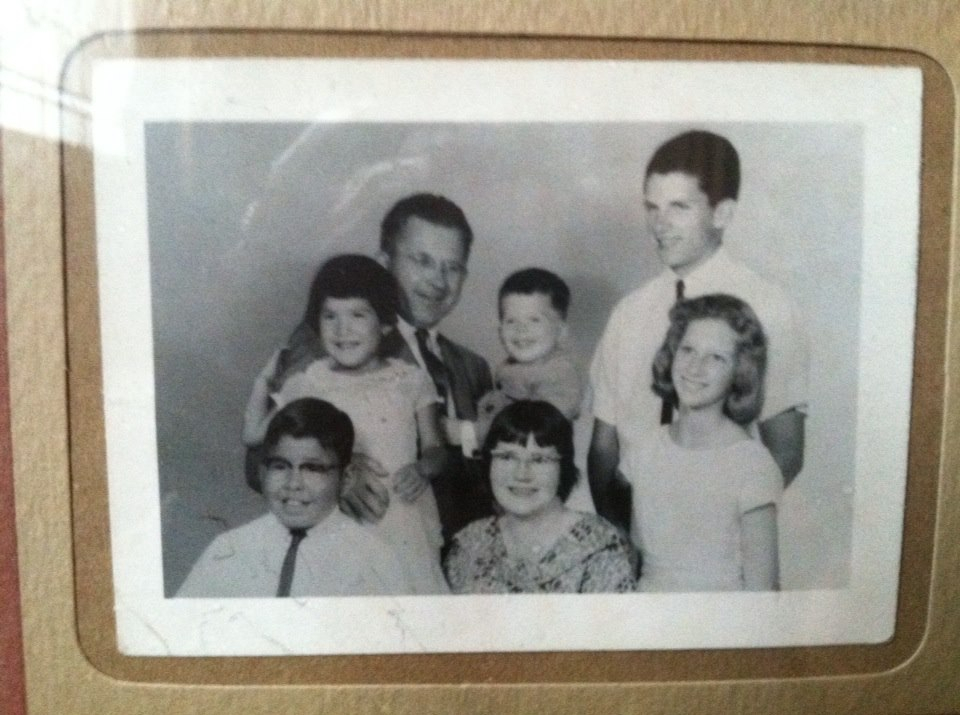
Four of us were adopted and my youngest brother was born to our parents after they were married 21 years.  This picture was taken at Thanksgiving 1963.  This is the last family picture before my mom died from cancer June 1964. 

 3. LaVerne was raised primarily where ?

  • On a farm in Oregon
  • In a suburb of San Francisco, CA correct answer
  • Near Grant Elementary School in Spokane, WA
  • Outside of Tacoma

(although I did live in all these place and lived with my grandparents during the summers). 

 4. LaVerne’s birth name was (pick one)?

  • LaVerne
  • Audrey
  • Mary Jo – correct answer
  • Doris

(I learned about my birth name when I was 31 going through my adoption information.)

  •  LaVerne’s first job was: (pick one)
    • Working in a cannery
    • Washing dishes – correct answer
    • Working as a waitress
    • Working for a florist

(I worked all these jobs while I lived in Salem, Oregon)

  •  In my late 20s (as a single parent) I struggled with:
    • Depression
    • Finances
    • Finding employment
    • All of the things listed (correct answer)
  •  In what order did LaVerne perform office work (move colors in the right order and hit K to finish?
    • Data Entry
    • Receptionist
    • HR Compliance Officer
    • Finance/Sales (correct order)
  •  I was raised by:  (pick as many answers that apply)
    • Traditional parents (mom and dad)
    • Grandparents
    • Dad and Stepmother
    • People from our church (all answers are correct)
  •  I finished my undergraduate degree in 2003.  What was my degree in?  (pick one answer)
    • Management communication – correct answer
    • Theater Arts
    • Music
    • Accounting and Finance

Any surprises?

Finding my Purpose:  When I applied to Western Baptist University for my undergrad degree in 2001 they asked me to write a testimony.  I had the same struggle then as I do now with dissecting my life.  Now you know a little about my early family life I’ll read to you what I wrote about what happened after my mom died. 

I was 13 when my father remarried and we moved to the valley.  I was unprepared for my trip to the valley.  At first glance the Valley’s lush green walls, occasional blue skies, and running river were beautiful.  However, in time its high walls felt confining, the darkness oppressive, and the river turbulent.  The river divided my dad and us children offering us little protection. 

This described a harsh abusive household that was filled with mental illness, drug abuse, violence, and volatile rules.  Our family was shattered.  The good news was that God gave me hope during this troubled time.  (from my 2001 paper)

It was at his time that our church visited the Valley, and brought gifts of compassion understanding and love.  It showed me that Christ’s Church is really “the people”.  People who were Christ’s ambassadors.  They left me the gift of Faith. 

….I left the Valley with Faith alone. 

I left home at 17 and moved to Salem Oregon and then to Spokane when I was 20.  I had no other family here.  I wanted anonymity from my family and from God.  I ventured toward other faith practices and found them empty and meaningless.  I worked as a waitress for 10 years.  I believe I married in my early 20s because I thought it would provide me some stability.  I put my faith in a safe place but didn’t bring it out very often.  I thought I could pull the faith map out when I wanted it.  I discovered that the stability I sought didn’t come with love and acceptance.  The marriage gave me two wonderful kids, no self esteem, and no money.  This is another passage from my 2001 paper:

The isolation of the Desert appealed to me after my stay in the Valley.  It had vast open spaces, stark regal mountians, sparse plant and animal life, continual warmth from the sun and sand, and limited water. 

I had brought Faith with me to the Desert and my hat of Trust-in Self.  I left behind the armor of Trust-in-God because I believed that reason and logic were enough for my “walkabout”. 

I wandered in the Desert (although not for forty years) with my hat of “trust-in-Self” and discovered that the Desert is a deceptive place.  Its open spaces caused me to wander.  The place I was seeking turned out to be mirage.  Children were born, and my marriage dissolved.  The Desert mountains became unobtainable, and its insects crept into my camp.  In the cold and chilling evenings wild animals roamed freely.  Its sun and sand scorched me, and the water came only in drenching rains.  My hat of Trust-Inself had worn out. 

Armed with Faith alone, I crawled on my hands and knees out the Desert.      

Even now its difficult for me to read this.  I had been seeking God’s direction and putting together a plan on rerouting my songline.  My songline needed to pivot on God’s guidance, my children’s wellbeing, and obtaining some job skills.    

First I talked about my Purpose and now I’ll talk about My Connection:  I had people directing and guiding me.  One pivotal person was Larry Edmonds (he use to attend this meeting) who ensured that I got a job with the Soil Conservation Service doing data entry and directed me to this church.  From my 2001 paper:

During my climb to the mountains, I once again came across Christ’s Church.  This time it showed me the meaning of forgiveness, and I finally put on the armor of Trust-in-God. 

The view from the mountains was breathtaking.  From their vantage points I could clearly see the paths I had traveled.  They offered me protection from the winds, gave me warm rains, lush green valleys, blue skies, river lakes, and nourishment.  The mountains offered the safety that I had not known since I was a child.  …………….. With the armor of Trust-in-God secured, I began to freely walk around the mountains. 

I believe that God had his hand in me meeting Kent.  He was an answer to prayer.  We blended our two families, struggled with jobs, finances, starting a business, and mending deep wounds together.  We learned to lean on each other for support.  Connecting my past encouraged me to understand and love my step children unconditionally.  Looking down from the mountain I can see how every challenge brought me better understanding about myself and others in similar situations. 

Purpose, Connection and now Strength:  God continues to give me strength when I am weak, disheartened, and confused.  I love David’s imagery of the 23rd Psalms. 

Psalms 23 (my paraphrase)

The Lord is my shepherd, I shall not be in want.  (because he is there to lead me)

He makes me lie down in green pastures,  (Really he forces me)

He leads me besides the still waters, (this was a lake chosen for me.  It was during my first visit to the Lake of beside the still waters that my relationship with Christ changed.  I had always known that Jesus was my Savior, but her he finally become my shepherd.)

He restores my soul.

He guides me in the paths of righteousness for his name’s sake (a pledge of protection)

Even though I walk through the valley of the shadow of death, (and the desert of trust in self)

I will fear no evil,

For you are with me;

Your rod and your staff, (will defend and carry on to guide me)

They comfort me.  (finally)

You prepare a table before me

            In the presence of my enemies. (in plain sight of the shepherd)

You anoint my head with oil; my cup overflows, (you protect and give me enough to share with others)

Surely goodness and mercy will follow me (God’s goodness and love will shadow over me.  It’s nothing I can produce on my own)

            All the days of my life,

And I will dwell in the house of the Lord forever.  (ahhhhhhhhhhhh home at last)

With Christ as my Shepherd I am free to continue my journey.  John 10:27-28 – My sheep listen to me voice; I know them, and they follow me.  I give them eternal life, and they shall never perish, no one can snatch them out of my hand.  The Shepherd maintains infinite peace and protection for me and for all of you.     

My aimless walkabout has ended.  My dreaming continues because I can walk confidently in God’s grace and generosity.  I can move confidently with purpose, connection, and strength.  Or maybe (just maybe) the Shepherd wants me to reverse the order and have the strength and insights to maintain connections with people on purpose.  I must continue my journey because my songline is not finished. 

This message was given at Spokane Friends Church by LaVerne Biel on Sunday morning, August 30, 2020.

Posted in Messages | Comments Off on LaVerne’s Songline by LaVerne Biel

Kindness . . . the sharing of light and love by Walter Simon

In this summer of violence we experience as Americans a divided nation, social edges frayed by hostility and confused by self-serving, awkward, and politically skewed interests.

In faith and understanding what I offer today is to express our obligation to find reason and strength by reinforcing common values in favor of our long-term survival and the longevity of the nation that serves our generation and the future prospects of our offspring. It’s an endorsement for kindness, as a cohesive device for bonding –a psychological tool for a better, more positive point of view.

In the last month I’ve had doubts about my ability to write on kindness, given recently I have failed at moments, but today, overcoming questions, hopefully represent a road map for us to consider.

For those, as myself tricked by justification, all I can offer are methods of understanding, but first let’s consider a few lines of a song I remember sung by Benny King:

STAND BY ME

“… no matter who you are

No matter where you go in life

At some point you’re going to need

Somebody to stand by you…”

If you choose by imagination Barnaby’s Fairy Godfather,  let’s say an imagined alter ego, you run the risk of  redundant thinking where logic becomes circular and stalls growth; but if you choose to join the greater society, think beyond yourself,  you have the potential of emotional growth, to build bonds with the greater society, for example as referenced to Christ in Mathew 22:39:  “Though shalt love thy neighbor as thyself.”

I offer for your consideration the use of kindness, and to grow by building bridges, inviting those to whom you offer kindness to stand by you, as a useful reinforcement of the good in you, shared with others.

In my own case, I’ve had to ask myself to go deeper than my potential to show kindness, to breakdown a wall of defense. Not easy, but what is offered today is the potential to understand the social benefit of kindness.

There is no society of one. As fragile as our present nation may be, kindness I recommend builds character and community.  I pose it’s good for the mind, let me add a nourishment for the soul, indeed a confidence builder, a well-installed reminder that actions speak louder than our more persuasive thoughts.

Some sympathetic words for understanding kindness include compassion, benevolence, sympathy, humanity, and helpfulness. I’d like to explain to you this morning the thoughts of others, who have given to acts of kindness.

Walter Cronkite, noted at a broadcast convention I attended in the mid-sixties… an insightful reminder.  The CBS anchor and distinguish broadcaster was talking about the value of a good dog story as a capper in the news, but he paused and reflected: “…that theoretically man’s best friend should be man, but it’s been a longtime coming.”  Change may be slow, yet with hopes unfilled –a nasty fall of spirit– we are compelled in the interest of emotional survival to keep trying for personal growth.

Recall the New Testament as a guidepost for understanding kindness inspired by example, as in the teachings of Jesus Christ. We hopefully expect these models to come from our leaders and social guides  whether in the White House, or by state governors, eleemosynary associations, neighbors, from our parents, guardians, and the pulpit.  As Cronkite quips, it doesn’t quite work this way.  Presently kindness seems limited, but I insist needed now more than ever in our everyday lives.

This is a talk about what it means to be kind. For example is kindness an honest gesture or a tool used as a manipulated device, for exploiting others? Unfortunately, the answer is yes to both points of view.

As positive reinforcement be pleased to know World Kindness Day is internationally celebrated on November 13th , and one would think the fact of its’ recognition would include a day off from work, yet few in the USA know of its’ existence.  Perhaps we should paint the date on the streets of America.

Equally understand these four letters K I N D, have been in use for over 500 years, offering a positive gesture of support.

Benevolence is a kind-of-kindness, but let’s start with Eric Fromm’s thoughts on love, as a significant generator endorsing kindness:

       “ I love you also myself.” Self-love, in this sense, is the opposite of selfishness. Love, paradoxically, makes me more independent because it makes me stronger and happier. In loving I experience “I am you,” you — the loved person, you — the stranger, you — everything alive. In the experience of love lies the only answer to being human.”

In my words: “Overcome hatred with love; and remember kindness is not weakness.”

For insight: We can heal someone with kindness,  forgive foolishness out of the kindness,  and take nourishment from the milk of human kindness. Such thinking helps to bring a gesture of kindness to others, making us better for the offering.

Abe Lincoln delivered a good example of kindness at Gettysburg, in recent history Ronald Reagan touched on his sensitivity after the Challenger explosion, more recent  Obama voiced his compassion, adding tears after the Sandy Hook shooting: “shared  vulnerability and our natural sympathy for one another,” as noted by the  esteemed columnist A.J. Doyle.

Casual research reveals that the word kindness ranks in the top 30% for usage, which suggest it’s use is an important constant in our collective minds. The word holds historical reference implying sensitivity and our natural sympathy for one another. Kindness, the word root, was used before the 12th century and obviously is still in use today.

In 2020 we seem to need kind thoughts and gestures, a contemporary application, understanding the word kindness offers a dimension of understanding as a sincere offering, a gift-of-grace to enhance the human condition.

Definitions include the quality or state of being kind treating people with kindness and respect a kind deed, a benefit as “You did me a great kindness”.  To speculate: in the primitive sense think of an affection built into our persona from birth.

Suggested alternative words for kindness include a boon, courtesy, favor, grace, indulgence, mercy, and service.  Lots of wiggle room for expressing kindness and its use, but for motivation consider some  amending examples.

We see instances of our brothers and sisters “paying it forward” add a trumpet message that kindness will change our lives for the better. Consider kindness to you is kindness to me –to extend this thought, consider in fact kindness to yourself is kindness to others, in fact builds an internal strength. It is suggested kindness improves mental health, helps to make  the world a better place by celebrating and promoting good deeds.

It was Henry James who wrote in the early 20th Century emphasizing humankind’s cardinal virtues  and most cherished social currencies to be: “The first is to be kind.  The second is to be kind. The third is to be kind”.   Kindness to children is considered a key to their happiness, clearly makes us happier parents.  Theoretically it works against the cyberbully. Kindness and self-compassion go hand-in-hand.

I have offered the thoughts of others more qualified than myself to explain kindness but understand what we share with each other has a meaning that goes beyond the hidden conflicts of our childhood and human foible common to our adult lives.

If we give-up trying as a society, based on the divisive fractions that seem to separate us, we run the risk of failing.

This is an appropriate time, if you accept basic Quaker principles, as I understand them, to accept the obligation to speak on the conviction that there are solutions to present conflicts, to offer reasons why peaceful resolution, passive resistance and nonviolence are good examples supporting peace on our streets and in our hearts, a kind gesture in the face of contemporary conflicts, asserting the intrinsic value of humanity.

Recall a recent TV public service advisory:  Restore Hope; Dream Again.

I learned many years ago that the eyes are the gateway to the soul. Beside mugging on stage, I ask you with kindness intended, not to look away from our obvious present national conflicts, for it offers a potential danger that obscures our willingness to make positive change seeking betterment of all, all that represents us as Friends. As Francisco Burgos,  recently posed: “Accept the challenge”.

What I have avoided in this essay is a comment on the lack of trust in evidence between the police and the civilian, between citizen and government.  These are less than obvious issues that will not be easily resolved. The threat is understandable, the outcome deeper than my comprehension.

I do hope historians will be kind to us, and civility will prove a good measure of a core understanding that “United we stand and divided we fall”.

Use of guns, nightsticks and tear gas is not a solution, but a desperate failing of reason, a measure of self-interest and the reckless craving for control, that seems a spear in the side of our democratic traditions.  Who of us will rise beyond protest, to endorse a mutual kindness that offers prosperity over willful self-destruction?

Thank you for your courtesy this morning.  Suggesting a weakness for whimsey: I consider it a gesture of your kindness.

Like King’s song imbedded in this talk:

“If the sky we look upon… should tumble and fall; though mountains should crumble to the sea…” (kindly) stand by me”. #


This message was given by Walter Simon to Spokane Friends Meeting for Worship on August 9, 2020.

(Dedicated to LaVerne Biel and family for their recent kindness.)


Posted in Messages | Comments Off on Kindness . . . the sharing of light and love by Walter Simon

Finding the Lost Coin by Oscar Mmbali

…. ‘Celebrate with me because I’ve found my lost coin’ (Luke 15: 9)

Our ministry in Belize, looks like the parable of the lost coin (Luke 15: 8-9). It is like a house with many things in it, and it is dark, then a coin is lost. To find the lost coin, one must light the lamp, start turning things around, until the lost coin is found. In this speech, I will illustrate how the southside is full of things, that can keep the coin buried unless someone lights the lamp. I will also illustrate how turning things around make it possible to recover the lost coin.

The Southside of Belize City is like the house in Luke 15:8-9, with so many things in it. So, when something valuable, though small, like a coin, falls, it is lost in there. Years ago, a Mennonite businessman build a warehouse near the port of Belize. He sold auto spares. He created jobs for a few people from the community. Then his business started experiencing challenges. Finally, it closed. Nothing happened over there, for a couple of years that followed. The bank auctioned his building. It was like the feeling of the lost coin.

When I first visited Belize, Friends had just purchased this building. It was in a bad shape. Pigeons lived in an apartment upstairs that seemed livable if cleaned. Friends from Western Yearly Meeting had started cleaning it and Dale Graves had started staying in it anyway. Bees lived in the ceiling downstairs. Friends had a vision to make this place a school, a church and a community center.   

I wanted to cut my hair. So, Frank took me to a barber shop and introduced me to one of the barbers. We then started a conversation. He wondered why Friends had kept this school alive for years. He wondered why Friends would want to have a church on the southside and what good a community center would do. The southside, to him, was irredeemable. His, was not an isolated view. On many occasions, Dale and I went around Belize city shopping for a vehicle or running other errands. Dale was an amazing storyteller. I remember on several occasions, vehicle dealers, warehouse attendants, mechanics, and store attendants listened attentively to Dale tell the story of Friends in Belize, then suggested other places on the North side that would be better for what Friends were doing in Belize city. That is how it feels when you have lost a coin, and there are so many things in the house.

OLYMPUS DIGITAL CAMERA

I know students who dropped out of school because their parents did not have $Bz 10(US $5) to apply for a social security card. Every year, I have seen kids who are afraid or reluctant to fill high school application forms, because their parents can’t afford $Bz 20 (US $10) high school application fee. Last year, one parent came to school for a meeting and said all she wanted for her twin boys, was to know how to read and write. However, the boys excelled that expectation. They passed primary school examination. One was admitted to Wesley College while another to Excelsior High school. All are on FUM scholarship.

I have been there when Maggie called some parents for months and pleaded with them to come to school, but they were afraid to come because they wondered what else they could do to help their children. I have been there, when parents were excited that their kids at Belize Friends school had passed examinations and were going to high school. Then the next moment, they were overwhelmed with anxiety because they did not have money to buy shoes, shirts, pants, books or pay fees for high school. In our ministry, we mostly deal with young people who have lost or are at risk of losing something valuable to them. It feels like the experience of losing a coin, one that could make all the difference if you got it back.   

On Sundays, we used to open the church door to the yard, so that kids could go there and play at least before the service started. However, we learned that every time they saw a police patrol truck passing on the street, they all ran in commotion back into the church. We have a Police patrol truck passing on the road after every 10-15 minutes. That is a lot of running while scared. Something valuable, freedom to live in peace, confidence and safety has been lost in this community. That feels like a lost coin.  

While serving in Belize, I have had an opportunity to meet the Minister of Foreign and Home Affairs, the CEO in the Ministry of National Security, two Commissioners of Police, church leaders and community leaders, over improving relations between young people and police, improving police detention facilities, and improving community safety. I have learned that all of them grew up on the southside under difficult circumstances. Even though we have made progress on some of the policy issues we have talked about, they have insisted on the role of faith-based communities to support young people on the southside, because there are things government cannot do, or do effectively like faith-based communities can. It takes a lot of community support to help young people on the southside navigate challenges that come from poverty, violence and limited resources. For those young people whose parents or community has given up on them, they are most vulnerable because of the many things that stand in their way to success. Therefore, we become that community to help them go through all that stands between them and the lost coin they are seeking.

To find what is lost, especially if it is something that can be easily abandoned, or difficult to see, you need someone like the woman in Luke 15:8-9, to light the lamp and start turning things around, until what is lost is found. The support you give us, the resources, and the mission trips you make to Belize makes it possible for us to light the lamp in this community and start turning things around. Over the past three years, I have seen Friends from Western Yearly Meeting, Indiana, Iowa and Wilmington, coming to Belize to work on what was formerly a warehouse, to turn it around and make it a school, a church, and a community center. I will highlight what that lamp that was lit here, and the efforts to turn things around have achieved.

Among the young men I work with, is a 13-year-old boy. One day, when he was 11years, he came to church and told me his mother had been arrested. He was staying at home with his two little sisters who were 10 and 8 years. He wondered what he could do. As I drove around the city picking other kids to bring to church, I asked him to make a list of things his mother did everyday to take care of them. Then I told him to go home and do for his little sisters, all that his mother had done to take care of them. I called a retired judge and a lawyer who I had known during the Community Safety Forums we were hosting at Belize City Friends Center. She took the case and days later, this boy’s mother was released. The boy was at the time a student of Belize Friends School. He later passed primary school examination and was admitted at Wesley Junior College, one of the top three schools in Belize. Over the last two years, he has retained the second position on the College’s Honor Roll because of his outstanding academic performance. He wants to become a lawyer so that he can help people like his mother. We have three students from Belize Friends School at Wesley College. Two of these have been on the College’s Honor Roll for two and three years respectively.

Belize Friends Church and Community Center engage in community work in response to the needs that emerge in the community. Since 2017, they have:

  • engaged in advocacy meetings with the Minister of Home Affairs, CEO in the Ministry of National Security, and Commissioner of Police over a range of topics including policing, detention centers, and human rights;
    • hosted community safety forums;
    • conducted community education and awareness campaign against human trafficking;
    • hosted Alternative to Violence Project training;
    • hosted free medical and legal services assistance programs;

Belize City Friends Church is growing out of peer-to -peer outreach. Everyone at the church except the missionaries were invited by a friend or relative. It has been a steady and gradual growth. Usually, a friend invites a friend to church service, field trip or sporting activity. This invitation is often a culmination of friend-to-friend witness conversations about their experiences attending church at Belize City Friends Center. Some of the invited guests choose to come again and soon, they start attending services regularly. Some come sporadically but in the long run, they start attending services regularly. Others come and we never see them again. One woman started attending services after her sister in-law, recommended our church to her. Another woman 26, and a man, 29 started attending services after they were invited by their younger brother. One Belizean, who is now training for ministry, was referred to us by a Friends Meeting he had been attending, while he was in California. Our outreach and evangelism is relational. It is done by Belizeans who have roots in their own communities. The fruit of this ministry calls us to focus our resources and efforts on pastoral care to nurture this peer-to-peer outreach model.

The work of Friends in Belize is to light the lamp and turn things around. We can do so with God’s help. We need your support to continue doing this. We pray that from time to time, we can call you, write to you, or visit to celebrate with you, because we have lit the lamp, turned things around and found the lost coin. Thank you for your support!


This message was given to Spokane Friends Meeting by Oscar Mmbale on August 2, 2020 via Zoom.

Posted in Messages | Comments Off on Finding the Lost Coin by Oscar Mmbali

Soaked in the Peace of Christ by Paul Blankenship

Christ the little girl

Christ is a little girl locked in a basement cellar. Starving, she hasn’t eaten in weeks. Abandoned, she doesn’t know where her parents are. Someone—somehow, for some reason—is pumping a poisonous gas into her basement from upstairs. It is filling the room and becoming the air she breathes.

There is one window in Christ the little girl’s basement. Though she tries to break it open—and free herself to live free of her suffering—her hands are too weak. They bang and slap at the window and then bleed and break. As the poisonous gas fills her lungs, Christ the little girl is dying. Breath by breath.

She is gasping for air now, choking. On the floor—in desperation—she pleads for help.

Everyone hears Christ the little girl’s plea for help, but few understand it. We hear the plea on television and the streets and social media every day. Everyone sees that Christ the little girl is dying, but no one is paying close enough attention. We often look at her presence not with love but fear. We often respond to her suffering not with compassion but violence.

Father forgive us, for we know not what we are doing.

Christ the little girl is living in your enemy. She is dying in the person you hate. Christ the little girl will forgive you but—right now—she is pleading with you to turn the poisonous gas off. To stop cursing her. To have compassion. Understanding. To speak life. Christ the little girl is pleading with you to open the window. To let her breathe. To let her forgive and be forgiven. Without much time left, she is telling you that her window cannot be opened with something that destroys. Please, she says, put the bat down. Put the gun away. Only peace will open the window, she says. She says this in her cursing and negligence; in her hatred and violence. Only peace will set me free, she says.

Christ the little girl pleads for peace in the body of your enemy.

Mother forgive us, for we know not what to do.

Brother. Sister. Friend. Christ the little girl. Forgive us, for we know not what we do.

A divided time

We live in a divided time. We live in a shared wound infected by emotional hatred. Democratic against Republican. Police against people of color. Big business against the poor. Science against religion. Muslim against Christian. Fundamentalist against the world. Father against daughter. Humanity against environment. Often, we become who we are on the basis of the others we reject. Rejection is a power that glues people into place. In this divided time, emotional hatred spreads like an unseen virus. A poisonous gas. A glue used to divide. Somehow it seems and feels right to scorn and ridicule and humiliate the people who threaten us. We do not labor to free the people we hate from their suffering. In fact, we may pray for the people we hate to catch the virus of their own hatred. If we took the virus of emotional hatred as seriously as we do COVID-19, I imagine we’d have the kind of peace Quakers long pray for. This—that emotional hatred be taken as seriously as COVID-19—is only an absurd proposition or fanciful idea when a culture is oppressed under the demonic weight of cruel capitalism and has given up faith that Christ comes to make this world new.

In her book, Waiting for God, Simone Weil wrote that religion is nothing more than a perspective. Religion, in her provocative manner of speech, teaches us to see the world in a particular way. Its fundamental assignment is to set our soul’s gaze in a specific direction. It is an astute observation we can relate to. Quakerism, we often say, is most essentially a learning how to see that of God in everyone.

An anthropology teacher of mine has written that every generation meets god in their own manner. God made us in God’s image, as people often say, and we return the favor. Though we trust that God is universal—that the Spirit transcends space and time—history teaches us that how people come to see and experience God is colored by the unique culture they live in. Culture is a shepherd for sacred longing and seeing.

When the colonies were founded, for example, God was imagined as a kind of invisible police officer who queried into your mind and finances and threatened you with eternal damnation if you didn’t have your domestic house in order. Slothfulness was the great sin of the day. Poverty was evidence of forthcoming hellfire. In the late 1900s, Jesus was imagined as the manliest of manly men in order to save the culture from what many ministers saw as a curse of feminization. It was a great sin for a boy to grow up and be too much like his mother; a sign of spiritual weakness.

In the late 60s and early 70s, Jesus was a hippie. He was cool and with it. You could meet Jesus on an acid trip—as a founder of the church I grew up in did—or take a walk with him through the forest, smoking pot.

Last week, I suggested that we look for the universal Christ in the current political uprisings over racial and economic injustice. I invited us to consider Christ in the black and brown lives matter movements because I honestly believe Christ stands in a particularly sacred way with those who struggle for life and justice against the currents of ignorance and bigotry and hatred.

Today, I am suggesting that we remember that there is that in God in the person who you least expect and hate the most. The police officer who lynched George Floyd; the other officers who were complicit. Nancy Pelosi, Donald Trump, or any other powerful social architect. Christ is in the person standing in the way of justice and peace and truth as you imagined it. In your adversary, Christ calls out for peace.

Language is always a poor flashlight on the often-dark road to divine love, the road I think friends are supposed to help one another travel. The metaphor of Christ the little girl who lives inside your enemy is one limited way—not to manipulate the senses—but to illuminate truth. There is no person or creature divine love does not inhabit. Love is, in the final analysis, what is most real. Everything that is not of love will one day be washed away, forgotten, made new. Nonviolently, we are called to wash hatred away with the healing waters of divine love.

Jesus did not come for the healthy. He came for the sick. The sick is not just the person dying on the side of the road or alone in a hospital or prison. The sick is also the person who has become possessed by hatred and violence. Personally, I cannot think of a greater and more insidious sickness the human spirit could suffer. We are sick when our lives are animated by hatred and violence, whether we came to embody that hatred and violence by social conditioning or personal freedom. Though we are called to fight nonviolently against injustice, we are also called to heal the haters who perpetuate injustice and the systems that create the uniforms people step into.

Let she who is without sin cast the first stone.

Come, Jesus said, follow me.

Soaked in peace

The art of peace is not mastered through intuition. Effective peace work must be learned. Fortunately, we have a number of brilliant peace teachers in the world. They include Jesus, the Buddha, Howard Thurman, Mahatma Gandhi, Martin Luther King, Jr., Cornel West, Marshal Rosenburg, Pema Chodron, Thích Nhất Hạnh, and many others.

Peace work and enemy love—whether in our own house, at work, on the roads and highways, or among nations—also, in my mind, requires being soaked in the peace of Christ. To love our enemies and build peace in a time marked by radical division and emotional hatred, we need to open ourselves to a power greater than ourselves. I do, at least. I need Christ the divine beloved—who swims fiercely and gently in the waters of culture—to empower me to pursue peace with the people I hate.

I want to close by inviting you to consider the spiritual practices that help you soak in the peace of Christ. And I want to suggest that you commit to such a practice with great sincerity in the coming months. Give one half hour a day to a spiritual peace practice—to whatever soaks you in the peace of Christ. As our world continues to grapple with the wounds of racial and economic injustice—and our own nation enters a new and profound election season where leaders will exploit our divisions—we need to be rooted and grounded in the peace of Christ through regular and intentional practice. And perhaps remember that the first battlefield is in your heart.

Sometimes I like to do a practice some Pentecostals call soaking prayer. Soaking prayer involves turning on music that helps you feel God’s love and laying down on the floor with your arms open like you are a sponge soaking the song of divine love into your deepest pores. You do nothing other than accept—experientially, on faith—that you are the beloved of God.

Maybe there is only one rule when it comes to soaking in the peace of Christ—do not do what tradition tells you or what your inner critic says. Instead, follow your own unique soul’s pull into the peace of Christ. No one knows your soul’s gravity except you. And Christ. Your love affair is exceptionally intimate and personal. Go dance there, naked and unafraid.

In Matthew 11, Christ speaks:

28-30 “Are you tired? Worn out? Burned out on religion? [Politics?] Come to me. Get away with me and you’ll recover your life. I’ll show you how to take a real rest. Walk with me and work with me—watch how I do it. Learn the unforced rhythms of grace. I won’t lay anything heavy or ill-fitting on you. Keep company with me and you’ll learn to live freely and lightly.”

In John 14, Christ reminds us:

Peace I leave with you; my peace I give to you. I do not give as the world gives. Do not let your hearts be troubled, and do not let them be afraid.

This message was given to Spokane Friends by Paul Blankenship on July 5, 2020, during Sunday morning worship service.


Posted in Messages | Comments Off on Soaked in the Peace of Christ by Paul Blankenship

The Cabin in the Forest by Paul Blankenship

Inside of you there is a forest. Passed the sycamore trees, the creeks, the night owls, and the crickets, there is a cabin. Your cabin sits under the sun and the moon and the other stars. It was built—and is sustained by—the spiritual gravity of divine love. Inside of your cabin is a fire burning in a fireplace. It is the everlasting and intimate that of God in you. Your eternal home. You are alone in your cabin under the sun and the moon and the other stars. You can’t put the fire in the fireplace out—because it burns from a mysterious source—but you share responsibility for the quality and intensity of the burn. You also share responsibility for what to do with the knocks at your door.

In the book of Revelation, Christ speaks:

“I stand at the door. I knock. If you hear me call and open the door, I’ll come right in and sit down to supper with you.” 3: 20

A Walk through the Forest

Will you take a walk through a kind of forest with me? I want to help you find your cabin and listen to Christ’s knock.

Two weeks ago, a man I call the Rock Whisperer asked if I’d like to go on an adventure. He said the adventure would take one hour and that it would end at a waterfall. Though I was in a foul mood—I woke up late, hadn’t had a cup of Indaba coffee yet, and had a lot of work to do—I decided to go. I reasoned that one should never turn down an adventure that ends at a waterfall—not even if the sun and the moon and the other stars seem to be falling down from the sky and headed straight for one’s cabin.

At 11:00AM, I came outside to meet the Rock Whisperer. He had his dog Bebé and I had my dog Wendell. Beneath grey clouds and a light rain, we began our adventure. I should say that I call the Rock Whisperer the Rock Whisperer because of how delicately and beautifully he arranges rocks along the Spokane River. I never knew someone who loved rocks—and understood their power to love—before I met the Rock Whisperer.

A Talkative Mood

The Rock Whisperer is in a talkative mood. He gives detailed perspectives on politics, religion, science, and the non-human world. Every few blocks, the Rock Whisperer stops and marvels at small flowers. He calls me to attend to their intricate and varied lines of purple. ‘Look here, brother,’ he says. ‘Evolution, sure, but with a divine kick.’ When he speaks like this, it is as though the divine fire in my cabin is warm upon my face.

I am sincerely delighted to hear what the Rock Whisperer thinks and watch him marvel at flowers. His passion for the world is infectious. After an hour of this, however, I am deeply annoyed. Deeply. For one thing, we are not at the waterfall yet. The Rock Whisperer, actually, says we are only halfway. For another thing, I don’t want to hear any more opinions or marvel at any more flowers. I just want to see the golly darn waterfall and get on with my golly dang day. I am also annoyed, I must confess, that I am annoyed. I wish I could be more present to the beauty in this moment. When I have the patience to see, his words grow out of his mouth like wildflowers. Finally, after an hour and a half, we reach the waterfall. The Rock Whisperer lights a cigarette. He asks me if I see how skillful Mother Nature is. I walk close to the waterfall and stand beneath it. This is no Niagara Falls, to be sure, but it is a small wonder and a beautiful power. A true feast for the human spirit.

When the water falls onto my face, I feel like the drops are hot embers from the divine fire inside my cabin; like I am being remade in the divine fire.

The Return

After fifteen minutes of standing beside the waterfall, we head back. On the return, I suggest to The Rock Whisperer that we should just listen to Mother Nature: the creeks, the birds, the wind through the trees, the crack of our feet onto Her dried grass. ‘Yes brother,’ he says, ‘let’s listen to our Mother.’

Ah. Tranquility. Finally, I could enter into a holy silence. I could let the nature of silence hold me like a mother. Before we could listen to Mother Nature finish a sentence, however, The Rock Whisperer said he wanted to take me to another place. No, he says. Two more places. And to get there, he said, we need to go up the hill and around the corner.

Reluctantly, I agree to go as the Rock Whisperer goes on and on again about all the thoughts running through his head. Farewell to tranquility, I think.

‘Here it is, brother. This is what I wanted to show you. The Rock Whisperer points to a sign. The sign says we are standing at the last resting place for Spokane Garry, a former chief of a Spokane Tribe. Spokane Garry—whose Salish name was Slough-Keetcha—pursued peace with whites but got betrayed by their demonic powers of heartless capitalism and colonial religion.

The Rock Whisperer takes me a few more feet to a patch of land under three trees. No sign, but just as sacred. “This place right here, brother,’ he says, ‘is where I used to sleep. I slept here for two years when I didn’t have a house.’ The Rock Whisperer lights another cigarette. He picks up some trash on the ground and puts it in his pocket. He touches a tree that shaded him; he seems to touch his memories.

Holy, holy, holy. Holy is the ground we are standing on. Holy, holy, holy. Holy is the land my ancestors stole. Holy, holy, holy. Holy are the houseless who need houses. Holy, holy, holy. Holy are the trees that remember. Holy, holy, holy. Holy is the Spirit that call us to heal the wounds of the world and labor for the life of all creatures. Holy, holy, holy. Holy are we in our anger and denial and righteousness and love.

I thank The Rock Whisperer for bringing me here, and for sharing his story with me. He said he is grateful to be able to share. He said it is important for elders to pass on their stories. By listening to history, he said, we gain a greater appreciation for the present. I realize now that he has been—in his own beautiful, meandering, and longwinded way—inviting me to be a memory bearer and to labor for the good of life all around us.

I must confess: I often don’t want to listen to the sounds that trouble my serenity. I may block out and vilify what disturbs me. I like my cabin quiet. I don’t often think that a loud knock at the door could be the Universal Christ, bringing good wood for my fire.

Black and Brown Lives Matter

We are in a watershed moment in our country. We are becoming more aware of the degree to which our country violently protects and masks white supremacy and the degree to which we wittingly and unwittingly participate in racial injustice. Slavery and lawful segregation may have ended, but anti-blackness and brownness has not. The murders and lynchings of black and brown people by police are not the result of a few bad apples. It is the result of a rotting tree that was planted in another people’s soil. So, people are rising up. They are taking to the streets and city councils. They are demanding new soil and new trees. They want structural change: that, for example, less money be allocated to bloated, militarized police budgets and more money be given to mental health treatment, equitable education, public housing, and clean water.  

Like me, you may sometimes see the protests and think they are too loud. You may wish people would put down their megaphones and take a silent walk through nature. Like me, you may also realize that is precisely your white privilege that allows you to experience the call for justice and an end to systemic violence as an unnecessary disturbance. Though we cannot condone violence, toxic anger, and hatred, we must see that of God in every protestor and justice builder—violent or not—pleading for what every human spirit needs to breathe and live fully into the call of Christ: justice, equity, peace.

Amos

In Amos 5, the prophet issues a lament and a call for repentance.

(10-12)

People hate this kind of talk.
    Raw truth is never popular.
But here it is, bluntly spoken:
    Because you run roughshod over the poor
    and take the bread right out of their mouths,
You’re never going to move into
    the luxury homes you have built.
You’re never going to drink wine
    from the expensive vineyards you’ve planted.
I know precisely the extent of your violations,
    the enormity of your sins. Appalling!
You bully right-living people,
    taking bribes right and left and kicking the poor when they’re down.

(16-17)

“Go out into the streets and lament loudly!
    Fill the malls and shops with cries of doom!
Weep loudly, ‘Not me! Not us, Not now!’
    Empty offices, stores, factories, workplaces.
Enlist everyone in the general lament.
    I want to hear it loud and clear.

(21-24)

“I can’t stand your religious meetings.
    I’m fed up with your conferences and conventions.
I want nothing to do with your religion projects,
    your pretentious slogans and goals and book studies.
I’m sick of your fund-raising schemes,
    your public relations and image making.
I’ve had all I can take of your noisy ego-music.
    When was the last time you sang to me?
Do you know what I want?
    I want justice—oceans of it.
I want fairness—rivers of it.
    That’s what I want. That’s all I want.

Knocks at the Door

George Floyd. Knock. Breonna Taylor. Knock. Ahmaud Arbery. Knock. No justice, no peace. Knock. The poor people’s campaign. Knock. A green new deal. Knock. A moral revolution in our meetinghouse, in our domestic houses, in our streets, in our schools, in our malls, in our government. Knock, knock, knock.

The Cabin in the Forest Inside of you there is a forest. Past the sycamore trees, the creeks, the night owls, and the crickets, there is a cabin. Your cabin sits under the sun and the moon and the other stars. It was built—and is sustained by—the spiritual gravity of divine love. Inside of your cabin is a fire in a fireplace. It is the everlasting and intimate that of God in you. Your eternal home. You are alone in your cabin under the sun and the moon and the other stars. You can’t put the fire in the fireplace out—because it burns from a mysterious source—but you share responsibility for the quality and intensity of the burn. You also share responsibility for what to do with the knocks at your door. “I stand at the door. I knock. If you hear me call and open the door, I’ll come right in and sit down to supper with you.”

This message was given to Spokane Friends Church by Paul Blankenship during Sunday Worship service on June 28,2020.

Posted in Messages | Comments Off on The Cabin in the Forest by Paul Blankenship

The Stories We Tell Ourselves . . . by Deborah Suess

Text John 14:8-12

My father’s name was Martin Suess.  And while I always loved my dad, it took some growing up on my part to fully appreciate him.

As a 12 year old, Daddy didn’t exactly match my image of the perfect strong All-American father — which in my mind was a cross between John F. Kennedy and Captain James T. Kirk of the Starship Enterprise.

Instead, Dad was a tender-hearted, thoughtful and rather eccentric micro-biologist who promoted his back-to-nature philosophy by refusing to mow our front lawn in order to grow native prairie grasses; that is, until the neighbors wrote a strong letter of complaint which  totally and utterly embarrassed his youngest daughter.

Thankfully, I grew out of that embarrassment stage and learned to genuinely appreciate him — eccentricities and all.  After his death, I mentioned to my Aunt Vera that while I loved his tenderness, I wished I had seen more of his strength.  Vera replied she saw my father as a man of great strength and courage, and she shared a bit of story that my sisters and I had never heard before.

Background: In 1936, as a young Jewish teenager, my father escaped Hitler’s Germany and landed in Chicago.  When he turned 19, he was drafted by the U.S. Army. So Dad’s first return to his native country was as a non-combatant soldier and his primary job was to serve as a translator.

What I hadn’t known, was that one day when he was translating for an interrogator, Dad was asked to curse at and demean an innocent young German girl.  My father refused to translate that degrading message and as a result (among other things) he was demoted in rank.

That was integrity and courage.  And again helped me rewrite the story I told myself about my father.

Some of you know the work of Dr. Brené Brown, a social worker who has done research in the area of shame and vulnerability.  Her research suggests that it’s vitally important to be aware of the stories we tell ourselves.  She illustrates this by describing a time when she and her husband Steve decided to take a swim across a beautiful Texan lake one summer morning.

They are swimming together when halfway across the lake, Brené looks at her husband and is so grateful to be there with him in that moment. So while treading water, she decides to get vulnerable and says to Steve:

“Honey, I’m so glad I am with you and that we decided to do this swim together.”

Her husband replies: “Yep, water’s good,”

Brené feels hurt by his response but decides to make another bid for connection. A few minutes later she catches Steve and says:

“Steve, This is so great! Right now I feel so close to you.”

He answers: “Yep, water’s good,” and then swims away.

Now Brené is thinking: What’s going on? I don’t know if I’m supposed to feel humiliated or hostile.

By the time they arrive back at shore, she is furious but she takes a big breath and then tells him,  “I’m not sure why you kept blowing me off today. But the story I’m making up right now is that one of two things just happened,”

“Either you looked over at me and thought, ‘Yikes, she’s gotten old and doesn’t know how to really free-style swim anymore’.

“Or, you looked over at me and thought ‘Jeez man – she sure doesn’t rock a speedo like she did twenty years ago.”

Steve listened as she spoke. And then replied that he was not trying to be distant but during the whole swim he was focused on fighting off a panic attack. So much so that he had no idea what she even had said to him.

With some embarrassment he went on to explain that the night before, he dreamt that he and their kids were rafting on the lake when a speedboat came screaming toward them, and he had to pull the children into the water so they wouldn’t get killed by the raging vessel. As a result, all  he could do in the water that morning was count strokes and keep swimming to keep the panic attack at bay.  Steve had no idea what she had said to him.

Then it all made sense and Brené thanked him for speaking vulnerably. To which Steve replies, “Oh no — don’t start quoting your shame and vulnerability research to me.

Here’s what you really want: when the speedboat comes raging, you want the guy who takes all six kids and throws them onto the shore, woosh, woowsh, woosh.  And then swims so fast that he lands on the shore and catches them all. And then he looks across the lake and goes, Don’t worry, little lady, I’ve got this[Superhero Steve}

As Brené and Steve realized, they each were telling themselves a story. For her it was about body image, which so many of us struggle with. And for Steve it  was the need  to be a super hero.

Brené Brown concluded that it is vital for all of us to become aware of the stories we are telling ourselves.

Which brings me finally to the whole God thing. So — just as I had to mature in my understanding of who my father was, I have to also keep growing up in my understanding of the Divine.  Or to put it another way, I had to look (and keep on looking) at the stories I tell myself about God.

As a youngster it was really comforting (and probably age appropriate) to imagine God as a combination Santa Claus and Superman.  But (by age 16 or so) that story no longer worked for me, as I faced into the inevitable ups and downs of everyday life.

Indeed somewhere along the way, I began to let go of God as Santa/Superman, and instead decided to let Jesus introduce me to God — introduce me to the One whom he called Father.  I began to look for God as revealed in the person of Jesus.  For as Jesus said to his disciple Philip, “If you’ve seen me, you’ve seen the father.

So the question I offer this morning is: Who or what do you see when you see Jesus? How does seeing in that manner impact your understanding of God and the story about God that you tell yourself?

For me, among other things, I see a prophet bravely speaking truth to power. I see a kind healer who is unafraid to touch those considered “untouchable”.  I see a man who is constantly ticking off religious leaders by asking hard questions.  And I see him lovingly shaking his head and trying again, when his disciples (including me) totally miss the point.

And I see in Jesus, One who kept speaking the truth, even when he knew it would lead to the cross.

So Friends, as we move into open worship, I invite you to consider:

  1. What happens when you see Jesus? Who or What do you see?
  2. How might seeing/knowing Jesus influence how you see and know God?
  3. And How does that seeing impact the stories you tell yourself and others??

My prayer on this Father’s Day is that we be reminded that God so loved the world that God gave us the beloved: Jesus, who in turn calls us to help write a new story of what it means to live out Love.  Here. Now. Today. Amen.


This message was given by Deborah Suess to Spokane Friends Meeting on Sunday, June 21, 2020, during Worship Service

Posted in Messages | Comments Off on The Stories We Tell Ourselves . . . by Deborah Suess

The Will to Love and the Wind of Friendship by Paul Blankenship

I am a cosmic ball of emotional energy, sitting in the world of my mind, the world of my office, the world of homelessness, the world of academia.  

There is excitement. In a few short hours, I will see my committee members from Berkeley and Stanford and defend my dissertation on the spiritual lives of people experiencing homelessness in Seattle, which I call “Soul Woundedness.” It will be a helpful conversation, I think. It is a rare gift to have compassionate and brilliant minds so devoted to you, your development, and your work.

There is fear. I have heard horror stories: of people failing their defense, of being sent back to the library, of some unexpected disruption. I have worked a very long time for this degree—eight years—and much as I try to convince myself otherwise, it would hurt my ego and my pocketbook to fail or step backward. Very much.  

There is also the peace that comes from a deep call. I did not go to graduate school to get two fancy letters and a period next to my name (fancy in some worlds, I should say, but repulsive in others). I did not go to graduate school to become an expert at something. A divine call pulled me into graduate school, I believe: a call to love: a call to listen to the wounds of the world: a call to work for social healing through understanding, study, dialogue, and spiritual practice. In a sense, I went to graduate school to become a better novice: a person possessed by good questions and a healing presence.

So, two weeks ago, as I sat in my office chair, getting ready to defend my PhD at the Graduate Theological Union, I am all of these things. Excited. Afraid. At peace. A cosmic ball of energy between worlds.

Anyway, I could not remain sitting down. I felt the need to get out of my chair and do something in the hours before.

So, I grab Veronika’s rainbow hammock. I take one of my favorite books down from my bookshelf—Teresa of Avila’s The Interior Castle—and put it in my Carhart backpack. I think it will do this cosmic ball of energy some good to cool off, sit beside the river, sway, and read something pleasant.

I also feel called to perform a spiritual practice I’ve been developing. There is no one definition of spiritual practice but, with the help of Elizabeth Liebert, who has written extensively on the subject, I am thinking of spiritual practice as something we do consciously and repeatedly to help us burn more fiercely into the Divine Fire. I can think of nothing I’d rather be than a torch of divine fire in a world darkened by suffering.

I step outside. I begin walking down, down to the river to pray.

I see a brown bird. I wonder what kind of bird it is and I wonder about how much there is to learn about the world. I wonder at wonder.

I am reminded, too, of a passage from the Gospel of Luke in which Jesus likens himself to a mother hen who longs to make people safe under her wings.

The first step of my spiritual practice is to remind myself that—whether I walk through the valley of the shadow of a dissertation defense or just to the Spokane River in a Lilac Spring—God is with me. Paul puts it well in Romans:

“Do you think anyone is going to be able to drive a wedge between us and Christ’s love for us? There is no way! Not trouble, not hard times, not hatred, not hunger, not homelessness, not bullying threats, not backstabbing, not Covid.

None of this fazes us because Jesus loves us. I’m absolutely convinced that nothing—nothing living or dead, angelic or demonic, today or tomorrow, high or low, thinkable or unthinkable—absolutely nothing can get between us and God’s love because of the way that Jesus our Beloved has embraced us.”

With the divine presence in mind, I keep walking: down by the river to pray.

After a few blocks, I pass an immense patch of yellow wildflowers. Wildflowers or weeds, I don’t always know the difference—or when the difference really matters. Maybe one man’s weed is another man’s wildflower.

I stop and stare for a while. Here is a second dimension of this spiritual practice: I observe what is present and marvel at how beauty grows in the world without my having anything to do with it, and what a delight it is to meet Beauty on the journey.

Then I do something I fear is violent, but which I imagine the wildflowers allow out of love for me, our species, and the world we share.

I pluck one yellow wildflower from its home and ask it—not because it speaks like a human but because, like me, it is alive and does communicate—if it will accompany on my journey.

I keep walking: down to the river to pray.

Step after step, I hold the yellow wildflower before my eyes. I breathe into it. I also give the yellow wildflower a name: Friend. I ask Friend to hold my thoughts and my feelings about my defense: my excitement, my fear, even the call I feel has led me here and will lead me further on. Friend is carrying what has been carrying me as we walk together.

I reach People’s Park, one of my favorite places in Spokane. I stop and look at the bridge.

Looking at the bridge.

Looking at the bridge, I am reminded of the young woman experiencing homelessness I met on the Monroe Street Bridge, more than a year ago, who was thinking of killing herself. I remember my promise to this young woman as her legs hung from the bridge and somewhat free from the weight of the world: that things would be okay if she stayed, that the world would help heal the social wounds ravaging her life, that the rocks she would have surely broken her head open on would not have been kinder to her than the world I asked her to come back to.

Looking at the bridge, thinking of this young woman and my promise to her, I am reminded that I need to live my life faithful to that promise. Come what may. I hope my dissertation—though a scholarly project—is also a love letter to the woman I met on the bridge and the world that has wounded her.

Friend and I walk to the bridge. Like the young woman I met, we lean off the bridge and look down at the river.

Throwing the flower in.

Many of you know that we have been reading The Book of Joy by Douglas Abrams, the Dalai Lama, and Desmund Tutu. One thing I have learned from the book, and our Zoom conversations, is the importance of non-attachment. To be non-attached is to avoid suffering and welcome joy; it is to live life without violently clinging to it; it is to be free to move as the divine wind blows. While non-attachment is usually considered a Buddhist practice, I think it is also a deeply Christian one. It is a place, as Veronika once told me, where Christianity and Buddhism hold hands.

In Matthew 6, Jesus says:

“If you decide for God, living a life of God-worship, it follows that you don’t fuss about what’s on the table at mealtimes or whether the clothes in your closet are in fashion. There is far more to your life than the food you put in your stomach, more to your outer appearance than the clothes you hang on your body. Look at the birds, free and unfettered, not tied down to a job description, careless in the care of God.”

Proverbs 3 invites us to live our lives in pursuit of love and loyalty and wisdom, step into the unknown, and trust God:

1-2 Good friend […] it reads,

5-12 Trust God from the bottom of your heart;
    don’t try to figure out everything on your own.
Listen for God’s voice in everything you do, everywhere you go;
    the divine beloved is the one who will keep you on track.
Don’t assume that you know it all.”

I am in the middle of the bridge now, holding Friend in my hand. I imagine, again, that I have placed my attachments inside of her: the emotions, the immediate outcome of my defense, even what comes after as I step into a terrible job market in higher education. Friend helps me practice non-attachment and deep trust in God. She teaches me how to become more free to love and open to the divine wind. I tell Friend my wish—to pass my defense, get a job, and, most important of all, love the wounded lovingly—and then I toss Friend from the bridge.

Delicately, Friend lands in the river and moves along with the current. Friend asks me, as I imagine it, to watch her fade from sight and continues to teach me to let go, step more confidently and calmly into the unknown, and entrust myself to The River of the Good.

It may not always seem like it, Friends, but I have faith that our world is always moving in the River of the Good. The question is how to become more aware of that and allow its eternal current—fierce but gentle—to guide us.

I went closer to the river, hung Veronika’s rainbow hammock between the trees, and did some reading and some swaying. I read and swayed too long, actually. I lost track of time and had to run all the way home to make it to my defense on time.

Before I signed on to Zoom, and as the waters of fear began to rise once again, I checked my text messages and email. I found a wind. I found a Wind of Friendship. There were emails and texts from many of you: telling me that you are thinking of me, praying for me; encouraging me and guiding me. Your Wind of Friendship helped me step confidently and calmly into my defense—and understand how important it is to ensure that people always have a wind of friendship at their back.

Queries

A few weeks ago, Leann Williams invited us to experience COVID as a liminal time ripe with powerful opportunities for personal and social transformation. Last week, Paul Anderson invited us to listen deep for how God might be calling. This morning, I invite you to consider what spiritual practices help you cultivate trust in God’s presence. I am throwing yellow wildflowers into the river and reading encouraging notes from friends. How is God inviting you to splash into the River of the Good and create a wind of Friendship at someone’s back?  

This message was given by Paul Blankenship to Spokane Friends Sunday Meeting for Worship on May 24, 2020.

Posted in Messages | Comments Off on The Will to Love and the Wind of Friendship by Paul Blankenship

You Feed Them by Gary Jewell

Matthew 14: 13-21 

Some of us were raised with a whole host of very clear and explicit rules in our families; and for some of us the rules were a little less explicit.  I suspect most of the rules in our families were more “caught than taught”.  But one explicit rule in taught by my mother relates to the gospel story for this morning.  She taught me that, if you were eating something in the presence of others, it was extremely rude to not share.  Whatever you had (usually a snack), it was forbidden to not share what you had with those around you.  I don’t think she was thinking of the story of the loaves and the fishes, but essentially it was the same principle.

In some ways this concept of sharing, in particular sharing of elements essential for life, i.e. food, is the basis of human civil society.  All human social structures, from the earliest tribal societies to the most modern and urban ones, depend upon this principle of sharing for the very sake of long-term survival.  Over a few short millennia, humans have moved from tribal groups to city-states to nation states.  Now we stumble toward a new and unknown era of global and ecological interdependence.  Eight billion people on the planet….  And not unlike the original disciples asking Jesus about how to deal with 5000 plus hungry people, we too ask, “Who will feed them?”   And granted, none of us know where these new challenges are taking us, but one thing is certain, without the basic practice of “sharing” and “enough” all of life fails to thrive…. and the gospel calls the world toward thriving! IT ALWAYS CALLS THE WORLD TOWARD THRIVING!

And while the principle of sharing isn’t original concept with Jesus, in this story it is an essential one.  Jesus, in the best fashion of rabbinic instruction, is not just telling his disciple about sharing, he commands them, by faith, to demonstrate it.  He says, “You feed them.”

The basic problem of hunger was presented to him, “Rabbi, send them away so that they can go into the villages and get something to eat.”  And I suppose Jesus could have sighed, and said, “O.K. Look.  Sending folks out to the nearby villages to find food is not realistic.  Where you going to find enough, even in the villages, to feed this many people?  I’ll tell you what.  I’ll take care of it.  Give me what you have, and I WILL DO IT.  I will perform the miracle!”  But Jesus doesn’t say this, does he?  He says, “You give them something to eat!”  What an astounding reply.  It’s like he is saying, “Don’t pass this on to me.  Through the power of faith and the “limited” resources you have, you have the power to feed the hungry!”  This is essentially what Jesus is saying, isn’t it?

Now this little lesson about the power of sharing and our personal responsibility to work the magic of sharing, isn’t an original interpretation of this story.  Many preachers and writers of  commentaries have noticed this lesson on personal responsibility and sharing.  In fact, on the outside of the Bread for the World building (an ecumenical Christian organization dedicated to feeding a hungry world) is this quote from Jesus to his disciples, “You feed them!”

In some ways this story challenges us to redefine what is an actual miracle. Yes, walking on water is a miracle.  Raising from the dead is a miracle.  Giving sight to the blind is a miracle.

But this “miracle story” of the loaves and fishes is a bit different in nature.  While this event takes place through the instruction of Rabbi Jesus, it actually is performed by the human action of the disciples themselves, and their willingness to take what seemingly little they have and, by the simple act of giving thanks and sharing, they satisfy the basic problem of physical human hunger.  A miracle indeed.  Magic happens through the act of sharing — even if it appears that we don’t have enough..

Food and sharing of food are basic principles we see time and again in the biblical narratives.  When it seems there are limited resources and not enough to go around, through the act of giving thanks and sharing what is available, abundance happens.  The fruit of satisfaction is enjoyed by all.

Remember the story of Elijah and the starving widow and her son told in 1 Kings 17.  A famine is in the land. Elijah meets a widow and her son preparing to eat the very last of their food and then simply to give up and die.  But in the act of her sharing what she had with the great prophet, the miracle of provision got them through.

Other stories – Moses and manna in the wilderness.  Jesus changing water into wine.  The story of Great Banquet.  All these biblical stories point us toward this one magical truth about faith and abundance …. when we share what we have with those around, life thrives.

Now we live in a capitalist society. And most of the world currently does. Even China, a supposed communist society, works out of the principles of capitalism. And while many wonderful benefits happen from this economic system,  as followers of Jesus, we have to wrestle with the fact that our corporate-based, capitalistic system rests on the economic mindset of scarcity and competition.  Supply and demand.  Acquisition and, quite frankly, greed.  Socially, without deep concerns for justice and equality, it degenerates into “survival of the fittest.” Not merely in terms of business survival, but more essentially in terms of people survival.  (Precious brothers and sisters created in God’s image).  Whatever the economic structure is (capitalist, socialist, or some kind of blend), from a Christian perspective, the message of the “loaves and fishes” story has to be accounted for …. those powerful final words to the story….“they all eat and were satisfied.”

Whenever we are seeking to gain insight into scripture, especially when reading the Gospels, it is important to read the stories that surround it.  In other words, context is always important.  Proceeding this story of the Feeding of the Five Thousand is the story of the beheading of John the Baptist.  The powerful, disconnected, and urbane Herod is having a birthday party and is so delighted by his step-daughter’s dance performance that he pledges to give her whatever she asks.  At the bidding of her mother, she asks for the head of John the Baptist, who up to this point has been in prison for speaking truth to power.  Herod reluctantly complies.

Interesting contrast!  The violent, fearful, corrupt, and socially disconnected Herod living isolated in this palace in Jerusalem on one hand.  And Jesus in the countryside, speaking with the common folks who are desperately hungry for hope, inspiration, wisdom, leadership, and ….. food.

One of the ways that the Bible speaks and teaches is by showing us the contrasts of false paths and true paths.  Paths of destruction juxtaposed with paths of truth and hope.  This is one of those places in scripture.  It is not coincidence. Herod lives in the world of scarcity and fear.  Jesus lives in the world of abundance and faith.  Herod lives in a world where the strong prey upon the weak.  Jesus lives in the world where meek share what they have and kingdom belongs to peacemakers.  Herod lives in isolation and loneliness.  Jesus gathers a community of sharing and abundance.

The truth of the Gospel is this…. we have enough!  The truth is God gives us a world in which it should be easy to imagine everyone doing well.   It is easy to imagine because it is totally possible…. we just refuse engage in the first part – the imagining.  You ask most people, and they would say that creating, or even working toward, a world where all are satisfied is delusional at best.  Naïve. Ridiculous.  Liberal idealism.

But I say this…. I don’t think I exaggerate to say that we as an American society have gravitated more toward Herod’s world of fear and scarcity, and away from Jesus’ world reality of plenty and enough.

Many in the “evangelical” world go along with Herod’s view.  “Turn away the immigrants (legal or otherwise) and close down the borders….we don’t have enough!”  “Cut programs that help lift people out of poverty… we don’t have enough!”  “Cut Meals on Wheels… we don’t have enough!”  Ignore the growing injustices of wealth disparity and then treat homelessness as a problem rather than a symptom of a much deeper problem of a broken economic system.

If I could faithfully preach the gospel, and not make reference to political and economic systems, I would.  But I can’t.  Preaching requires that we relate the gospel to our current lives.  And I’m talking not of ridiculous partisan rancor, I’m talking about what any self-respecting, God fearing preacher needs to be talking about, and that is human dignity and well-being.

Jesus cared not one ounce for partisan parties or religious loyalty… he only cared about the well-being of God’s precious creation….and especially for the lost and vulnerable human beings.

We need to question any systems that teaches us that scarcity, not “enough,” is the way the God has set up the world.  We need to question the mentality that suggests that we don’t have enough.

“Not enough” is the devil’s lie! The truth of the Gospel is WE DO HAVE ENOUGH!  The challenge of the Gospel is we don’t have to hoard or deny or withdraw.  The hope of the Gospel is that when we come together and share what we have, God will meet our needs.   Faith challenges us to move beyond the mentality of scarcity and toward the mentality of abundance.

I’m sure that you share in abundance.  You share of your time.  Of your money.  Of your attention.  You share in your prayers and your words of nurture. When it seems you don’t have enough, you give it anyway and God is glorified. I don’t say this to flatter you or win favor, but I know for a fact that this is a very generous congregation.   In many ways I am preaching to the choir.  So this is a sermon meant to say; 1) keep up the good work.  2) keep that good work going and go further with it if you can because God does provide!

The story of the “loaves and fishes” should recall to us that: a) the Gospel is about abundance, not scarcity. b) We can’t expect Jesus to do the work alone, but we need to let Jesus do the work through us;  And finally, c) life is fleeting and brief, and we take nothing with us, but what we leave behind  (our generosity, our kindness, our sharing, our wisdom).

In these times when many social and political systems around the globe seem to be governed by fear, cruelty, cynicism, lies, and malevolence,  I want to end with the prophetic and hopeful words from Isaiah 55.

“Come all you who are thirsty.  Come to the waters.  And you who have no money, come, buy and eat.  Come, buy wine and milk without money and without cost.  Why spend your money on what is not bread, and your labor on what does not satisfy?  Listen, listen to me, and eat what is good.   As the rain and the snow come down from heaven and do not return to it without watering the earth and making it bud and flourish, so that it yields seed for the sower and bread for the eater, so is my word that comes out from mouth: it will not return to me empty, but will accomplish what I desire and achieve the purpose for which I sent it.”

I declare to you this morning with utmost confidence…. “This is the Word of the Lord!


This message was given to  Spokane Friends during Meeting for Worship on Sunday, May 11, 2019


Posted in Messages | Comments Off on You Feed Them by Gary Jewell